
Russian Soyuz rocket
NASA PRESS KIT
Posted: October 11, 2004
| |
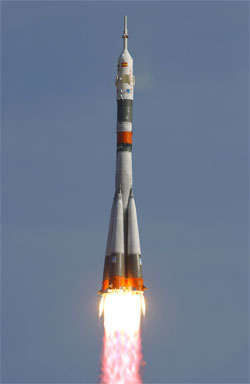
A Russian Soyuz rocket launches from Baikonur. Credit: NASA
|
Throughout history, more than 1,500 launches have been made with Soyuz launchers
to orbit satellites for communications, Earth observation, weather, and scientific
missions, as well as for human flights.
The basic Soyuz vehicle is considered a three-stage launcher in Russian terms and is
composed of:
A lower portion consisting of four boosters (first stage) and a central core
(second stage).
An upper portion, consisting of the third stage, payload adapter and payload fairing.
Liquid oxygen and kerosene are used as propellants in all three Soyuz stages.
First Stage Boosters

The first stage's four boosters are assembled laterally around the second stage central
core. The boosters are identical and cylindrical-conic in shape with the oxygen tank
located in the cone-shaped portion and the kerosene tank in the cylindrical portion.
An NPO Energomash RD 107 engine with four main chambers and two gimbaled vernier
thrusters is used in each booster. The vernier thrusters provide three-axis flight control.
Ignition of the first stage boosters and the second stage central core occur
simultaneously on the ground. When the boosters have completed their powered flight
during ascent, they are separated and the core second stage continues to function.
First stage booster separation occurs when the pre-defined velocity is reached, which is
about 118 seconds after liftoff.
Second Stage
An NPO Energomash RD 108 engine powers the Soyuz second stage. This engine differs
from those of the boosters by the presence of four vernier thrusters, which are necessary
for three-axis flight control of the launcher after the first stage boosters have separated.
An equipment bay located atop the second stage operates during the entire flight of the
first and second stages.
Third Stage
The third stage is linked to the Soyuz second stage by a latticework structure. When the
second stage's powered flight is complete, the third stage engine is ignited. Separation
of the two stages occurs by the direct ignition forces of the third stage engine.
A single-turbopump RD 0110 engine from KB KhA powers the Soyuz third stage.
The third stage engine is fired for about 240 seconds, and cutoff occurs when the
calculated velocity increment is reached, After cutoff and separation, the third stage
performs an avoidance maneuver by opening an outgassing valve in the liquid oxygen tank.
Launcher Telemetry Tracking & Flight Safety Systems
Soyuz launcher tracking and telemetry is provided through systems in the second and
third stages. These two stages have their own radar transponders for ground tracking.
Individual telemetry transmitters are in each stage. Launcher health status is downlinked
to ground stations along the flight path. Telemetry and tracking data are transmitted to the
mission control center, where the incoming data flow is recorded. Partial real-time data
processing and plotting is performed for flight following and initial performance
assessment. All flight data is analyzed and documented within a few hours after launch.
Baikonur Cosmodrome Launch Operations
Soyuz missions use the Baikonur Cosmodrome's proven infrastructure, and launches
are performed by trained personnel with extensive operational experience.
Baikonur Cosmodrome is located in the Republic of Kazakhstan in Central Asia
between 45 and 46 degrees north latitude and 63 degrees east longitude. Two launch
pads are dedicated to Soyuz missions.
Final Launch Preparations
The assembled launch vehicle is moved to the launch pad on a horizontal railcar.
Transfer to the launch zone occurs two days before launch, during which the vehicle is
erected and a launch rehearsal is performed that includes activation of all electrical and
mechanical equipment.
On launch day, the vehicle is loaded with propellant and the final countdown sequence
is started at three hours before the liftoff time.
Rendezvous to Docking
A Soyuz spacecraft generally takes two days after launch to reach the space station.
The rendezvous and docking are both automated, though once the spacecraft is within
150 meters (492 feet) of the station, the Russian Mission Control Center just outside
Moscow monitors the approach and docking. The Soyuz crew has the capability to
manually intervene or execute these operations.
|




 International Space Station officials at Johnson Space Center provide a detailed preview of the Expedition 10 mission during this pre-launch press conference. (19min 15sec file)
 A review of the soon-to-be completed Expedition 9 mission aboard the International Space Station is presented by mission managers at Johnson Space Center. (32min 38sec file)
 Expedition 10 commander Leroy Chiao, flight engineer Salizhan Sharipov and Russian taxi cosmonaut Yuri Shargin climb aboard their Soyuz capsule for a fit check in advance of launch to the International Space Station. (1min 45sec file)
 The three men to launch aboard the next Soyuz spacecraft bound for the International Space Station -- Expedition 10 commander Leroy Chiao, flight engineer Salizhan Sharipov and Russian taxi cosmonaut Yuri Shargin -- hold a pre-flight news conference near Moscow on Sept. 23. (43min 05sec file)