The Atlas 2A vehicle data
SPACEFLIGHT NOW
Posted: March 6, 2002

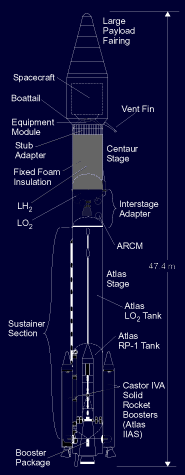
The Atlas 2A is a two-and-one-half stage rocket capable to lifting payloads of 3,070 kg (6,760 lb) into a geostationary transfer orbit. It features no strap-on solid rocket boosters and is the least powerful version of the Atlas family.


ATLAS STAGE

Size: 3.05-m Dia x 24.90-m Length

Propellant: 156,400-kg Liquid Oxygen & RP-1

Propulsion: Rocketdyne MA-5A booster and sustainer engines

CENTAUR UPPER STAGE

Size: 3.05 m Dia x 10.06 m Length

Inert Mass: 1,840 kg

Propellant: 16,930 kg Liquid Hydrogen & Liquid Oxygen

Propulsion: Two Pratt & Whitney restartable RL-10A-4 engines

Vehicle description
Atlas is the name of a family of booster stages. Centaur is a family of high-energy, restartable upper stages. Atlas 2A is the designation for an Atlas 2A booster combined with a Centaur 2A upper stage.

The Atlas 2A is a two-and-one-half stage launch vehicle. The Centaur upper stage is mounted on top of the one-and-one-half stage Atlas booster.

Launch
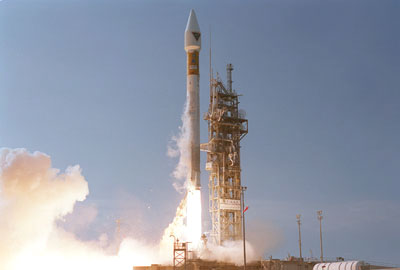
The Lockheed Martin Atlas 2A rocket lifts off with TDRS-H. Photo: NASA
 

Atlas Booster
The Atlas booster is 10 feet in diameter and 81.7 feet long. The propellant tanks are a thin-wall, fully monocoque, corrosion resistant stainless steel construction. The fuel tank, which contains RP-1, and the oxidizer tank, which contains liquid oxygen, are separated by an ellipsoidal intermediate bulkhead. Structural integrity of the tanks is maintained in flight by the pressurization system and on the ground by either internal tank pressure or application of mechanical stretch.

  Atlas
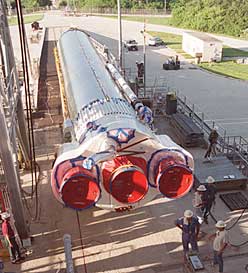
The Atlas stage to launch TDRS-I is prepared for lifting upright on the launch pad. Photo: NASA
 
The Atlas uses the Centaur avionics system for guidance, flight control, and sequencing functions. An external equipment pod houses Atlas systems such as range safety, propellant utilization, pneumatics, and instrumentation.

Atlas booster propulsion is provided by the Rocketdyne MA-5A engine system, which includes the sustainer engine and booster engine system. All engines are ignited before liftoff and develop a total sea-level-rated thrust of 490,000 pounds. The section containing the booster engine is jettisoned (booster package jettison [BPJ]) at an axial acceleration of 5.0 g. Flight continues powered by the sustainer engine ("sustainer phase" flight) until propellant depletion.

The Atlas is connected to the Centaur by the interstage adapter. This aluminum structure provides the structural link between Atlas and Centaur. The Atlas is separated from the Centaur by a flexible linear-shaped charge system attached to the forward ring of the interstage adapter.

Centaur Upper Stage
Centaur, the Atlas 2A upper stage, is 10 feet in diameter and 33 feet long. It employs high-energy liquid hydrogen and liquid oxygen propellants separated by a double-wall, vacuum-insulated intermediate bulkhead. The propellant tanks (like those of the Atlas stage) are of thin-wall, fully monocoque, corrosion-resistant stainless steel construction. Tank stabilization is maintained at all times by internal pressurization or application of mechanical stretch.

  Centaur
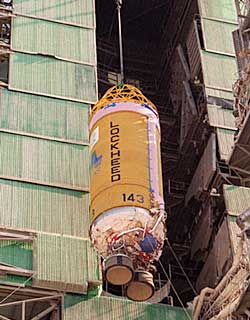
The TDRS-I's Centaur is hoisted into the launch pad tower. Photo: NASA
 
Centaur avionics packages, mounted on the equipment module, control and monitor all vehicle functions. Centaur avionics perform the inertial guidance and attitude control computations for both Atlas and Centaur phases of flight, and control Centaur tank pressures and propellant use.

The Centaur propulsion system uses two RL10A-4-1 engines with extendible nozzles manufactured by Pratt & Whitney. Each engine is has a rated thrust of 22,256 pounds. The Centaur engines are restartable and are capable of multiple firings in space, separated by coast phases.

The stub adapter and equipment module are attached to the forward end of the Centaur. The stub adapter is bolted to the forward ring of the Centaur tank and supports the equipment module and payload fairing. The equipment module attaches to the forward ring of the stub adapter and provides for mounting of the Centaur avionics and the spacecraft adapter.

Payload Fairing

  Fairing
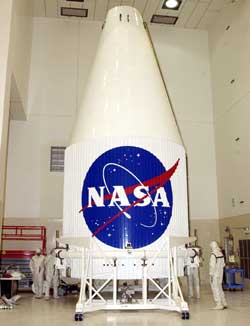
The payload fairing for TDRS-I. Photo: NASA
 
The payload fairing protects the spacecraft from time of encapsulation through atmospheric ascent. The fairing used by the TDRS-H mission is 14 feet in diameter.

The payload fairing is a two-half-shell structure constructed of aluminum with vertical, split-line longerons. It consists of a cylindrical section topped by a conical nose cone and a spherical cap.

The conical section external surface of the fairing is insulated with cork to limit temperatures to acceptable levels. Non-contaminating thermal control coatings are used on internal surfaces to reduce incident heat fluxes to the spacecraft.

Approximately 1 minute after Atlas booster jettison, the payload fairing is jettisoned.

Spacecraft Adapter
The mechanical interface between the TDRS-I spacecraft and the launch vehicle is provided by a Lockheed Martin Astronautics standard adapter, 47-inch-diameter adapter and a payload separation system.

In transfer orbit, the Centaur issues separation commands to release and separate the spacecraft from the forward adapter.

Flight data file
Vehicle: Atlas 2A (AC-143)
Payload: TDRS-I
Launch date: March 8, 2002
Launch window: 5:39-6:19 p.m. EST (2239-2319 GMT
Launch site: SLC-36A, Cape Canaveral AFS, Fla.
Satellite broadcast: GE-2, Trans. 9, C-band

Pre-launch briefing
Launch timeline - Chart with times and descriptions of events to occur during the launch.

Ground track - See the trajectory the rocket will follow during its flight.

Launch windows - Available windows for possible future launch dates of TDRS-I.

TDRS-I - Description of this NASA tracking and data relay satellite.

Atlas index - A directory of our previous Atlas launch coverage.


Apollo 11 special patch
Special collectors' patch marking the 35th anniversary of the historic Apollo 11 moon landing is now available.
 Choose your store:
U.S. - U.K. - E.U. - Worldwide

Inside Apollo mission control
An insider's view of how Apollo flight controllers operated and just what they faced when events were crucial.
 Choose your store:
U.S.

The ultimate Apollo 11 DVD
This exceptional chronicle of the historic Apollo 11 lunar landing mission features new digital transfers of film and television coverage unmatched by any other.
 Choose your store:
U.S. - U.K. - E.U. - Worldwide

Next ISS crew
Own a little piece of history with this official patch for the International Space Station's Expedition 11 crew. We'll ship yours today!
 Choose your store:
U.S.

Gemini 7
Gemini 7: The NASA Mission Reports covers this 14-day mission by Borman and Lovell as they demonstrated some of the more essential facts of space flight. Includes CD-ROM.
 Choose your store:
U.S. - U.K. - E.U. - Worldwide

Apollo patches
The Apollo Patch Collection: Includes all 12 Apollo mission patches plus the Apollo Program Patch. Save over 20% off the Individual price.
 Choose your store:
U.S. - U.K. - E.U. - Worldwide

Mars Rover mission patch
A mission patch featuring NASA's Mars Exploration Rover is available from our online.
 Choose your store:
U.S. - U.K. - E.U. - Worldwide

Apollo 9 DVD
On the road to the moon, the mission of Apollo 9 stands as an important gateway in experience and procedures. This 2-DVD collection presents the crucial mission on the voyage to the moon.
 Choose your store:
U.S. - U.K. - E.U. - Worldwide

Apollo 11 special patch
Special collectors' patch marking the 35th anniversary of the historic Apollo 11 moon landing is now available.
 Choose your store:
U.S. - U.K.

Expedition 20
The official embroidered patch for the International Space Station Expedition 20 crew is now available from our stores.
 U.S. STORE
 WORLDWIDE STORE

Current Shuttle Mission Patch
The official embroidered patch for shuttle Atlantis' flight to deliver critical spare equipment to the space station.
 U.S. STORE
 WORLDWIDE STORE


Ares Patch
The Ares Project will develop two new rockets to launch astronauts back to the Moon under NASA's Vision for Exploration. The Ares 1 will employ a single space shuttle solid rocket booster to loft the Orion crew capsule. The gigantic Ares 5 will haul the equipment and cargo needed for such lunar voyages. This is the Ares emblem.
 U.S. STORE


One Giant Leap
Hosted by Corbin Bernsen, this award winning documentary marks the 50th anniversary of the U.S. space agency and features exclusive interviews with veteran astronauts.
 U.S. STORE
 WORLDWIDE STORE

Expedition 21
The official embroidered patch for the International Space Station Expedition 21 crew is now available from our stores.
 U.S. STORE
 WORLDWIDE STORE

Mission Report
Gemini 7: The NASA Mission Reports covers this 14-day mission by Borman and Lovell as they demonstrated some of the more essential facts of space flight. Includes CD-ROM.
 U.S. STORE
 WORLDWIDE STORE

Spaceflight Now Plus
The web's best space video service! Get additional video, audio, image and virtual reality content for a low-cost monthly or annual subscription fee. Subscriptions start at $5.95/£3.50. Click here to see what's currently available.
 SUBSCRIBE (U.S. Dollars)
 SUBSCRIBE (U.K. Pounds)

Hubble Posters
Stunning posters featuring images from the Hubble Space Telescope and world-renowned astrophotographer David Malin are now available from the Astronomy Now Store.
 U.S. STORE
 U.K. & WORLDWIDE STORE

Get e-mail updates
Sign up for our NewsAlert service and have the latest news in astronomy and space e-mailed direct to your desktop (privacy note: your e-mail address will not be used for any other purpose).
Enter your e-mail address:
MISSION STATUS CENTER

INDEX | PLUS | NEWS ARCHIVE | LAUNCH SCHEDULE
ASTRONOMY NOW | STORE

ADVERTISE

© 2009 Spaceflight Now Inc.