The first planned orbital Starship mission is scheduled for launch from Starbase in Texas as soon as Sept. 28, pending final approval from the Federal Aviation Administration.
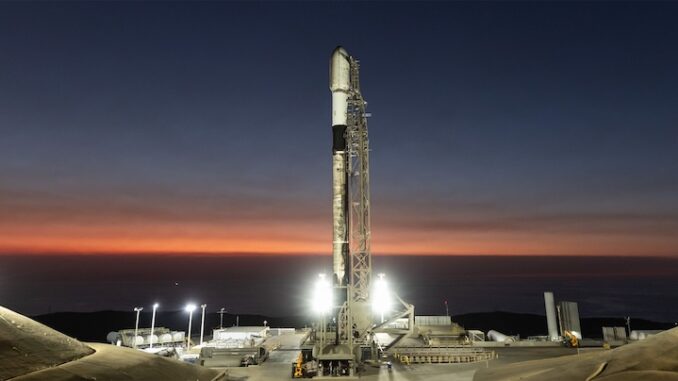
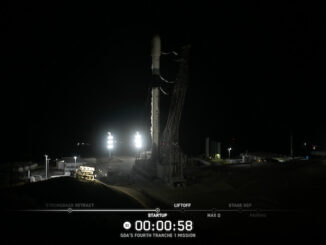
The rocket carried an unspecified number of satellites to orbit. Liftoff from pad 4E at Vandenberg Space Force Base happened on Wednesday, Sept. 16, 6:07:56 p.m. PDT / 9:07:56 p.m. EDT on Sept. 16 (0107:56 UTC on Sept. 17).
The mission, with the shorthand VV30, is the second launch of a Vega-C rocket managed solely by Avio without Arianespace. Liftoff from Ensemble de Lancement Vega at Europe’s Spaceport in French Guiana happened at 10:21 p.m. local time (9:21 p.m. EDT / 0121 UTC / 3:21 a.m. CEST).
The launch marks the 400th orbital flight from Space Launch Complex 40 at Cape Canaveral Space Force Station. Liftoff is scheduled during an 87-minute window that opens at 2:49 p.m. EDT (1849 UTC).
The mission, dubbed USSF-153 mission, launched an undisclosed number of satellites for the U.S. Space Force. Liftoff from pad 4E at Vandenberg Space Force Base happened at 8:42 a.m. PDT (1142 a.m. EDT / 1542 UTC).
SpaceX decided to shift all Starlink missions flying on Falcon 9 rockets to the West Coast as it pushes towards the debut of its Starship-Super Heavy in Florida. Liftoff of the Starlink 15-24 mission from Vandenberg Space Force Base happened at 7:26 a.m. PDT (10:26 a.m. EDT / 1426 UTC).
Using a donated Hubble-class mirror originally built for a spy satellite, NASA’s Roman Space Telescope launched Sunday on a $4.3 billion mission to open a new window on the universe. Liftoff from the Kennedy Space Center atop a SpaceX Falcon Heavy came at 7:26 a.m. EDT (1126 UTC).
The Falcon 9 rocket flew on a south-easterly trajectory upon launching from Vandenberg Space Force Base. Liftoff happened at 2:35 a.m. PDT (5:35 a.m. EDT / 0935 UTC).