|
|
|
|
BY JUSTIN RAY Follow the entry and landing of the space station's Expedition 17 crew. Reload this page for the very latest on the mission.

0430 GMT (12:30 a.m. EDT)
0401 GMT (12:01 a.m. EDT)
0353 GMT (11:53 p.m. EDT Thurs.)
0351 GMT (11:51 p.m. EDT Thurs.)
0338 GMT (11:38 p.m. EDT Thurs.)
0336 GMT (11:36 p.m. EDT Thurs.)
0331 GMT (11:31 p.m. EDT Thurs.) At an altitude of five kilometers, the module's heat shield is scheduled to be jettisoned. This is followed by the termination of the aerodynamic spin cycle and the dumping of any residual propellant from the Soyuz. Computers also will arm the module's seat shock absorbers in preparation for landing. With the jettisoning of the capsule's heat shield, the Soyuz altimeter is exposed to the surface of the Earth. Using a reflector system, signals are bounced to the ground from the Soyuz and reflected back, providing the capsule's computers updated information on altitude and rate of descent.
0327 GMT (11:27 p.m. EDT Thurs.)
0324 GMT (11:24 p.m. EDT Thurs.)
0324 GMT (11:24 p.m. EDT Thurs.) Initially, the Descent Module will hang underneath the main parachute at a 30-degree angle with respect to the horizon for aerodynamic stability, but the bottommost harness will be severed a few minutes before landing, allowing the Descent Module to hang vertically through touchdown.
0322 GMT (11:22 p.m. EDT Thurs.) The parachute deployment creates a gentle spin for the Soyuz as it dangles underneath the drogue chute, assisting in the capsule's stability in the final minutes before touchdown.
0316 GMT (11:16 p.m. EDT Thurs.)
0314 GMT (11:14 p.m. EDT Thurs.) The entry guidance by the spacecraft's onboard software package is scheduled to start in a couple of minutes.
0313 GMT (11:13 p.m. EDT Thurs.)
0311 GMT (11:11 p.m. EDT Thurs.) The three segments of the Soyuz TMA-12 spacecraft have jettisoned apart, allowing the crew-carrying Descent Module to safely ferry the three crew members back to Earth. The no-longer-needed Orbital Module and Instrumentation/Propulsion Module are designed to burn up in the atmosphere.
0306 GMT (11:06 p.m. EDT Thurs.) In about four minutes at an altitude of 87 miles, just above the first traces of the Earth's atmosphere, computers will command the separation of the three modules that comprise the Soyuz vehicle. With the crew strapped in to the Descent Module, the forward Orbital Module containing the docking mechanism and rendezvous antennas and the rear Instrumentation/Propulsion Module, which houses the engines and avionics, will pyrotechnically separate and burn up in the atmosphere. The Descent Module's computers will orient the capsule with its ablative heat shield pointing forward to repel the buildup of heat as it plunges into the atmosphere. Entry interface at the upper fringes of the atmosphere, when the capsule is about 400,000 feet above the Earth, happens about three minutes after module separation.
0249 GMT (10:49 p.m. EDT Thurs.)
0247 GMT (10:47 p.m. EDT Thurs.)
0245 GMT (10:45 p.m. EDT Thurs.)
0019 GMT (8:19 p.m. EDT Thurs.)
0016 GMT (8:16 p.m. EDT Thurs.)
0013 GMT (8:13 p.m. EDT Thurs.)
THURSDAY, OCTOBER 23, 2008 Read our landing preview story.
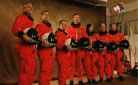
2115 GMT (5:15 p.m. EDT) Expedition 17 commander Sergei Volkov, flight engineer Oleg Kononenko and computer game designer Richard Garriott said their goodbyes to the station's new crew -- Expedition 18 commander Mike Fincke and flight engineers Yury Lonchakov and Greg Chamitoff -- and then floating into the Soyuz TMA-12 craft currently docked to the station's Pirs compartment. The hatchway between the station and Soyuz was closed shortly before 5:15 p.m. EDT (2115 GMT). The homeward-bound crew will work together for a next couple of hours to power up the Soyuz, active the craft's systems, remove docking clamps, depressurize the vestibule between the capsule and station and perform other work to ready for undocking. Fincke, Lonchakov and Garriott launched to the station on October 12 aboard Soyuz TMA-13. After the brief stay, Garriott is going home while Expedition 18 is left behind to continue operations on the outpost. The command to begin opening hooks and latches firmly holding Soyuz to its docking port will be sent at 8:13 p.m. EDT (0013 GMT). Physical separation between the two craft occurs three minutes later. After moving a short distance from the station, the Soyuz engines will fire for 15 seconds to execute the so-called separation burn to propel the craft out of the orbiting lab's vicinity. About two-and-a-half hours later, the capsule's engines will ignite for the deorbit burn to brake from space. The onboard computers will initiate an engine firing at 10:45:19 p.m. EDT (0245:19 GMT) that slows the ship just enough to slip out of orbit for the return to Earth. The burn will last four minutes and 22 seconds. Shortly before reaching the top of the atmosphere, the Soyuz's three distinct modules will separate at 11:10:31 p.m. EDT (0310:31 GMT) under computer command. The crew will be located in the Descent Module, which is sandwiched between the forward Orbital Module containing the docking mechanism and the rear Instrumentation and Propulsion Module housing the engines and avionics. The Descent Module orients itself to point the ablative heat shield in the direction of travel to protect the craft and crew from the intense plunge back to Earth. At 11:13:29 p.m. EDT (0313:29 GMT) and an altitude of 63 miles, the moment of Entry Interface occurs as the capsule hits the upper fringes of the atmosphere for the fiery re-entry. During the fall to Earth, the Orbital Module and Instrumentation and Propulsion Module will burn up in the atmosphere. About seven minutes after Entry Interface, the crew will experience the period of maximum G-loads during entry at an altitude of 20 miles, as they feel the tug of Earth's gravity for the first time since launch. At 11:22:04 p.m. EDT (0322:04 GMT), the onboard computers will start a commanded sequence for deployment of the capsule's parachutes at an altitude of about 6.6 miles. Two "pilot" parachutes are unfurled first, extracting a drogue parachute. The parachute deployment creates a gentle spin for the Soyuz as it dangles underneath the drogue chute, assisting in the capsule's stability in the final minutes before touchdown. The drogue chute will be jettisoned, allowing the main parachute to be deployed. It is connected to the Descent Module by two harnesses. Initially, the Descent Module will hang underneath the main parachute at a 30-degree angle with respect to the horizon for aerodynamic stability, but the bottommost harness will be severed a few minutes before landing, allowing the Descent Module to hang vertically through touchdown. At an altitude of just over three miles, the heat shield will be cast free. That is followed by dumping of any residual propellant from the Soyuz. Once the heat shield is gone, the Soyuz altimeter is exposed to the surface of the Earth. Using a reflector system, signals are bounced to the ground from the Soyuz and reflected back, providing the capsule's computers updated information on altitude and rate of descent. At an altitude of about 40 feet, cockpit displays will tell the crew to prepare for the soft landing engine firing. Just seconds before touchdown, the six solid propellant engines are fired in a final braking maneuver, enabling the Soyuz to land to complete its mission. Touchdown is expected at 11:36:38 p.m. EDT (0336:38 GMT) on the steppes of central Kazakhstan, about 85 minutes after sunrise at the landing site. The target spot is 51.0 degrees North latitude and 67.10 degrees East longitude. Expedition 17 concludes with a duration of 198 days, 16 hours, 19 minutes and 59 seconds. A group of Russian helicopters carrying the recovery forces should arrive soon after landing to help the crew exit the capsule. Each crew member will be placed in special reclining chairs near the capsule for initial medical tests and begin readapting to Earth's gravity. They will be transferred into a portable medical tent erected near the touchdown point where the three crew members can remove their spacesuits. Post-landing plans call for the crew to be flown from the site in helicopters.
|
|
|
|
John Glenn Mission Patch Free shipping to U.S. addresses! The historic first orbital flight by an American is marked by this commemorative patch for John Glenn and Friendship 7.Final Shuttle Mission Patch Free shipping to U.S. addresses! The crew emblem for the final space shuttle mission is available in our store. Get this piece of history!Celebrate the shuttle program Free shipping to U.S. addresses! This special commemorative patch marks the retirement of NASA's Space Shuttle Program. Available in our store!Anniversary Shuttle Patch Free shipping to U.S. addresses! This embroidered patch commemorates the 30th anniversary of the Space Shuttle Program. The design features the space shuttle Columbia's historic maiden flight of April 12, 1981.Mercury anniversary Free shipping to U.S. addresses! ![]() Celebrate the 50th anniversary of Alan Shephard's historic Mercury mission with this collectors' item, the official commemorative embroidered patch. Fallen Heroes Patch Collection The official patches from Apollo 1, the shuttle Challenger and Columbia crews are available in the store. |
||||||||||||||||||||
|
INDEX | PLUS | NEWS ARCHIVE | LAUNCH SCHEDULE ASTRONOMY NOW | STORE ADVERTISE © 2012 Spaceflight Now Inc. |
||||||||||||||||||||||||||