|
 |

|
||||
|
|
||||
|
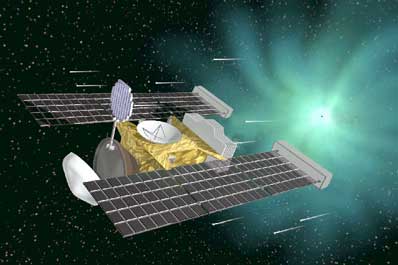
Stardust's science objectives FROM NASA PRESS KIT Posted: December 30, 2003 The primary goal of the Stardust mission is to collect samples of a comet's coma and return them to Earth. In addition, interstellar dust samples will be gathered en route to the comet. In laboratories, the samples will be scrutinized to understand their elemental makeup; presence of isotopes; mineralogical and chemical properties; and possible biogenic properties.
During selected portions of its cruise phase, Stardust collected interstellar grains now passing through the solar system. Interstellar gas samples should also be absorbed in the aerogel, allowing direct measurement of isotopes of elements such as helium and neon. Laboratory investigation of the returned samples using instruments such as electron microscopes, ion microprobes, atomic force microscopes, synchrotron microprobes and laser probe mass spectrometers will allow examination of cometary matter and interstellar grains at the highest possible level of detail. Advances in microanalytical instruments provide unprecedented capabilities for analysis on the micron and submicron level, even to the atomic scale for imaging. These instruments will provide direct information on the nature of the interstellar grains that constitute most of the solid matter in the galaxy, and they will provide a highly intimate view of both pre-solar dust and nebular condensates contained in comets. Such materials will be compared with primitive meteorites and interplanetary dust samples to understand the solids involved in solar system formation, the solids that existed in the outer regions of the nebula where comets formed, and solids in the inner regions of the nebula where asteroids formed. The data will provide fundamental insight into the materials, processes and environments that existed during the origin and early evolution of the solar system. Interstellar grains are currently studied mainly by astronomical techniques capable only of revealing general physical properties such as size and shape. The recent discovery and study of rare interstellar grains preserved in meteorites has shown that they contain excellent records about the nature of their parent stars, including details of the complex nuclear reactions that occur within the stars. The interstellar grains that have been identified in meteorites are predominantly grains that formed in gas flows from carbon-rich stars such as red giants and what are called ABG stars, while the more typical grains from oxygen-rich stars have not been found. It is expected Stardust will collect grains produced by star types that are major sources of interstellar dust. Comets are now known to contain large quantities of volatiles, including organic compounds and a rich variety of microparticles of various types (pure organic particles, silicates, sulfides and mixed particles) with sizes ranging as low as submicron diameters. Organic particulates actually consist of several sub-populations, which can be described based on the elements that they are made up of. These include particles containing:
The volatiles and silicates that appear to be in comets also are found in interstellar clouds. How the elements necessary for life entered the solar system, were transformed by solar system processes, were distributed among planetary bodies, and what molecular and mineral forms they took during this history are questions of major importance for exobiology. Comparing the composition of the volatiles from cometary material with those found in carbonaceous meteorites and interplanetary dust will provide a basis to determine which particles, if any, have common source regions. Finally, the discovery of iridium in rocks at Earth's Cretaceous-Tertiary geologic layer
marking the end of the age of the dinosaurs about 65 million years ago has, along with
other evidence, raised the probability that an impact of an asteroid-sized body with
Earth was responsible for the demise of the giant creatures. Although the chance of
finding a unique elemental signature in captured cometary coma material might be
slight, such a discovery would be enormously valuable in distinguishing whether it was
an asteroid or a comet that made the impact.
|
|
|
|

|
|
|
MISSION STATUS CENTER |
|||||