Strips of foam peeled away from Endeavour's fuel tank
BY WILLIAM HARWOOD
STORY WRITTEN FOR CBS NEWS "SPACE PLACE" & USED WITH PERMISSION
Posted: July 16, 2009

Post-launch photography of the shuttle Endeavour's external tank shows multiple areas of bare metal where thin strips of foam insulation peeled away during the climb to space, the result of an as-yet-unknown mechanism. In at least two "events," debris hit Endeavour's heat shield tiles during the early stages of flight when the shuttle is most vulnerable to damage. But mission managers said Thursday there is no evidence of any serious problems that would prevent a safe re-entry.

Credit: NASA TV
|
"There is nothing that we have seen on the orbiter that causes us any concern," said shuttle Program Manager John Shannon. "Of course, since this looks like a new mechanism of shedding foam off the intertank, we need to understand that. It did not hurt us, apparently, on this flight, because it came off so late. But we'll need to understand that before the next flight."
The shuttle Discovery is scheduled for launch around Aug. 18, but it's too early to say what impact, if any, additional testing might have on that flight or subsequent missions.
Endeavour blasted off on a space station assembly mission Wednesday evening. A camera mounted on the side of the shuttle's external tank showed multiple instances of foam insulation falling away. In several cases, a larger piece of debris disintegrated in a cloud of fragments after hitting the supersonic airstream.
Debris impacts are most troublesome in the first two minutes and 15 seconds of flight when the shuttle is still in the dense lower regions of the atmosphere. When lightweight foam hits the airstream in that region of flight, it instantly slows down and the shuttle can run into it at a high relative velocity. After 135 seconds, however, atmospheric density drops to the point where debris tends to continue moving with the shuttle and impact velocities are much lower.
A large piece of foam hit the shuttle Columbia's left wing 82 seconds after launch in 2003, blasting a hole in the wing leading edge and triggering a catastrophic failure during re-entry Feb. 1, 2003.
Since then, NASA has redesigned the way foam is applied to the tank to minimize "shedding" and to prevent large pieces from breaking away. In recent flights, tanks have performed well and shuttle heat shield damage has been minimal to non-existent. During the most recent flight in May, however, foam debris gouged the top layer of several tiles under the forward part of the ship's right wing. The damage was not serious enough to warrant repairs and Atlantis made a safe re-entry.
This time around, engineers were surprised by the amount of debris and its source: the so-called "intertank," the ribbed section of the external tank that separates the hydrogen and oxygen sections and provides the structural backbone needed for launch.

Spots of lost foam on Endeavour's tank are highlighted in this image. Credit: NASA
|
Of a dozen or so debris events, two were in the aerodynamically sensitive time frame. One such debris event occurred at one minute and 47 seconds into flight, resulting in impacts that eroded the black outer coating on heat shield tiles in three areas. Another event eight seconds later produced another area of erosion.
The erosion noted in both impacts appears less severe than the damage seen during Atlantis' flight in May.
"The foam loss that we saw was mostly in that intertank area," Shannon said of Endeavour's foam loss. "That's a little bit of a surprise to us because it does not undergo much deflection because it is so structurally strong. It also does not experience the extreme (low) temperatures you get in the liquid hydrogen tank. So we don't typically expect to see large losses in that intertank area."
Normally, engineers notice a phenomenon known as "popcorning" on the intertank foam, in which "you have small air bubbles in that area and in the heating of ascent they'll expand and pop off," Shannon said. "Usually, that's in the two-and-a-half to three-minute timeframe on the flight."
"What we saw here, though, was strips of the foam covering the intertank structure ... it just kind of peeled off the primer layer of the metal and you can actually see the metal underneath it," he said. "It's not thick foam at all. The foam is about a half an inch thick, so it kind of came off in little sheets in about seven or eight different areas. We don't understand why that happened. It looks like the base primer just was not holding onto the foam well."
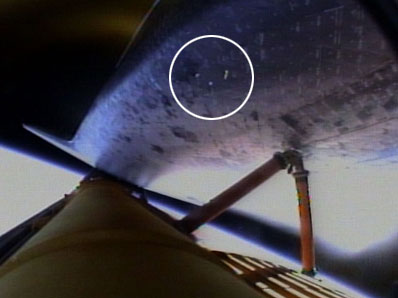
Slight tile damage on Endeavour was visible from the external tank camera during Wednesday's launch. Credit: NASA TV
|
At least 10 areas of foam loss can be seen in the intertank area on the side facing the shuttle with another five possible areas on the opposite side. In addition, engineers noticed two areas of foam loss high up on the oxygen section of the tank where a pressurization line is attached.
"We're right in the middle of our normal inspection process," Shannon said. "We have a bit of a mystery on the external tank foam loss. It's from an area we don't typically expect to see foam to be lost and we'll go off and work on that."
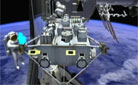
The Endeavour astronauts spent most of the day Thursday carrying out a now-routine inspection of the shuttle's reinforced carbon carbon nose cap and wing leading edge panels using a laser scanner and cameras mounted on the end of a 50-foot-boom attached to the shuttle's robot arm.
No obvious problems were seen, but data analysis will take several days to complete.
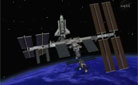
During final approach to the International Space Station on Friday, commander Mark Polansky will guide the shuttle through a slow back flip, exposing the belly of the orbiter to cameras aboard the space station. Any damage caused by debris strikes should be easily visible for detailed analysis.
"We're right in the middle of our typical assessment of the health of the thermal protection system," Shannon said. "Nobody on the Mission Management Team saw any reason to indict the vehicle. If we had some kind of a contingency, we would feel perfectly comfortable bringing this vehicle back. But barring that, we will do our normal process of assessment."

An artist's concept of the inspections. Credit: NASA TV
|
Back at the Kennedy Space Center, engineers plan to haul the shuttle Discovery from its hangar to the Vehicle Assembly Building on Monday to attach it to an external tank and boosters for launch around Aug. 18. Shannon said engineers are now planning to carry out a series of tests on ET-132 to find out if there are any obvious problems with the foam in the intertank region.
Along with doing so-called "plug-pull" tests that measure how hard it is to pull foam away from the underlying metal, engineers also are discussing X-ray analysis to determine if there are any defects that might lead to similar shedding in August.
"It looks like it just completely peeled off and that we did not have good adhesion between the primer undercoat and the foam itself," Shannon said. "We have a ton of data, of course, on the external tanks, we'll look at all of the plug-pull data, we'll look at any X-ray data we've got in that area, we'll X-ray ET-132 and probably we'll end up X-raying every one of the tanks to see if there's anything else we can find out. We have a lot of data review and investigation to go perform."

Additional coverage for subscribers:
 VIDEO:
FLIGHT DAY 1 HIGHLIGHTS MOVIE PLAY VIDEO:
FLIGHT DAY 1 HIGHLIGHTS MOVIE PLAY
VIDEO:
THE FULL STS-127 LAUNCH EXPERIENCE PLAY
VIDEO:
INSIDE MISSION CONTROL DURING LAUNCH PLAY
VIDEO:
LAUNCH REPLAY: VAB ROOF PLAY | HI-DEF
VIDEO:
LAUNCH REPLAY: PRESS SITE PLAY | HI-DEF
VIDEO:
LAUNCH REPLAY: PAD PERIMETER PLAY | HI-DEF
VIDEO:
LAUNCH REPLAY: BEACH TRACKER PLAY | HI-DEF
VIDEO:
LAUNCH REPLAY: UCS-23 TRACKER PLAY | HI-DEF
VIDEO:
LAUNCH REPLAY: PLAYALINDA BEACH PLAY | HI-DEF
VIDEO:
LAUNCH REPLAY: PATRICK AIR FORCE BASE PLAY | HI-DEF
VIDEO:
LAUNCH REPLAY: BANANA CREEK VIP SITE PLAY | HI-DEF
VIDEO:
LAUNCH REPLAY: PAD FRONT CAMERA PLAY | HI-DEF
VIDEO:
LAUNCH REPLAY: WEST TOWER PLAY | HI-DEF
VIDEO:
LAUNCH REPLAY: CAMERA 070 PLAY | HI-DEF
VIDEO:
LAUNCH REPLAY: CAMERA 071 PLAY | HI-DEF
VIDEO:
LAUNCH REPLAY: CAMERA CS-1 PLAY
VIDEO:
LAUNCH REPLAY: CAMERA CS-2 PLAY
VIDEO:
LAUNCH REPLAY: CAMERA CS-6 PLAY

VIDEO:
SHUTTLE ENDEAVOUR BLASTS OFF! PLAY | HI-DEF
VIDEO:
STS-127 POST-LAUNCH NEWS CONFERENCE PLAY
VIDEO:
FOOTAGE OF FUEL TANK AFTER JETTISON PLAY
VIDEO:
ASTRONAUTS REACH PAD 39A PLAY | HI-DEF
VIDEO:
CREW DEPARTS QUARTERS FOR LAUNCH PAD PLAY | HI-DEF
VIDEO:
ASTRONAUTS DON SPACESUITS FOR LAUNCH PLAY | HI-DEF
VIDEO:
WEATHER SCRUBS LAUNCH AGAIN PLAY | HI-DEF
VIDEO:
CREW ARRIVES AT PAD 39A ON MONDAY PLAY | HI-DEF
VIDEO:
CREW DEPARTS QUARTERS ON MONDAY PLAY | HI-DEF
VIDEO:
ASTRONAUTS SUIT UP ON MONDAY PLAY | HI-DEF
VIDEO:
THUNDERSTORMS SCRUB SUNDAY'S ATTEMPT PLAY | HI-DEF
VIDEO:
CREW DEPARTS QUARTERS ON SUNDAY PLAY | HI-DEF
VIDEO:
ASTRONAUTS SUIT UP ON SUNDAY PLAY | HI-DEF
VIDEO:
NARRATED SUMMARY SHUTTLE'S PREPARATIONS PLAY | HI-DEF
VIDEO:
NARRATED SUMMARY PAYLOADS' PREPARATIONS PLAY | HI-DEF
VIDEO:
LIGHTNING STRIKES POSTPONE ENDEAVOUR LAUNCH PLAY
VIDEO:
FRIDAY'S PRE-LAUNCH NEWS CONFERENCE PLAY
VIDEO:
THURSDAY'S STATUS REPORT ON THE COUNTDOWN PLAY
VIDEO:
COUNTDOWN PREVIEW AND WEATHER BRIEFING PLAY
VIDEO:
ASTRONAUTS RETURN TO CAPE FOR LAUNCH PLAY | HI-DEF
VIDEO:
NO LEAKS FOUND DURING SPECIAL TEST PLAY
VIDEO:
EXPLANATION OF THE HYDROGEN LEAK AND THE REPAIR PLAY
VIDEO:
POST-SCRUB NEWS BRIEFING PLAY
VIDEO:
FIRING ROOM UPDATE WITH LAUNCH DIRECTOR PLAY
VIDEO:
SCRUB NO. 2 DECLARED DUE TO HYDROGEN LEAK PLAY
VIDEO:
SUNDAY'S UPDATE FROM MISSION MANAGEMENT TEAM PLAY
VIDEO:
LEAK POSTPONES SHUTTLE ENDEAVOUR LAUNCH PLAY
VIDEO:
TIME-LAPSE OF SUN SETTING OVER PAD 39A PLAY
VIDEO:
ANOTHER TIME-LAPSE OF GANTRY RETRACTION PLAY
VIDEO:
TIME-LAPSE OF LAUNCH PAD TOWER ROLLBACK PLAY
VIDEO:
PRE-LAUNCH INTERVIEW WITH MARK POLANSKY PLAY
VIDEO:
PRE-LAUNCH INTERVIEW WITH DOUG HURLEY PLAY
VIDEO:
PRE-LAUNCH INTERVIEW WITH CHRIS CASSIDY PLAY
VIDEO:
PRE-LAUNCH INTERVIEW WITH JULIE PAYETTE PLAY
VIDEO:
PRE-LAUNCH INTERVIEW WITH TOM MARSHBURN PLAY
VIDEO:
PRE-LAUNCH INTERVIEW WITH DAVE WOLF PLAY
VIDEO:
THE STS-127 MISSION PREVIEW MOVIE PLAY
VIDEO:
THURSDAY'S PRE-LAUNCH NEWS CONFERENCE PLAY
VIDEO:
JAPANESE SCIENCE FACILITIES ABOARD STATION PLAY
VIDEO:
COUNTDOWN BEGINS TICKING FOR SATURDAY'S LAUNCH PLAY
VIDEO:
LAUNCH COUNTDOWN PREVIEW BRIEFING PLAY
VIDEO:
CREW ARRIVES JUST BEFORE MIDNIGHT PLAY | HI-DEF
VIDEO:
GET TO KNOW ENDEAVOUR'S ASTRONAUTS PLAY
VIDEO:
ASTRONAUTS PRACTICE EVACUATION OF SHUTTLE PLAY | HI-DEF
VIDEO:
CREW BOARDS SHUTTLE FOR PRACTICE COUNT PLAY | HI-DEF
VIDEO:
ASTRONAUTS SUIT UP FOR DRESS REHEARSAL PLAY | HI-DEF
VIDEO:
CREW INSPECTS CARGO IN THE PAYLOAD BAY PLAY | HI-DEF
VIDEO:
TRAINING SESSIONS AT LAUNCH PAD AND BUNKER PLAY | HI-DEF
VIDEO:
INFORMAL CREW NEWS CONFERENCE AT LAUNCH PAD PLAY
VIDEO:
ASTRONAUTS ARRIVE FOR PRACTICE COUNTDOWN PLAY
VIDEO:
FLIGHT READINESS REVIEW SETS LAUNCH DATE PLAY
VIDEO:
PAD 39A GANTRY ENCLOSES SHUTTLE PLAY | HI-DEF
VIDEO:
ROLLAROUND MOVES ENDEAVOUR TO PAD 39A PLAY | HI-DEF
VIDEO:
ENDEAVOUR IS HAULED OFF LAUNCH PAD 39B PLAY | HI-DEF
VIDEO:
TIME-LAPSE OF SHUTTLE'S LAUNCH PAD SWITCH PLAY
VIDEO:
SHUTTLE AND STATION PROGRAM UPDATE PLAY
VIDEO:
THE STS-127 MISSION OVERVIEW BRIEFING PLAY
VIDEO:
PREVIEW BRIEFING ON MISSION'S SPACEWALKS PLAY
VIDEO:
THE ASTRONAUTS' PRE-FLIGHT NEWS BRIEFING PLAY
VIDEO:
PAD 39B AND ITS LAST SPACE SHUTTLE PLAY | HI-DEF
VIDEO:
ENDEAVOUR'S SUNRISE ARRIVAL AT PAD 39B PLAY | HI-DEF
VIDEO:
MIDNIGHT ROLLOUT FROM ASSEMBLY BUILDING PLAY | HI-DEF
VIDEO:
ENDEAVOUR HOISTED FOR ATTACHMENT TO TANK PLAY | HI-DEF
VIDEO:
CRANE ROTATES ENDEAVOUR VERTICALLY PLAY | HI-DEF
VIDEO:
ENDEAVOUR MOVES TO ASSEMBLY BUILDING PLAY | HI-DEF
VIDEO:
ORION AND ARES ROCKET PROGRESS REPORT PLAY
SUBSCRIBE NOW
|