|
|
|

|
|
Rocket error dooms ice satellite's launch BY STEPHEN CLARK SPACEFLIGHT NOW Updated: October 8, 2005 @ 5 p.m. EDT
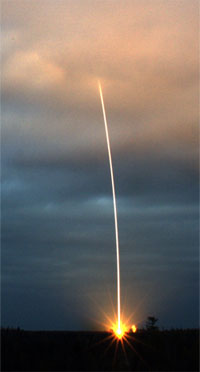
Cryosat lifted off at 1502 GMT (11:02 a.m. EDT) Saturday aboard a Rockot vehicle originating from the Russian Plesetsk Cosmodrome located in the nation's far north. The joint European-Russian Eurockot firm provided the launcher, which is largely derived from the Russian SS-19 missile used by military forces. However, problems arose before the rocket reached its target altitude for deployment of Cryosat, and the $170 million satellite fell into the Arctic Ocean near the North Pole before completing its first orbit of Earth. "Preliminary analysis of the telemetry data indicates that the first stage performed nominally. The second stage performed nominally until main engine cut-off was to occur. Due to a missing command from the onboard flight control system the main engine continued to operate until depletion of the remaining fuel," the satellite's owner, the European Space Agency, said in a statement announcing the launch failure.
"An investigating commission by the Russian State authorities has been established to further analyze the reasons for the failure, results are expected within the next weeks. This commission will work in close cooperation with a failure investigation board consisting of Eurockot, ESA and Khrunichev representatives." Plans called for Cryosat to be released at 1636 GMT (12:36 p.m. EDT) after two burns of the Rockot's Breeze-KM upper stage. The first two stages of the rocket were to complete their role in the flight within the first five minutes after launch. Russian ground stations were expected to lose communications with the launcher at eight minutes after liftoff, but the Redu site in Belgium was scheduled to acquire signals from the Breeze upper stage and Cryosat just a few minutes before spacecraft separation. But only silence was heard, immediately prompting concern that something had gone wrong. "We have no information on what the status of the mission is - whether separation has taken place or not and whether the satellite is healthy," said Volker Liebig, ESA's Director of Earth Observation, said earlier in the day amid confusion over what had happened. Within six hours of liftoff, ESA officials annnounced CryoSat was gone. "Jury Bakhvalov, first deputy director general of the Khrunichev Space Center on behalf of the Russian State Commission officially confirmed that the launch of CryoSat ended in a failure due to an anomaly in the launch sequence and expressed his regret to ESA and all partners involved," the ESA statement said. This was the sixth commercial launch of the Rockot booster since 2000. The previous five had been successful for the marketing firm Eurockot. What impact Saturday's failure will have on plans to launch a Korean science satellite in December is not immediately clear.
Cryosat was to fly in a circular orbit almost 450 miles high with an inclination of 92 degrees, allowing the observation platform to pass almost directly above the poles. The 1,500-pound satellite carried a radar instrument to pierce thick ice sheets to precisely measure their thickness as it changes over time. The Synthetic Aperture Interferometric Radar Altimeter device featured an operating mode to improve resolution above earlier experiments probing polar ice, and was the first radar altimeter ever exclusively designed to study the frozen ice masses. The radar would have worked by sending short pulses toward the surface and measuring the time it takes for the pulse to be reflected back to receivers aboard Cryosat. With two antennas, SIRAL was to determine depths within just a few tens of centimeters, an unprecedented level of resolution. The 136-pound instrument was largely based on the Poseidon 2 altimeter currently aboard the U.S.-French Jason mission. The Ku-band radar included several improvements that make SIRAL unique, including a second antenna that provides the across-track interferometry needed to augment results in rough terrain on the edges of large ice masses.
Scientists are seeking data on changes in Earth's ice caps to help their studies of global warming and its affect on the planet's climate and sea levels. Land ice covering most of Greenland and Antarctica are somewhat protected from melting by their sheer size, while more sensitive ocean ice sheets are more rapidly thinning in the Arctic Ocean and on the periphery of Antarctica. For example, estimates are that if all ice on Antarctica and Greenland were to melt, Earth's sea level would rise up to 200 feet. In addition, temperatures would significantly rise and climates across the globe would be impacted. Cryosat was to attempt to answer fundamental questions in climatology and global warming, such as whether the reports of shrinkage of ice sheets was true on a global scale, whether this has been induced by global climate change, and how long it will be until this issue begins to affect human society. |
|
|
|
 |
||||||||||||||||||||||||||

 The Pluto New Horizons spacecraft, destined to become the first robotic probe to visit Pluto and its moon Charon, arrives at NASA's Kennedy Space Center in advance of its January blastoff.
 NASA astronauts Bill McArthur and John Phillips chat with Associated Press space reporter Marcia Dunn about life aboard the International Space Station in this live space-to-Earth interview from the Destiny laboratory module on October 5.
 In preparation for the West Coast launch of Boeing's next-generation Delta 4 rocket, the two-stage vehicle is rolled out of its horizontal hangar and driven to the Space Launch Complex-6 pad for erection. The nose cone for the NRO payload is then brought to the pad.
 Boeing's Delta 4 rocket pad at Vandenberg Air Force Base was renovated in recent years, transforming Space Launch Complex-6 from the West Coast space shuttle launch site into a facility for the next-generation unmanned booster. This collection of footage shows the 1985 launch pad test using NASA's orbiter Enterprise.
 The Expedition 11 and Expedition 12 crews, along with space tourist Greg Olsen, hold a live news conference with American and Russian reporters on October 4. (26min 36sec file)
 A Russian Soyuz spacecraft safely launched from Baikonur Cosmodrome Friday night with the International Space Station's twelfth resident crew and a paying tourist aboard.
 The seven astronauts of space shuttle Discovery's return to flight mission recently gathered for a public celebration of their mission. They narrated an entertaining movie of highlights and personal footage taken during the mission.
 The Boeing Delta 2 rocket roars off Cape Canaveral's launch pad 17A carrying the first modernized Global Positioning System satellite for the U.S. Air Force.
 NASA unveils the agency's blueprint for building the future spacecraft and launch vehicles needed for mankind's return to the lunar surface in the next decade.
 Astronomers announce the detection by NASA's Swift satellite of the most distant explosion yet, a gamma-ray burst from the edge of the visible universe, during this media teleconference held Monday, September 12. (54min 01sec file)