Spaceflight Now Home


The Mission


Rocket: Proton M with Breeze M upper stage
Payload: Anik F3
Date: April 9, 2007
Time: 2254 GMT (6:54 p.m. EDT)
Site: Baikonur Cosmodrome, Kazakhstan
Satellite feed: Intelsat Americas 6, Transponder 11, C-band, 93° West


Spaceflight Now +


Premium video content for our Spaceflight Now Plus subscribers.

The Flight of Apollo 7
This documentary looks back at Apollo 7, the first manned flight of the Apollo program. Apollo 7 was designated as the essential engineering test of the spacecraft before the ambitious lunar missions could be attempted.

 Play

Running the Boston Marathon in space
NASA astronaut Suni Williams will run the Boston Marathon on a treadmill aboard the International Space Station. To preview the event, Williams, an accomplished marathoner, and Expedition 14 commander Michael Lopez-Alegria talk with The Boston Globe and the New England Sports Network.

 Play

Exercising on ISS
International Space Station Expedition 14 commander Michael Lopez-Alegria and flight engineer Suni Williams give a show-and-tell about the exercise equipment and routines aboard the orbiting complex.

 Play

Become a subscriber
More video


NewsAlert


Sign up for our NewsAlert service and have the latest news in astronomy and space e-mailed direct to your desktop.

Enter your e-mail address:

Privacy note: your e-mail address will not be used for any other purpose.


BY JUSTIN RAY

Follow the countdown and launch of the Russian Proton rocket carrying the Anik F3 communications satellite. Reload this page for the very latest on the mission.

TUESDAY, APRIL 10, 2007

Eleven years to the day since the Russian Proton rocket began flying under the marketing banner of International Launch Services, the heavy-duty booster overnight successfully heaved a 10,200-pound Canadian telecommunications satellite into Earth orbit.

Read our full story.

0850 GMT (4:50 a.m. EDT Mon.)

SUCCESS. ILS has announced that the Anik F3 has been deployed from the upper stage at the end of the successfully launch.

0330 GMT (11:30 p.m. EDT Mon.)

The Breeze M has carried out its the third and fourth firings of the night. In between the two burns, the emptied Additional Propellant Tank was jettisoned. This donut-shaped tank was shed to reduce the mass of the rocket for the remaining portion of the flight.

At present, the vehicle is in a highly inclined, highly elliptical orbit with an apogee at geosynchronous altitude around 22,000 miles. The forthcoming fifth and final final burn by the Breeze M about nine hours into flight will radically reduce the inclination to just 11 degrees north and south of the equator while also raising the orbit's low point to roughly 3,400 miles.

0105 GMT (9:05 p.m. EDT Mon.)

The second burn by the upper stage were performed as planned. The engine firing, lasting nearly 17 minutes, was designed to boost the rocket out of its initial parking orbit and into a higher intermediate orbit.

MONDAY, APRIL 9, 2007
2318 GMT (7:18 p.m. EDT)


T+plus 24 minutes, 45 seconds. The Breeze M motor's first burn was completed, officials now say. The vehicle has entered a coast period before the next firing occurs. The upper stage will perform a total of five burns to deploy Anik F3 into geosynchronous transfer orbit. Separation of the satellite to complete the launch is expected at T+plus 9 hours and 11 minutes, or 4:05 a.m. EDT (0805 GMT).

2309 GMT (7:09 p.m. EDT)

T+plus 15 minutes. ILS now confirms that the third stage engine cutoff occurred and the spent stage separated. The Breeze M upper stage and attached Anik F3 spacecraft were placed on a suborbital trajectory in preparation for the first of five planned firings by the upper stage to reach geosynchronous transfer orbit over the next nine hours.

The first Breeze M firing has begun.

2301 GMT (7:01 p.m. EDT)

T+plus 7 minutes. The second stage has been jettisoned, the Proton third stage ignited and the payload fairing enclosing the spacecraft atop the rocket separated.

2259 GMT (6:59 p.m. EDT)

T+plus 5 minutes. Coming up on burnout and separation of the second stage.

2257 GMT (6:57 p.m. EDT)

T+plus 3 minutes. Proton's second stage engines continue to fire. The rocket is 73 km in altitude and 160 km downrange from the launch pad.

2256 GMT (6:56 p.m. EDT)

T+plus 2 minutes, 15 seconds. The first stage engines have shut down and the spent stage has separated. The four second stage engines have ignited to continue boosting the vehicle to space.

2255 GMT (6:55 p.m. EDT)

T+plus 60 seconds. Now approaching the period of maximum dynamic pressure during the Proton's climb through the atmosphere.

2254 GMT (6:54 p.m. EDT)

T+plus 30 seconds. The vehicle has maneuvered to the proper heading. All six main engines are firing at full power.

2254 GMT (6:54 p.m. EDT)

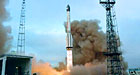
LIFTOFF! Liftoff of the Proton rocket and Canadian Anik F3 spacecraft!

2253 GMT (6:53 p.m. EDT)

T-minus 1 minute.

2252 GMT (6:52 p.m. EDT)

T-minus 2 minutes. The countdown is being run by a master computer sequencer.

2249 GMT (6:49 p.m. EDT)

T-minus 5 minutes. The launch readiness of the Proton core vehicle and Breeze M upper stage is verified over the last minutes in the countdown.

2244 GMT (6:44 p.m. EDT)

T-minus 10 minutes. Weather conditions at Baikonur are acceptable for launch. The temperature is 45 degrees F with light and variable winds.

2242 GMT (6:42 p.m. EDT)

T-minus 12 minutes. This will be the 325th Proton rocket launch and the 40th under the management of International Launch Services.

2239 GMT (6:39 p.m. EDT)

T-minus 15 minutes. ILS is not reporting any problems in the countdown.

2233 GMT (6:33 p.m. EDT)

T-minus 21 minutes and counting down to the launch of the Canadian Anik F3 spacecraft aboard the year's first Proton rocket flight.

MONDAY, APRIL 9, 2007

The countdown is underway for today's flight of the Proton rocket carrying the Canadian Anik F3 communications satellite from the Baikonur Cosmodrome. Liftoff is scheduled for 2254 GMT (6:54 p.m. EDT).

The Proton first stage's six RD-275 engines will ignite at liftoff to push the 19-story rocket away from Earth on two million pounds of thrust. After first stage separation two minutes into flight, four engines aboard the second stage fire for three-and-a-half minutes before shutting down and jettisoning. The Proton's third stage then comes to life for its four-minute job, during which time the protective payload fairing shielding Anik will separate.

The Breeze M upper stage then takes over for a series of maneuvers lasting nine hours to reach geosynchronous transfer orbit. The 10,200-pound satellite will be delivered in an elliptical orbit stretching 22,200 miles at its highest point, 3,400 miles at its lowest and an inclination of 11 degrees to the equator.

The Anik F3 spacecraft, built by EADS Astrium, boosts itself into a circular geostationary orbit where Telesat Canada of Ottawa will operate the satellite. Equipped with a payload to provide C-, Ka- and Ku-band services over North America, the craft will be parked in an orbital slot at 118.7 degrees West longitude. Its planned service life is 15 years.

Today's liftoff is under the management by International Launch Services, the commercial marketing firm for Russian Proton rocket. It comes 11 years to the day since the first ILS Proton launch.

Watch this page for live updates.

Copyright 2007 SpaceflightNow.com, all rights reserved.


Apollo patches
The Apollo Patch Collection: Includes all 12 Apollo mission patches plus the Apollo Program Patch. Save over 20% off the Individual price.
 U.S. STORE


Expedition 16 crew patch
The official embroidered patch of the International Space Station Expedition 16 crew is now available to U.S. customers from our store.
 U.S. STORE

Columbus mission patch
The official astronaut embroidered patch of Atlantis' STS-122 mission that launched the Columbus science lab in February is available to U.S. customers from our store.
 U.S. STORE

Project Orion
The Orion crew exploration vehicle is NASA's first new human spacecraft developed since the space shuttle a quarter-century earlier. The capsule is one of the key elements of returning astronauts to the Moon.
 U.S. STORE


The ultimate Apollo 11 DVD
This exceptional chronicle of the historic Apollo 11 lunar landing mission features new digital transfers of film and television coverage unmatched by any other.
 Choose your store:
U.S. - U.K. - E.U. - Worldwide

INDEX | PLUS | NEWS ARCHIVE | LAUNCH SCHEDULE
ASTRONOMY NOW | STORE

ADVERTISE

© 2008 Pole Star Publications Ltd