|
|
|


|
|
Prisma satellites will begin high-flying dance next week BY STEPHEN CLARK SPACEFLIGHT NOW Posted: June 7, 2010 
Two Swedish satellites are snugly packed inside the nose of a Ukrainian rocket for blastoff next week, when the duo will commence a risky test of new formation-flying and rendezvous technologies on a shoestring budget.
"Prisma is really a Christmas tree of different demonstrations," said Staffan Persson, the Prisma project manager from Swedish Space Corp. "Everybody should have something out of the mission as early possible. There's sort of an early harvest strategy involved here, and then we go to more and more advanced exercises." Over the course of 10 months, the two spacecraft will repeatedly approach one another testing each of the relatively low-cost technologies. "The priority is to demonstate autonomous formation-flying, meaning that we regard these two satellites as one entity," Persson said. "So they are supposed to keep a fixed position relative to each other without ground control in the loop." Swedish Space Corp. built the satellites for the Swedish National Space Board. The mission cost Sweden about $50 million, but that figure doesn't include contributions from European partners. "This choice of formation-flying was made because it was an an area nobody [has tried before], at least not with the precision that's going to be shown with the Prisma satellites," said Christer Nilsson, Prisma program manager at the Swedish space agency. "We wanted to provide this technology demonstration platform for instruments that needed to be tested for future missions," Nilsson said. "There was a lot of discussion in Europe at the European Space Agency and bilaterally that there were very few opportunities to fly components and instruments. There was really a need for in-orbit demonstrations." A small team of Swedish engineers finished preparing the spacecraft for launch Friday and will return home this week. "Everything we have done has gone exactly as we thought," Persson said. "Everything is ready now." The Prisma satellites occupy the lower position of the Dnepr rocket's space head module, the protective metallic shield that covers payloads during launch. A French solar research satellite named Picard will fly into space on the Dnepr's upper deck.
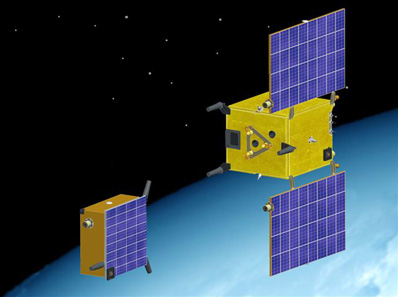
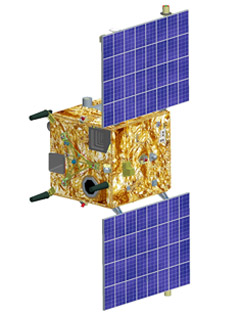
Prisma's two satellites, nicknamed Mango and Tango, will split apart at the start of the mission. Mango is a 331-pound cube-shaped craft about the size of a kitchen stove. It will take the active role during Prisma's formation-flying tests, keeping in lockstep with the smaller 88-pound Tango satellite, which has roughly the dimensions of an average microwave. The mission's development team selected the monikers during a naming competition. "The satellites will perform a sort of dance up in space," Nilsson said. Engineers at Prisma's control center in Stockholm will start the demonstrations after several weeks of post-launch tests to verify the satellites work as designed. Prisma will first test formation-flying and long-range rendezvous with Swedish and German GPS payloads. The radio frequency sensor from CNES, the French space agency, will next be activated to keep the satellites in formation. "Just to pick one demonstration is to give the CNES sensor an opportunity to test the range of their instrument," Persson said. "So at one point in the mission, we will give the control stick to CNES and they will want to go to the limit of their instrument's capability, and that is somewhere around 10 to 30 kilometers (6 to 18 miles)." Toward the end of the mission, controllers will shift their focus to an optical sensor modified from a star tracker developed by the Danish Technical University. Persson said officials are not sure of the vision-based sensor's range. The Mango satellite could track its smaller target from as far away as 100 kilometers, or 62 miles. Managers are saving the optical instrument test for last because it is more risky than Prisma's other objectives. "One could regard that as a bit dangerous because they will be getting close and, hopefully, really close to each other," Persson said. Mango should approach within a meter, or about three feet, of Tango late this year. The vision-based sensor will receive cues from a pattern of lights on the target satellite to help guide the spacecraft together. All of the rendezvous tests will be captured by an Italian video system aboard Mango. Officials plan to release footage throughout the mission.
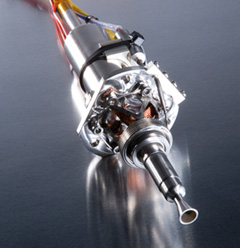
"It is a one-to-one switch with hydrazine, and you get a little bonus on top of it. It's a fuel that actually can be flown on regular aircraft," Nilsson said, referring to the green propellant's lighter transportation restrictions. "It has a much more benign composition than hydrazine." The green propellant thrusters produce just one-fifth of a pound of thrust, but they can stand in for any one of Mango's half-dozen hydrazine engines should they fail. The technology was developed by a subsidiary of Swedish Space Corp. focusing on ecological propulsion systems. The company is also designing more potent green propellant engines for larger satellites. Officials say the goal of the Prisma mission is to prove technologies that can be rapidly applied to future European satellites, improving their performance and reducing their cost. |
|
|
|
 |
|||||||||||||||||||||||||