
Spaceflight Now Home


Top Stories


A Zombiesat menace - The out-of-control Galaxy 15 satellite threatens to scramble signals from three more spacecraft by the end of August.

Good news for NPP - The next U.S. weather satellite receives its final observation instrument.

Curiosity's first steps - NASA drives the next Mars rover for the first time inside a California clean room.

ESA looks abroad - Europe's next space science missions depend on international help.

Clash in Congress - The House and Senate have proposed vastly different visions for NASA's human space program.

Taurus 2 update - Orbital Sciences says it will fly a standalone Taurus 2 rocket flight with extra NASA money.

Boeing unveils capsule - Boeing is developing a crew capsule to serve the International Space Station and private orbiting outposts.

Booster stacking begins - The solid rocket boosters for the final scheduled space shuttle mission are being assembled.

Bringing Mars to Earth - The multi-billion dollar effort to return samples from Mars could begin in 2018.

House presents bill - The House version of the NASA authorization act would undo White House proposals.

Spirit's future - The best time to hear from the hibernating Spirit rover again will be October.

WISE completes survey - NASA's WISE telescope finishes its first scan of the infrared universe.


NewsAlert


Sign up for our NewsAlert service and have the latest news in astronomy and space e-mailed direct to your desktop.

Enter your e-mail address:

Privacy note: your e-mail address will not be used for any other purpose.


NASA offers taste of images from infrared telescope
BY STEPHEN CLARK
SPACEFLIGHT NOW

Posted: February 17, 2010


Bookmark and Share

Splashed with vivid colors resembling abstract art pieces, four infrared snapshots from the WISE telescope show a streaking comet, the heart of a stellar nursery, and galaxies in the distant universe.

 
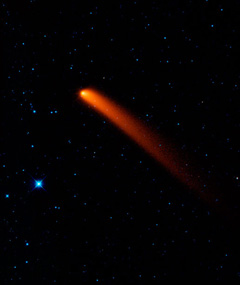
Comet Siding Spring is the subject of this image from WISE. The comet was heading toward the outer solar system in its orbit as WISE took this picture on Jan. 10, 2010. Credit: NASA/JPL-Caltech/UCLA
 
NASA released the images Wednesday, one month after the Wide-field Infrared Survey Explorer started scanning the cosmos to detect countless new galaxies, stars, asteroids and comets.

"WISE has worked superbly," said Ed Weiler, associate administrator for NASA's science mission directorate. "These first images are proving the spacecraft's secondary mission of helping to track asteroids, comets and other stellar objects will be just as critically important as its primary mission of surveying the entire sky in infrared."

The telescope snapped an image of comet Siding Spring with a trailing stream of dust 10 million miles long glowing red in infrared light.

Scientists believe WISE will discover dozens of previously unseen comets and up to 100,000 new asteroids, including bodies that bear watching because they occasionally swing close to Earth.

WISE has already taken more than 250,000 pictures since Jan. 14, and the telescope will continue capturing a new image every 11 seconds through at least October.

Images released Wednesday also show WISE's view inside a star-forming region some 20,000 light years away, a wide-angle shot of the Andromeda galaxy, and a picture of the Fornax galaxy cluster 60 million light years from Earth.


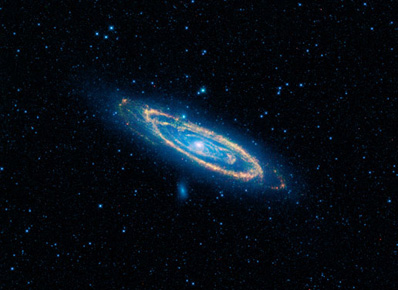
WISE collected this image of Andromeda, the closest large galaxy to the Milky Way, located about 2.5 million light years away. This mosaic covers the equivalent area of 100 full moons, or about a five-degree swath of the sky. Credit: NASA/JPL-Caltech/UCLA
 
"All these pictures tell a story about our dusty origins and destiny," said Peter Eisenhardt, the WISE project scientist at NASA's Jet Propulsion Laboratory in Pasadena, Calif. "WISE sees dusty comets and rocky asteroids tracing the formation and evolution of our solar system. We can map thousands of forming and dying solar systems across our entire galaxy. We can see patterns of star formation across other galaxies, and waves of star-bursting galaxies in clusters millions of light years away."

The picture are examples of regions and objects researchers hope to discover and study through WISE.

"We've got a candy store of images coming down from space," said Ned Wright, WISE principal investigator at UCLA. "Everyone has their favorite flavors, and we've got them all."

The observatory's reservoir of chilled solid hydrogen will be exhausted by October, effectively ending WISE's primary mission. The detectors of the 16-inch telescope are cooled by hydrogen to permit the instrument to observe some of the coldest objects of the universe with temperatures as low as -330 degrees Fahrenheit.

Scientists expect WISE will survey the entire sky one-and-a-half times by the time hydrogen runs out.

Current Shuttle Mission Patch

Free shipping to U.S. addresses!

The final planned flight of space shuttle Atlantis is symbolized in the official embroidered crew patch for STS-132. Available in our store!
 U.S. STORE
 WORLDWIDE STORE

STS-131 Patch

Free shipping to U.S. addresses!

The official embroidered patch for shuttle Discovery's STS-131 flight to launch science and supplies for the space station now available in our store!
 U.S. STORE
 WORLDWIDE STORE

Ares 1-X Patch
The official embroidered patch for the Ares 1-X rocket test flight, is available for purchase.
 U.S. STORE
 WORLDWIDE STORE

Apollo Collage
This beautiful one piece set features the Apollo program emblem surrounded by the individual mission logos.
 U.S. STORE
 WORLDWIDE STORE


Project Orion
The Orion crew exploration vehicle is NASA's first new human spacecraft developed since the space shuttle a quarter-century earlier. The capsule is one of the key elements of returning astronauts to the Moon.
 U.S. STORE


Fallen Heroes Patch Collection
The official patches from Apollo 1, the shuttle Challenger and Columbia crews are available in the store.
 U.S. STORE
 WORLDWIDE STORE

INDEX | PLUS | NEWS ARCHIVE | LAUNCH SCHEDULE
ASTRONOMY NOW | STORE

ADVERTISE

© 2010 Spaceflight Now Inc.