|
|
|


|
|
First direct spectrum of an exoplanet captured EUROPEAN SOUTHERN OBSERVATORY RELEASE Posted: January 13, 2010 
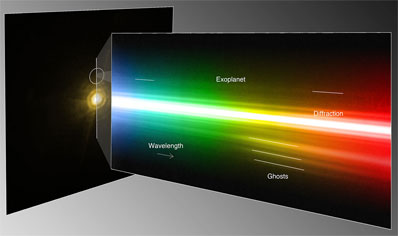
By studying a triple planetary system that resembles a scaled-up version of our own Sun's family of planets, astronomers have been able to obtain the first direct spectrum -- the "chemical fingerprint" [1] -- of a planet orbiting a distant star [2], thus bringing new insights into the planet's formation and composition. The result represents a milestone in the search for life elsewhere in the Universe.
The researchers obtained the spectrum of a giant exoplanet that orbits the bright, very young star HR 8799. The system is at about 130 light-years from Earth. The star has 1.5 times the mass of the Sun, and hosts a planetary system that resembles a scaled-up model of our own Solar System. Three giant companion planets were detected in 2008 by another team of researchers, with masses between 7 and 10 times that of Jupiter. They are between 20 and 70 times as far from their host star as the Earth is from the Sun; the system also features two belts of smaller objects, similar to our Solar System's asteroid and Kuiper belts. "Our target was the middle planet of the three, which is roughly ten times more massive than Jupiter and has a temperature of about 800 degrees Celsius," says team member Carolina Bergfors. "After more than five hours of exposure time, we were able to tease out the planet's spectrum from the host star's much brighter light." This is the first time the spectrum of an exoplanet orbiting a normal, almost Sun-like star has been obtained directly. Previously, the only spectra to be obtained required a space telescope to watch an exoplanet pass directly behind its host star in an "exoplanetary eclipse", and then the spectrum could be extracted by comparing the light of the star before and after. However, this method can only be applied if the orientation of the exoplanet's orbit is exactly right, which is true for only a small fraction of all exoplanetary systems. The present spectrum, on the other hand, was obtained from the ground, using ESO's Very Large Telescope (VLT), in direct observations that do not depend on the orbit's orientation. As the host star is several thousand times brighter than the planet, this is a remarkable achievement. "It's like trying to see what a candle is made of, by observing it from a distance of two kilometers when it's next to a blindingly bright 300 Watt lamp," says Janson. The discovery was made possible by the infrared instrument NACO, mounted on the VLT, and relied heavily on the extraordinary capabilities of the instrument's adaptive optics system [3]. Even more precise images and spectra of giant exoplanets are expected both from the next generation instrument SPHERE, to be installed on the VLT in 2011, and from the European Extremely Large Telescope. The newly collected data show that the atmosphere enclosing the planet is still poorly understood. "The features observed in the spectrum are not compatible with current theoretical models," explains co-author Wolfgang Brandner. "We need to take into account a more detailed description of the atmospheric dust clouds, or accept that the atmosphere has a different chemical composition from that previously assumed." The astronomers hope to soon get their hands on the fingerprints of the other two giant planets so they can compare, for the first time, the spectra of three planets belonging to the same system. "This will surely shed new light on the processes that lead to the formation of planetary systems like our own," concludes Janson. Notes [1] As every rainbow demonstrates, white light can be split up into different colors. Astronomers artificially split up the light they receive from distant objects into its different colors (or "wavelengths"). However, where we distinguish five or six rainbow colors, astronomers map hundreds of finely nuanced colors, producing a spectrum -- a record of the different amounts of light the object emits in each narrow color band. The details of the spectrum -- more light emitted at some colors, less light at others -- provide tell-tale signs about the chemical composition of the matter producing the light. This makes spectroscopy, the recording of spectra, an important investigative tool in astronomy. [2] In 2004, astronomers used NACO on the VLT to obtain an image and a spectrum of a 5 Jupiter mass object around a brown dwarf -- a "failed star". It is however thought that the pair probably formed together, like a petite stellar binary, instead of the companion forming in the disc around the brown dwarf, like a star-planet system. [3] Telescopes on the ground suffer from a blurring effect introduced by atmospheric turbulence. This turbulence causes the stars to twinkle in a way that delights poets but frustrates astronomers, since it smears out the fine details of the images. However, with adaptive optics techniques, this major drawback can be overcome so that the telescope produces images that are as sharp as theoretically possible, i.e., approaching conditions in space. Adaptive optics systems work by means of a computer-controlled deformable mirror that counteracts the image distortion introduced by atmospheric turbulence. It is based on real-time optical corrections computed at very high speed (several hundreds of times each second) from image data obtained by a wavefront sensor (a special camera) that monitors light from a reference star. |
|
|
|
|
|||||||||||||||||||||