|
|
|


|
|
Scientists use mirror effect to reproduce IBEX observation NASA-GODDARD RELEASE Posted: January 12, 2010 
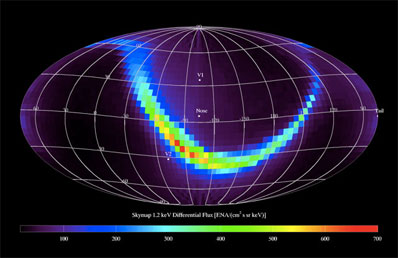
Ever since NASA's Interstellar Boundary Explorer, or IBEX, mission scientists released the first comprehensive sky map of our solar system's edge in particles, solar physicists have been busy revising their models to account for the discovery of a narrow "ribbon" of bright emission that was completely unexpected and not predicted by any model at the time.
The results appear in the January 10 issue of the Astrophysical Journal Letters. Jacob Heerikhuisen, a solar physicist at the University of Alabama in Huntsville, is the lead author of the paper. Heerikhuisen and his colleagues believe the orientation of the local galactic magnetic field is closely related to the location of the ribbon in the sky. Charged particles "orbit" magnetic field lines. When they suddenly lose their charge, they fly off in a straight line maintaining their current direction. Only particles that orbit the magnetic mirror, where it faces us directly, can flow back toward us and are captured by IBEX. These particles originate in our magnetized solar system, or heliosphere‹the region from the sun to where the solar wind meets the local interstellar medium (LISM). First these particles lose their charge and fly out of the heliosphere. At some distance they charge again and start "orbiting" a field line of the local interstellar magnetic field, where they get "recycled" by losing their charge again. Solar physicists did not expect this "mirror effect," which is "somewhat analogous to exploring an unknown cave," says Arik Posner, IBEX program scientist at NASA Headquarters. "By activating IBEX, we suddenly see that the solar system has a lit candle and see its light reflected in the 'cave walls' shining back at us," says Posner. "What we find is that the 'cave wall' acts more like a faint mirror than like a normal wall," he adds. What we saw with IBEX is that this "cave" we are exploring apparently has very straight and smooth magnetic walls, being shaped somewhat like a subway tunnel. IBEX can remotely observe the direction of the local interstellar magnetic field and may observe whether it stays the same or changes over time. The sun's presence affects the local interstellar magnetic field, bulging the field out to form something larger that is similar to a subway station. However, the "station" itself, our heliosphere, slowly moves along the tunnel, not subway cars. Straight magnetic field lines are only found in plasmas where the magnetic field is strong and shapes the flow of particles, such as the smooth magnetic loops observed in the sun's corona. The IBEX results appear consistent with a recent finding by the Voyager mission that the surrounding galactic magnetic field in the LISM is much stronger than previously thought. Assuming this "magnetic mirror effect" produces the narrow "ribbon" discovered by IBEX, then the orientation of the local galactic magnetic field is closely related to the location of the ribbon. With the help of global 3D models, this mechanism could help accurately determine the magnetic field's direction. The finding would also suggest that IBEX is detecting the particles from both inside and outside the heliopause, which is the boundary region between the outer solar system and the local interstellar medium. "The IBEX mission has from the outset stressed both the criticality of new measurements and the collaboration between observations and theoretical research," explains Robert MacDowall, IBEX mission scientist at NASA Goddard. "The discovery by Heerikhuisen and colleagues demonstrates how successful this approach can be." The IBEX spacecraft was launched in October 2008. Its science objective was to discover the nature of the interactions between the solar wind and the interstellar medium at the edge of our solar system. The Southwest Research Institute developed and leads the mission with a team of national and international partners. The spacecraft is the latest in NASA's series of low-cost, rapidly developed Small Explorers Program. NASA's Goddard Space Flight Center manages the program for the agency's Science Mission Directorate at NASA Headquarters in Washington. |
|
|
|
|
|||||||||||||||||||||