
Spaceflight Now Home


Top Stories


Come see a launch - There are only five more chances to witness an awe-inspiring shuttle launch.

Shuttle inspiration - The Endeavour astronauts were inspired by early shuttle memories.

Cassini extension - NASA has approved an extension of the Cassini mission at Saturn until 2017.

Countdown starts - The three-day countdown begins for the launch of shuttle Endeavour.

Budget good for science - The proposed 2011 NASA budget boosts funding for Earth science and deep space missions.

Uncertainty at KSC - The cancellation of the Constellation moon program leaves the future of KSC up in the air.

Crew reflects on shuttle - The Endeavour astronauts see a place in history for the space shuttles.

Astronauts arrive - Six astronauts fly to Florida for launch aboard Endeavour.

Progress launches - A fresh batch of supplies launch to the space station on a Progress freighter.

Budget short on details - NASA and the White House are still tweaking the new NASA vision just unveiled.

Moon program scrapped - President Obama's 2011 budget proposal would cancel moon program and rely on commercial crew transportation providers.

Stimulus funds awarded - NASA awards stimulus money to up-and-coming commercial providers for crew transportation.


NewsAlert


Sign up for our NewsAlert service and have the latest news in astronomy and space e-mailed direct to your desktop.

Enter your e-mail address:

Privacy note: your e-mail address will not be used for any other purpose.


Troubled asteroid mission stumbles on road home
BY STEPHEN CLARK
SPACEFLIGHT NOW

Posted: November 9, 2009


Bookmark and Share

Hopes are fading for the return of the Hayabusa space probe after another of its ion thrusters failed last week, leaving just one already-damaged engine to guide the hard-luck spacecraft back to Earth, potentially with the first precious samples of an asteroid.


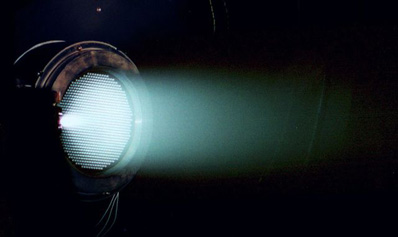
An ion engine in ground testing. JAXA
 
Hayabusa's four experimental microwave discharge ion engines consume xenon gas and expel the ionized propellant at high speeds to produce thrust. Two of the thrusters already failed before another engine shut down last Wednesday, according to the Japan Aerospace Exploration Agency.

Thruster D's failure was caused by a voltage spike due to problems with a neutralization vessel. A similar anomaly triggered the failure of another engine in 2007.

The fourth ion propulsion unit, called Thruster C, was already shut down after signs that it also might succumb to high voltage damage. Engineers are now testing that engine to determine if it is capable of long-duration firings.

Ion engines are more efficient than conventional chemical thrusters because they use less fuel and can operate continuously for thousands of hours.

Hayabusa's thrusters have accumulated almost 40,000 hours of burn time since the probe launched in May 2003.

The engine that failed last week had been firing since February to bend the 950-pound probe's trajectory, allowing it to reach Earth by June 2010 and release a small re-entry capsule possibly carrying samples from asteroid Itokawa.

In February, JAXA officials said Hayabusa needed to accelerate by about 900 mph to reach Earth. Thruster D was slated to continue operating until March, when Hayabusa would begin coasting toward its parachuted return over the desert of Australia.

Officials now say they are evaluating the asteroid mission's return course after last week's glitch.


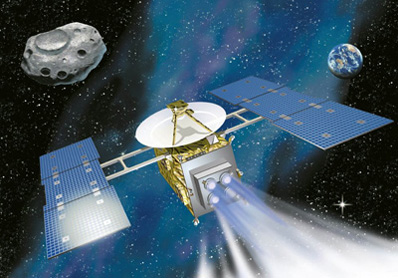
Artist's concept of Hayabusa. JAXA
 
Hayabusa spent three months exploring Itokawa in late 2005. The probe took 1,600 pictures and collected about 120,000 pieces of near-infrared spectral data and 15,000 data points with its X-ray spectrometer to investigate the small potato-shaped asteroid's surface composition.

The spacecraft approached Itokawa several times, attempting to fire a pellet into the asteroid's surface and retrieve rock samples through a funnel leading to a collection chamber.

During a failed sampling attempt in November 2005, Hayabusa made an unplanned landing and spent up to a half-hour on Itokawa, becoming the first spacecraft to take off from an asteroid.

Although telemetry showed Hayabusa likely did not fire its projectile while on the surface, scientists were hopeful bits of dust or pebbles found their way through the funnel and into the sample retrieval system.

Hayabusa was later stymied by a fuel leak and ground controllers temporarily lost communications with the spacecraft, which is about the size of an average refrigerator.

Controllers labored to overcome the issues, which were compounded by the loss of two orientation-controlling reaction wheels and power cells in an electrical battery.

The craft's departure from Itokawa was delayed a year because of the problems, postponing its return to Earth from 2007 until 2010.

Current Shuttle Mission Patch

Free shipping to U.S. addresses!

The official embroidered patch for shuttle Endeavour's flight to launch the Tranquility module and cupola to the space station now available in our store!
 U.S. STORE
 WORLDWIDE STORE

Ares 1-X Patch
The official embroidered patch for the Ares 1-X rocket test flight, is available for purchase.
 U.S. STORE
 WORLDWIDE STORE

Apollo Collage
This beautiful one piece set features the Apollo program emblem surrounded by the individual mission logos.
 U.S. STORE
 WORLDWIDE STORE


Project Orion
The Orion crew exploration vehicle is NASA's first new human spacecraft developed since the space shuttle a quarter-century earlier. The capsule is one of the key elements of returning astronauts to the Moon.
 U.S. STORE


Fallen Heroes Patch Collection
The official patches from Apollo 1, the shuttle Challenger and Columbia crews are available in the store.
 U.S. STORE
 WORLDWIDE STORE

INDEX | PLUS | NEWS ARCHIVE | LAUNCH SCHEDULE
ASTRONOMY NOW | STORE

ADVERTISE

© 2010 Spaceflight Now Inc.