|
|
|


|
|
With a little help, South Korea set to make history BY STEPHEN CLARK SPACEFLIGHT NOW Posted: August 18, 2009 
Partially made of critical technology bought from Russia, a South Korean space launcher is scheduled to rocket into history Wednesday on the country's first jaunt into Earth orbit.
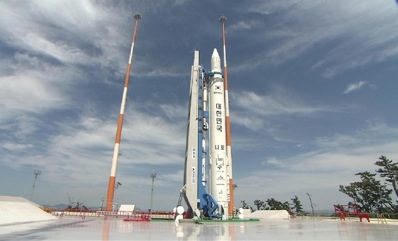
Korean news outlets reported officials will likely target launch for around 0800 GMT (4 a.m. EDT), or about 5 p.m. local time. Fueling of the KSLV's first stage should begin about two hours before launch and an automated countdown sequence will commence 15 minutes before the appointed liftoff time, according to the Korea Aerospace Research Institute. The 108-foot-tall rocket will head south from its island launch pad, crossing over the Sea of Japan and accelerating to more than 17,000 miles per hour in less than eight minutes. See our launch timeline for more details. If successful, the historic launch will place South Korea in an elite group of spacefaring countries with a domestic orbital launch capability. The former Soviet Union launched the world's first artificial satellite, Sputnik 1, in October 1957. The United States followed with the successful launch of Explorer 1 in January 1958. France, Japan, China, the United Kingdom, India and Israel later developed and successfully flew their own space launchers. Iran joined the club in February when it launched an experimental communications satellite with a Safir 2 rocket. Engineers rolled the KSLV 1 rocket from an assembly hangar to the launch pad on Monday. Ground controllers rehearsed countdown procedures and gave a "go" for launch on Tuesday. South Korea began designing the rocket in 2002 and originally hoped to launch the booster in 2005. After early development trouble, Russian rocket-maker Khrunichev signed on to the KSLV 1 project in 2004, spearheading the first stage and construction of the Naro launch site in Jeolladam-do province in the southwestern part of the country. The first stage is powered by an RD-191 main engined fueled by kerosene and liquid oxygen. Designed by Russian engine-builder Energomash, the propulsion system is based on the RD-171 and RD-180 engines that propel Zenit and Atlas rockets toward space. Officially named the Universal Rocket Module, the first stage was developed for Russia's next-generation Angara rocket, a modular design engineers hope will haul small, medium-sized, and heavy satellites into orbit. But Angara's development has been stymied by a series of delays, and the first stage of the new rocket will make its maiden flight from South Korea. About 160 Russian engineers are present at the Naro launch site to support the mission, according to reports from the Korea Times. Wednesday's launch was postponed from July 30 and Aug. 11 to give Khrunichev officials more time to analyze results of a critical engine test in Russia late last month. The RD-191 engine will ramp up to 430,000 pounds of thrust at liftoff, burning for nearly four minutes to guide the rocket to an altitude of more than 120 miles. After coasting through space for almost three minutes, the KSLV's Korean-bult solid-fueled second stage will ignite for a one-minute firing to accelerate the rocket to orbital velocity. The launcher will deploy the mission's 219-pound payload nine minutes after liftoff, according to KARI. The Science and Technology Satellite 2, or STSAT 2, will measure radiation in Earth's atmosphere and demonstrate several key technologies Korean scientists could use on future spacecraft. Officials may not know the outcome of the mission until STSAT 2 passes over a communications station about 13 hours after launch. |
|
|
|
|
|||||||||||||||||||||