|
|
|

 |
|
Japan's now-finished lunar mission found no water ice BY CRAIG COVAULT SPACEFLIGHT NOW Posted: July 6, 2009 
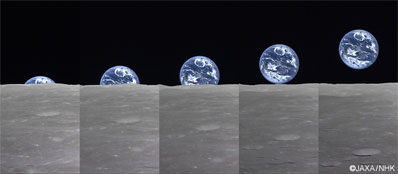
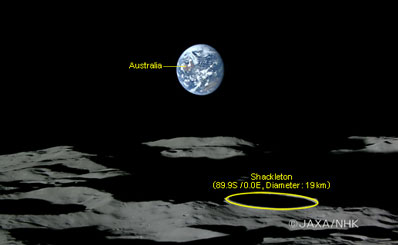
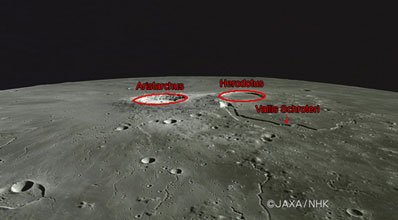
High resolution imaging sensors on the Japanese Selene/Kaguya lunar orbiter have failed to detect any signs of water ice in permanently shaded craters around the South Pole of the Moon. Selene's sensors were, however, able to able pierce the darkness to reveal details detailed deep in Shackelton crater that has been a top candidate for south polar ice as a resource for later human exploitation. Although the Japanese spacecraft found no ice it did find a crater much deeper than other lunar craters of a similar diameter and internal temperatures that could support ice delivered by comets over billions of years. The Japanese spacecraft has also returned stunningly beautiful images of the Earth and Moon as the 40th anniversary of the first manned lunar landing by Apollo 11 approaches on July 20.
Two unmanned NASA spacecraft have just arrived at the moon to look again for water ice, that would be a critical resource aiding future human lunar exploration. The NASA Goddard Lunar Polar Orbiter and NASA Ames/Northrop Grumman Lunar Crater Observation and Sensing Satellite (LCROSS) will use a direct impact by the flight's Centaur upper stage to kick up south polar lunar soil for direct sampling by LCROSS for evidence of water ice. The detection of frozen water was also a key science goal for the Japanese spacecraft that is the most ambitious lunar and planetary mission ever flown by Japan. According to a Japanese professional results paper printed in Science Magazine and also presented in March at the 40th Lunar and Planetary Science Conference in Houston, "The spacecraft's Terrain Camera (TC) team succeeded in three dimensional imaging of the Shackleton Crater on the lunar south pole...permanently shadowed and earlier believed to hold water-ice deposits." "However, [Selene imaging] indicates that exposed relatively pure water-ice deposits are lacking on the floor," according to the Japanese report. Japanese scientists said in Houston they could not find water ice anywhere else in craters near the Moon's rugged south pole, one of the primary NASA justifications for flying the LCROSS mission. The TC team did however successfully developed a three dimensional image showing the inside the Shackleton Crater for the first time by using TC observation data. The spacecraft found "Shackleton is a truncated cone-shaped crater with almost a concentric circular rim with a radius of up to 10.5 km and a floor with a radius of about 3.3 km, and a depth of about 4.2 km; it is much deeper than other similar-sized lunar craters," the Japanese paper says.
Just before its June 10 impact, Kaguya's high definition (HD) television camera took spectacular imagery as the 3 ton spacecraft, flying at 4,000 mph, descended at a shallow angle of only 1 deg. below the horizon. Small craters and rocks the size of cars can be seen flashing by until the scene goes black at impact.
The interactive capability of the spacecraft's data are illustrated on the JAXA website by manipulating this image of Tyco, the young south polar bright rayed crater easily visible to the naked eye from Earth.
The HD television system on the spacecraft for the first time allowed viewers on Earth to fly above the lunar farside, much rougher then the lunar nearside except for the lava plain of Tsiolkovskiy, in this motion video described by a JAXA commentator in English. |
|
|
|
||||