Spaceflight Now +

|
|
|
|
|
Subscribe to Spaceflight Now Plus for access to our extensive video collections!
 How do I sign up? How do I sign up?
Video archive
STS-106: Making the station a home in space
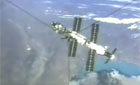
Following the Russian Zvezda service module's long-awaited launch to serve as the station's living quarters, Atlantis pays a visit in September 2000 to prepare the complex for arrival of the first resident crew.
Play | X-Large
STS-101: ISS service call
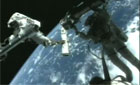
An impromptu maintenance mission to the new space station was flown by Atlantis in May 2000. The astronauts narrate their mission highlights.
Play | X-Large
STS-96: First ISS docking
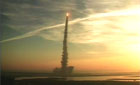
The first shuttle mission to dock with the fledgling International Space Station came in May 1999 when Discovery linked up with the two-module orbiting outpost. The STS-96 crew tells story of the mission.
Play | X-Large
STS-88: Building the ISS
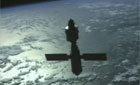
Construction of the International Space Station commenced with Russia's Zarya module launching aboard a Proton rocket and shuttle Endeavour bringing up the American Unity connecting hub. STS-88 crew narrates highlights from the historic first steps in building the outpost.
Play | X-Large
STS-74: Adding to Mir
The second American shuttle flight to dock with the space station Mir brought a new module to the Russian outpost. The astronauts narrate highlights from the Nov. 1995 mission.
Play | X-Large
STS-73: Microgravity lab
The STS-73 mission in 1995 marked two weeks in space for shuttle Columbia and the second trip for the U.S. Microgravity Lab.
Play
STS-55: German lab 2
The international crew of STS-55 narrates the highlights from the second German flight of Spacelab.
Play
STS-43: Building TDRSS
The STS-43 crew narrates the highlights of its mission to expand NASA's Tracking and Data Relay Satellite System.
Play
Delta 2 launches GPS
A Delta 2 rocket lifts off Dec. 20 from Cape Canaveral carrying the GPS 2R-18 navigation satellite for the Global Positioning System.
Full coverage
35 years ago: Apollo 17
Apollo's final lunar voyage is relived in this movie. The film depicts the highlights of Apollo 17's journey to Taurus-Littrow and looks to the future Skylab, Apollo-Soyuz and shuttle programs.
Play
Delta 4-Heavy launch
The first operational Delta 4-Heavy rocket launches the final Defense Support Program missile warning satellite for the Air Force.
Full coverage
Become a subscriber
More video
|
|
|
|
|
|
Jupiter's giant storms caught in Hubble telescope images
UNIVERSITY OF ARIZONA NEWS RELEASE
Posted: January 24, 2008
A University of Arizona scientist, observing Jupiter with the Hubble Space Telescope last May, took some of the best images of two unusual giant storms that erupted from the planet last spring.
Erich Karkoschka of the UA's Lunar and Planetary Laboratory is co-author on a scientific paper being published about his observations in the Jan. 24 issue of the journal Nature.

See larger image here
|
When the Pluto-bound New Horizons spacecraft flew by Jupiter in February 2007, it sent back images that showed a relatively quiet Jupiter, Karkoschka said. Then, on March 25, other astronomers using the Hubble telescope captured a view that showed the beginnings of an intense disturbance at Jupiter's middle northern latitudes, which is where the planet's strongest winds blow.
Such giant storms are rare. The last ones occurred in 1990 and 1975, before Hubble and other high-resolution telescopes were in operation. Scientists are interested in such eruptive storms because they are clues to what's going on deeper inside giant gas planets to fuel the jet winds that dominate atmospheres such as those belonging to Jupiter and Saturn.
Augustin Sanchez-Lavega from Spain's Universidad del Pais Vasco coordinated professional and amateur astronomers who monitored the storms as they developed in the following days.
Amateur astronomers play a major role in these kinds of observations, Karkoschka said. "Since professional telescopes are relatively rigid in their schedules, it was great to have amateurs making observations."

The background image is from Hubble Space Telescope and shows the turbulent pattern generated by the two plumes. The two bright plumes detach in the superimposed small infrared image obtained at the NASA-IRTF facility a month before. Credit: NASA, ESA, IRTF, A. Sanchez-Lavega and R. Hueso (Universidad del Pais Vasco, Spain)
See larger image here
|
Karkoschka has been using the Hubble telescope to study how high small hazes reach into Jupiter's upper atmosphere. He makes these observations as the planet's largest moon, Ganymede, dips from view behind the planet. Hubble observations are scheduled months in advance, and the storms didn't appear on the side of the planet Karkoschka was monitoring on April 9.
But the storms, initially seen at 250 miles across, grew to about five times that size in less than a day. They rapidly formed two 19-mile-high plumes of ammonia ice and water spewing from Jupiter's deep water clouds.
On May 1, Karkoschka used filters ranging from ultraviolet to visible to infrared on the Hubble telescope to make some of the best images that characterize the structure of the disturbance. Astronomers won more time on the Hubble to view the storms again in early June, but by that time, the disturbance was gone, leaving behind a band of a different color, he noted.
Karkoschka has been studying the atmospheres of outer planets for more than 20 years, first as a graduate student and since as a researcher with the Lunar and Planetary Laboratory. He has used the Hubble Space Telescope to take images of Saturn and its moon Titan, as well as Uranus and Neptune, to study the vertical profile of their gases and aerosols.
|
|
|
|
|