|
|
|

|
|
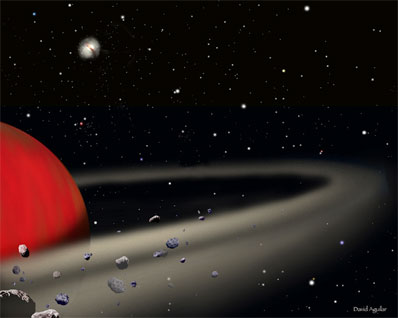
Jupiter's big brother has moon-forming dust disk CfA NEWS RELEASE Posted: June 5, 2006 Earth's Moon was created by an early collision with another large planetary body. It was a "chip off the old block." Mars captured its asteroidal moons as they passed by. But Jupiter made its own moons out of dust and gas remaining from its formation. Now, observations by astronomer Subhanjoy Mohanty of the Harvard-Smithsonian Center for Astrophysics (CfA) and his colleagues provide the first direct evidence for a dusty disk around a distant planet that in mass would be Jupiter's "big brother."
Mohanty presented the discovery today in a press conference at the 208th meeting of the American Astronomical Society. Other members of the team are Ray Jayawardhana (University of Toronto), Nuria HuČlamo (ESO) and Eric Mamajek (CfA). The team studied a planetary mass object known as 2MASS1207-3932B, which is located about 170 light-years from Earth in the direction of the constellation Centaurus. 2M1207B, as it is abbreviated, orbits a tiny brown dwarf star at a separation of about 40 astronomical units, or 3.7 billion miles - comparable to the size of Pluto's orbit. That separation is much larger than typical for binary brown dwarf systems. The wide separation may indicate that the duo formed in relative isolation, far from passing stars that could have pulled them apart. "This system probably won't survive for long. It won't last 5 billion years like our solar system has," said Mamajek. "All it would take is for a more massive interloper star to come along and yank the planet away from the brown dwarf." Observations by Mohanty's team showed that the brown dwarf has a mass of about 25 Jupiters and a temperature of 4100 degrees Fahrenheit (2600 K). Its companion 2M1207B weighs about 8 times Jupiter and has a temperature of 2400 degrees F (1600 K). Both objects are warm due to their young age of 5-10 million years, having retained the heat of formation. Given those temperatures, the team then calculated the expected brightness of both objects. The brown dwarf matched predictions but its companion was about 8 times fainter than expected. After examining several potential causes, the team concluded that the only plausible explanation was the presence of an edge-on dusty disk that blocked most of the planet's light. The planet is seen only in light scattered from the disk. Spectral analysis shows that 2M1207B is a gas giant like Jupiter with no solid surface. As a result, it would be a poor abode for life. Any moons that might form around it, however, could prove more hospitable. The large mass of 2M1207B relative to the brown dwarf star poses a puzzle for planetary formation theories. Typical planets like those in our solar system are less than one-hundredth the size of the central star. In contrast, 2M1207B holds one-third as much mass as the brown dwarf. "Mass ratios of that size are more typical for binary stars than for planetary systems," said Mohanty. "2M 1207B probably formed like a star, together with the brown dwarf, rather than from core accretion like giant planets around other stars." Mohanty and his colleagues plan to study the polarization of light from 2M1207B in order to investigate the inclination of its disk as well as the size of dust grains within the disk. Further studies await the next generation of large telescopes, such as the Giant Magellan Telescope and the Atacama Large Millimeter Array, which may be able to directly detect the disk around the planetary mass companion. Headquartered in Cambridge, Mass., the Harvard-Smithsonian Center for Astrophysics (CfA) is a joint collaboration between the Smithsonian Astrophysical Observatory and the Harvard College Observatory. CfA scientists, organized into six research divisions, study the origin, evolution and ultimate fate of the universe. |
|
|
|
 |
|||||||||||||||||||||

 Space shuttle program manager Wayne Hale and launch director Mike Leinbach hold this news conference May 31 from Kennedy Space Center to offer a status report on STS-121 mission preparations. The briefing was held at the conclusion of the debris verification review, which examined the external fuel tank and threats to the shuttle from impacts during launch.
 Dial-up:
  NASA created its Tracking and Data Relay Satellite (TDRS) system to serve as a constellation of orbiting spacecraft that would replace the costly ground tracking stations scattered around the globe for communications with space shuttles and other satellites. Space shuttle Discovery's STS-29 mission in March 1989 launched the massive TDRS-D craft. This post-flight film narrated by the crew shows the deployment, the astronauts running a series of medical tests and the monitoring of a student-developed chicken embryo experiment.
 Space shuttle Columbia began mission STS-61C with a beautiful sunrise launch in January 1986 after several delays. Led by commander Hoot Gibson, the astronauts deployed a commercial communications satellite and tended to numerous experiments with the Materials Science Laboratory, Hitchhiker platform and Getaway Special Canisters in the payload bay. The crew included Congressman Bill Nelson of Florida, the first U.S. Representative to fly in space. Watch this post-flight film narrated by the astronauts.
 The Boeing Delta 4 rocket launches from pad 37B at Cape Canaveral Air Force Station with the GOES-N spacecraft, beginning a new era in weather observing for the Americas.
 As night fell over Kennedy Space Center on May 19, space shuttle Discovery reached launch pad 39B to complete the slow journey from the Vehicle Assembly Building. Discovery will be traveling much faster in a few weeks when it blasts off to the International Space Station.
 The November 1985 flight of space shuttle Atlantis began with a rare nighttime blastoff. The seven-member crew, including a Mexican payload specialist, spent a week in orbit deploying three communications satellites for Australia, Mexico and the U.S. And a pair of high-visibility spacewalks were performed to demonstrate techniques for building large structures in space. The crew narrates the highlights of STS-61B in this post-flight crew film presentation.
 Eight astronauts, the largest crew in history, spent a week in space during the fall of 1985 aboard shuttle Challenger for mission STS-61A, the first flight dedicated to the German Spacelab. The crew worked in the Spacelab D-1 laboratory conducting a range of experiments, including a quick-moving sled that traveled along tracks in the module. A small satellite was ejected from a canister in the payload bay as well. The astronauts narrate the highlights of the mission in this post-flight film.