Spaceflight Now +
|
|
|
|
|

Premium video content for our Spaceflight Now Plus subscribers.
Atlas 5 launches ASTRA
 The Lockheed Martin Atlas 5 rocket blasts off with the European ASTRA 1KR television broadcast satellite right on time April 20 from Complex 41 at Cape Canaveral Air Force Station. The Lockheed Martin Atlas 5 rocket blasts off with the European ASTRA 1KR television broadcast satellite right on time April 20 from Complex 41 at Cape Canaveral Air Force Station.
 Play video Play video
STS-51A: Daring mission
 Soon after the Palapa and Westar communications satellites got stranded in worthless orbits following their deployment from shuttle Challenger in February 1984, planners began devising a rescue mission to launch that November. The STS-51A flight of shuttle Discovery is arguably one of the most daring and complex space missions ever attempted. The crew successfully launched two communications satellites and then retrieved Palapa and Westar during extraordinary spacewalks using jet-propelled backpacks and hands-on muscle power. Watch the amazing flight unfold with narration by the crew in this post-flight film. Soon after the Palapa and Westar communications satellites got stranded in worthless orbits following their deployment from shuttle Challenger in February 1984, planners began devising a rescue mission to launch that November. The STS-51A flight of shuttle Discovery is arguably one of the most daring and complex space missions ever attempted. The crew successfully launched two communications satellites and then retrieved Palapa and Westar during extraordinary spacewalks using jet-propelled backpacks and hands-on muscle power. Watch the amazing flight unfold with narration by the crew in this post-flight film.
Small | Medium | Large
Memories of STS-1
 In the continuing 25th anniversary celebration of STS-1, this program looks at the engineering challenges behind development of the space shuttle and performing the first flight from Mission Control. This panel includes Milt Heflin, the STS-1 ascent/entry electrical power system flight controller, former space shuttle program manager Bob Thompson, former orbiter project manager Aaron Cohen, Neil Hutchinson, the STS-1 ascent flight director, and astronauts John Young and Bob Crippen. In the continuing 25th anniversary celebration of STS-1, this program looks at the engineering challenges behind development of the space shuttle and performing the first flight from Mission Control. This panel includes Milt Heflin, the STS-1 ascent/entry electrical power system flight controller, former space shuttle program manager Bob Thompson, former orbiter project manager Aaron Cohen, Neil Hutchinson, the STS-1 ascent flight director, and astronauts John Young and Bob Crippen.
Dial-up | Broadband
STS-1 anniversary event
 This 25th anniversary celebration of the first space shuttle launch took place April 12 at Space Center Houston. Speakers included Johnson Space Center Director Mike Coats, NASA Administrator Mike Griffin, Congressman Tom DeLay, Senator Kay Bailey Hutchison, STS-1 commander John Young and pilot Bob Crippen. This 25th anniversary celebration of the first space shuttle launch took place April 12 at Space Center Houston. Speakers included Johnson Space Center Director Mike Coats, NASA Administrator Mike Griffin, Congressman Tom DeLay, Senator Kay Bailey Hutchison, STS-1 commander John Young and pilot Bob Crippen.
Dial-up: Part 1 | Part 2
Broadband: Part 1 | 2
New lunar mission
 During this NASA news conference on April 10, agency officials unveil the Lunar Crater Observation and Sensing Satellite, or LCROSS, that will launch piggyback with the Lunar Reconnaissance Orbiter spacecraft in October 2008. LCROSS will use the launch vehicle's spent upper stage to crash into the moon's south pole in an explosive search for water. During this NASA news conference on April 10, agency officials unveil the Lunar Crater Observation and Sensing Satellite, or LCROSS, that will launch piggyback with the Lunar Reconnaissance Orbiter spacecraft in October 2008. LCROSS will use the launch vehicle's spent upper stage to crash into the moon's south pole in an explosive search for water.
Dial-up | Broadband
LCROSS mission plan
 Daniel Andrews, the LCROSS project manager from NASA's Ames Research Center, narrates this animation depicting the mission from launch through impact on the lunar surface. Daniel Andrews, the LCROSS project manager from NASA's Ames Research Center, narrates this animation depicting the mission from launch through impact on the lunar surface.
Play video
STS-1 crew looks back
 In this highly entertaining program, commander John Young and pilot Bob Crippen of the first space shuttle crew tell stories and memories from STS-1. The two respected astronauts visited Kennedy Space Center on April 6 to mark the upcoming 25th anniversary of Columbia's maiden voyage. In this highly entertaining program, commander John Young and pilot Bob Crippen of the first space shuttle crew tell stories and memories from STS-1. The two respected astronauts visited Kennedy Space Center on April 6 to mark the upcoming 25th anniversary of Columbia's maiden voyage.
Dial-up | Broadband
Become a subscriber
More video
|
|
|
|
|
|
Galaxies don mask of stars in new Spitzer image
NASA/JPL NEWS RELEASE
Posted: April 26, 2006
A pair of dancing galaxies appears dressed for a cosmic masquerade in a new image from NASA's Spitzer Space Telescope.
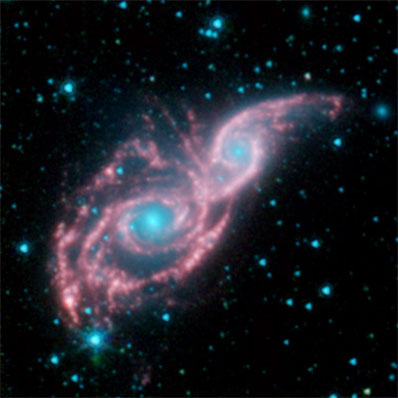
Credit: NASA/JPL-Caltech/Vassar
Download larger image version here
|
The infrared picture shows what looks like two icy blue eyes staring through an elaborate, swirling red mask. These "eyes" are actually the cores of two merging galaxies, called NGC 2207 and IC 2163, which recently met and began to twirl around each other.
The "mask" is made up of the galaxies' twisted spiral arms. Dotted along the arms, like strings of decorative pearls, are dusty clusters of newborn stars. This is the first time that clusters of this type, called "beads on a string" by astronomers, have been seen in NGC 2207 and IC 2163.
"This is the most elaborate case of beading we've seen in galaxies," said Dr. Debra Elmegreen of Vassar College in Poughkeepsie, N.Y. "They are evenly spaced and sized along the arms of both galaxies."
Elmegreen is lead author of a paper describing the Spitzer observations in the May 1 issue of the Astrophysical Journal.
Astronomers say the beads were formed when the galactic duo first met. "The galaxies shook each other, causing gas and dust to move around and collect into pockets dense enough to collapse gravitationally," said Dr. Kartik Sheth of NASA's Spitzer Science Center at the California Institute of Technology in Pasadena. Once this material condensed into thick bead-like clouds, stars of various sizes began to pop up within them.
Spitzer's infrared camera was able to see the dusty clouds for the first time because they glow with infrared light. The hot, young stars housed inside the clouds heat up the dust, which then radiates at infrared wavelengths. This dust is false-colored red in the image, while stars are represented in blue.
The Spitzer data also reveal an unusually bright bead adorning the left side of the "mask." This dazzling orb is so packed full of dusty materials that it accounts for five percent of the total infrared light coming from both galaxies. Elmegreen's team thinks the central stars in this dense cluster might have merged to become a black hole.
Visible-light images of the galaxies show stars located inside the beads, but the beads themselves are invisible. In those pictures, the galaxies look more like a set of owl-like eyes with "feathers" of scattered stars.
NGC 2207 and IC 2163 are located 140 million light-years away in the Canis Major constellation. The two galaxies will meld into one in about 500 million years, bringing their masquerade days to an end.
Other authors of this research include Bruce Elmegreen of IBM Watson Research Center, Yorktown Heights, N.Y., Michele Kaufman of Ohio State University, Columbus; Curt Struck of Iowa State, Ames; Magnus Thomasson of Onsala Space Observatory, Sweden; and Elias Brinks of the University of Hertfordshire, United Kingdom.
The Jet Propulsion Laboratory manages the Spitzer Space Telescope mission for NASA's Science Mission Directorate, Washington. Science operations are conducted at the Spitzer Science Center at Caltech. JPL is a division of Caltech. Spitzer's infrared array camera was built by NASA's Goddard Space Flight Center, Greenbelt, Md. The instrument's principal investigator is Dr. Giovanni Fazio of the Harvard-Smithsonian Center for Astrophysics.
|
|
|
|

|