|
|
|

|
|
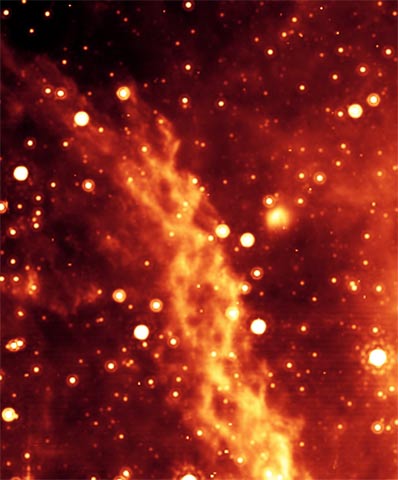
Double helix nebula found in center of the Milky Way UCLA NEWS RELEASE Posted: March 15, 2006 Astronomers report an unprecedented elongated double helix nebula near the center of our Milky Way galaxy, using observations from NASA's Spitzer Space Telescope. The part of the nebula the astronomers observed stretches 80 light years in length. The research is published March 16 in the journal Nature.
The double helix nebula is approximately 300 light years from the enormous black hole at the center of the Milky Way. (The Earth is more than 25,000 light years from the black hole at the galactic center.) The Spitzer Space Telescope, an infrared telescope, is imaging the sky at unprecedented sensitivity and resolution; Spitzer's sensitivity and spatial resolution were required to see the double helix nebula clearly. "We know the galactic center has a strong magnetic field that is highly ordered and that the magnetic field lines are oriented perpendicular to the plane of the galaxy," Morris said. "If you take these magnetic field lines and twist them at their base, that sends what is called a torsional wave up the magnetic field lines. "You can regard these magnetic field lines as akin to a taut rubber band," Morris added. "If you twist one end, the twist will travel up the rubber band." Offering another analogy, he said the wave is like what you see if you take a long loose rope attached at its far end, throw a loop, and watch the loop travel down the rope. "That's what is being sent down the magnetic field lines of our galaxy," Morris said. "We see this twisting torsional wave propagating out. We don't see it move because it takes 100,000 years to move from where we think it was launched to where we now see it, but it's moving fast - about 1,000 kilometers per second - because the magnetic field is so strong at the galactic center - about 1,000 times stronger than where we are in the galaxy's suburbs." A strong, large-scale magnetic field can affect the galactic orbits of molecular clouds by exerting a drag on them. It can inhibit star formation, and can guide a wind of cosmic rays away from the central region; understanding this strong magnetic field is important for understanding quasars and violent phenomena in a galactic nucleus. Morris will continue to probe the magnetic field at the galactic center in future research. This magnetic field is strong enough to cause activity that does not occur elsewhere in the galaxy; the magnetic energy near the galactic center is capable of altering the activity of our galactic nucleus and by analogy the nuclei of many galaxies, including quasars, which are among the most luminous objects in the universe. All galaxies that have a well-concentrated galactic center may also have a strong magnetic field at their center, Morris said, but so far, ours is the only galaxy where the view is good enough to study it. Morris has argued for many years that the magnetic field at the galactic center is extremely strong; the research published in Nature strongly supports that view. The magnetic field at the galactic center, though 1,000 times weaker than the magnetic field on the sun, occupies such a large volume that it has vastly more energy than the magnetic field on the sun. It has the energy equivalent of 1,000 supernovae. What launches the wave, twisting the magnetic field lines near the center of the Milky Way? Morris thinks the answer is not the monstrous black hole at the galactic center, at least not directly. Orbiting the black hole like the rings of Saturn, several light years away, is a massive disk of gas called the circumnuclear disk; Morris hypothesizes that the magnetic field lines are anchored in this disk. The disk orbits the black hole approximately once every 10,000 years. "Once every 10,000 years is exactly what we need to explain the twisting of the magnetic field lines that we see in the double helix nebula," Morris said. Co-authors on the Nature paper are Keven Uchida, a former UCLA graduate student and former member of Cornell University's Center for Radiophysics and Space Research; and Tuan Do, a UCLA astronomy graduate student. Morris and his UCLA colleagues study the galactic center at all wavelengths. NASA's Jet Propulsion Laboratory in Pasadena, Calif., manages the Spitzer Space Telescope mission for the agency's Science Mission Directorate. Science operations are conducted at the Spitzer Science Center at the California Institute of Technology. JPL is a division of Caltech. NASA funded the research. |
|
|
|
 |
|||||||||||||||||||||

 During the final seconds prior to the planned launch of the Space Technology 5 mission on March 15, a retention pin that holds the starboard-side fin aerosurface on the Pegasus rocket first stage did not retract. That forced the launch team to call an abort. This movie shows the scrub as it happened.
 Space Shuttle Program Manager Wayne Hale announces his decision to replace suspect fuel-level sensors inside the liquid hydrogen portion of Discovery's external tank. The three-week job means Discovery will miss its May launch window, delaying the second post-Columbia test flight to the next daylight period opening July 1. Hale made the announcement during a news conference from Johnson Space Center on March 14.
 NASA's Stardust spacecraft returned to Earth in January with the first samples ever retrieved from a comet. This briefing with mission scientists held March 13 from the Johnson Space Center offers an update on the initial research into the comet bits.
 The Cassini spacecraft orbiting the planet Saturn has found evidence indicating pockets of liquid water may exist near the surface on the icy moon Enceladus, raising the question of whether the small world could support life. This movie includes stunning images of Enceladus taken by Cassini and animation of geysers seen erupting from the moon.
 The make-or-break engine firing by the Mars Reconnaissance Orbiter to enter orbit around Mars and the subsequent aerobraking to reach the low-altitude perch for science observations are explained by project manager Jim Graf in this narrated animation package.
 Fuk Li, Mars program manager at JPL, Jim Graf, MRO project manager, Rich Zurek, MRO project scientist, and Dan McCleese, the principal investigator for the Mars Climate Sounder instrument, provide an overview on the Mars Reconnaissance Orbiter on March 8, about 48 hours before arrival at Mars.
 Spacelab was an orbiting laboratory tucked in the payload bay of the space shuttle for scientists to conduct a range of experiments. The joint European/NASA program flew multiple times aboard shuttle missions starting with STS-9 in November 1983. In this post-flight film presentation, the astronauts from that Columbia mission narrate the highlights from Spacelab-1.