|
|
|

|
|
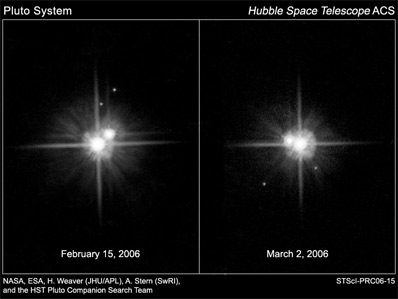
Hubble supports a common birth of Pluto's moons APPLIED PHYSICS LABORATORY NEWS RELEASE Posted: March 12, 2006 Using new Hubble Space Telescope observations, a research team led by Dr. Hal Weaver of the Johns Hopkins University Applied Physics Laboratory and Dr. Alan Stern of the Southwest Research Institute has found that Pluto's three moons are essentially the same color - boosting the theory that the Pluto system formed in a single, giant collision.
All three satellites have surfaces that reflect sunlight with equal efficiency at all wavelengths, which means they have the same color as the Sun or Earth's moon. In contrast, Pluto has more of a reddish hue. The new observations were obtained March 2 with the high-resolution channel of the Hubble's Advanced Camera for Surveys. The team determined the bodies' colors by comparing the brightness of Pluto and each moon in images taken through a blue filter with those taken through a green/red filter. "The high quality of the new data leaves little doubt that the hemispheres of P1 and P2 that we observed have essentially identical, neutral colors," says Weaver. The new results further strengthen the hypothesis that Pluto and its satellites formed after a collision between two Pluto-sized objects nearly 4.6 billion years ago. "Everything now makes even more sense," says Stern. "If all three satellites presumably formed from the same material lofted into orbit around Pluto from a giant impact, you might well expect the surfaces of all three satellites to have similar colors." The researchers hope to make additional Hubble color observations, in several more filters, to see if the similarity among the satellites persists to longer (redder) wavelengths. They have proposed to obtain compositional information on the new satellites by observing them at near-infrared wavelengths, where various ice and mineral absorptions are located. The researchers also hope to better refine the orbits of P1 and P2 and measure the moons' shapes and rotational periods. The Hubble observations were made in support of NASA's New Horizons mission to Pluto and the Kuiper Belt. New Horizons launched on Jan. 19, 2006, and will fly through the Pluto system in July 2015, providing the first close-up look at the ninth planet and its moons. Stern leads the mission and science team as principal investigator; Weaver serves as the mission's project scientist. The Johns Hopkins University Applied Physics Laboratory, Laurel, Md., manages the mission for NASA's Science Mission Directorate and operates the New Horizons spacecraft. The other members of the Hubble Space Telescope-Pluto satellite observing team include Max Mutchler of the Space Telescope Science Institute, Baltimore; Drs. William Merline, John Spencer, Andrew Steffl, Elliot Young and Leslie Young of Southwest Research Institute, Boulder, Colo.; and Dr. Marc Buie of Lowell Observatory, Flagstaff, Ariz. The Applied Physics Laboratory, a not for profit division of The Johns Hopkins University, conducts research and development primarily for national security and for nondefense projects of national and global significance. |
|
|
|
 |
|||||||||||||||||||||

 The Russian Progress M-54 cargo freighter undocks from the International Space Station's Zvezda service module aft port on March 3, as viewed by onboard and ISS cameras. Known in the station's assembly sequence as Progress 19P, the craft was launched last September with food, water, equipment and fuel. It was filled with trash before the undocking to burn up in the atmosphere.
 Mike Suffredini, NASA's program manager for the International Space Station, updates reporters on the technical aspects of implimenting the revised assembly sequence and configuration for the orbiting outpost in this teleconference held March 3.
 Leaders from the U.S., Russian, European, Japanese and Canadian space agencies hold this press conference at Kennedy Space Center on March 2 following meetings to approve a revised assembly sequence for the International Space Station using 16 space shuttle flights.
 A status report on the space shuttle program's efforts to fly the second post-Columbia test flight, including changes to the external fuel tank, is provided in this news conference from Kennedy Space Center on Feb. 28. The participants are Wayne Hale, shuttle program manager, Mike Leinbach, shuttle launch director, and Tim Wilson, external tank tiger team lead.
 As part of Lockheed Martin's plans for the Crew Exploration Vehicle, the company has announced that final assembly and testing of the capsules will be performed at the Kennedy Space Center's Operations and Checkout Building. Lockheed Martin officials, Florida's lieutenant governor, the local congressman and a county economic development leader held this press conference Feb. 22 to unveil the plans.