Premium video content for our Spaceflight Now Plus subscribers. NASA through the decades This film looks at the highlights in NASA's history from its creation in the 1950s, through the glory days of the Mercury, Gemini and Apollo programs, birth of the space shuttle and the loss of Challenger, launch of Hubble and much more. Small | Medium | Large STS-49: Satellite rescue If at first you don't succeed, keep on trying. That is what the astronauts of space shuttle Endeavour's maiden voyage did in their difficult job of rescuing a wayward communications satellite. Spacewalkers were unable to retrieve the Intelsat 603 spacecraft, which had been stranded in a useless orbit, during multiple attempts using a special capture bar. So the crew changed course and staged the first-ever three-man spacewalk to grab the satellite by hand. The STS-49 astronauts describe the mission and narrate highlights in this post-flight presentation. Small | Medium | Large First satellite repair The mission for the crew of space shuttle Challenger's April 1984 flight was two-fold -- deploy the experiment-laden Long Duration Exposure Facility (LDEF) and then track down the crippled Solar Max spacecraft, capture it and perform repairs during spacewalks. Initial attempts by the astronauts to grab the craft while wearing the Manned Maneuvering Unit spacewalk backpacks failed, but the crew ultimately retrieved Solar Max and installed fresh equipment while it was anchored in the payload bay. The crew narrates this post-flight presentation of home movies and highlights from mission STS-41C. Small | Medium | Large STS-26: Back in space The space shuttle program was grounded for 32 months in the painful wake of the 1986 Challenger accident. Americans finally returned to space in September 1988 when shuttle Discovery safely launched for its mission to deploy a NASA communications satellite. Enjoy this post-flight presentation narrated by the astronauts as they show movies and tell the story of the STS-26 mission.
Small | Medium | Large Amazing STS-51I flight Imagine a space shuttle mission in which the astronaut crew launched two commercial and one military communications spacecraft, then conducted a pair of incredible spacewalks to recover, fix and redeploy a satellite that malfunctioned just four months earlier. The rescue mission was a success, starting with an astronaut making a catch of the spinning satellite with just his gloved-hand. Enjoy this post-flight presentation narrated by the astronauts as they tell the story of shuttle Discovery's August 1985 mission known as STS-51I.
Small | Medium | Large Discovery's debut In our continuing look back at the classic days of the space shuttle program, today we show the STS-41D post-flight presentation by the mission's astronauts. The crew narrates this film of home movies and mission highlights from space shuttle Discovery's maiden voyage in August 1984. STS-41D deployed a remarkable three communications satellites -- a new record high -- from Discovery's payload bay, extended and tested a 100-foot solar array wing and even knocked free an icicle from the shuttle's side using the robot arm. Small | Medium | Large "Ride of Your Life" As the title aptly describes, this movie straps you aboard the flight deck for the thunderous liftoff, the re-entry and safe landing of a space shuttle mission. The movie features the rarely heard intercom communications between the crewmembers, including pilot Jim Halsell assisting commander Bob Cabana during the landing. Play video Message from Apollo 8 On Christmas Eve in 1968, a live television broadcast from Apollo 8 offered this message of hope to the people of Earth. The famous transmission occurred as the astronauts orbited the Moon. Play video Become a subscriber More video
Hubble's view of Orion reveals thousands of stars NASA/JPL NEWS RELEASE Posted: January 11, 2006
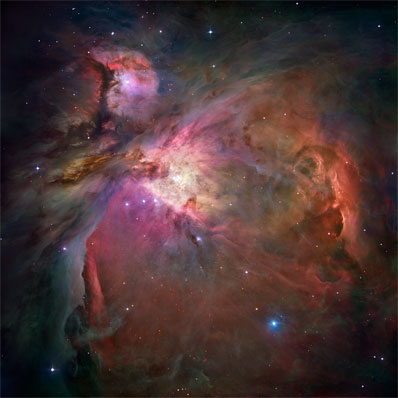
In one of the most detailed astronomical images ever produced, NASA's Hubble Space Telescope is offering an unprecedented look at the Orion Nebula. This turbulent star-formation region is one of astronomy's most dramatic and photogenic celestial objects.
Credit: NASA, ESA, M. Robberto (Space Telescope Science Institute/ESA) and the Hubble Space Telescope Orion Treasury Project Team Download larger image version here
"Orion is a bustling cauldron of activity. This new large-scale Hubble
image of the region reveals a treasure-house of beauty and
astonishing detail for comprehensive scientific study," said Jennifer
Wiseman, NASA's Hubble program scientist.
The crisp image reveals a tapestry of star formation, from the dense
pillars of gas and dust that may be the homes of fledgling stars to
the hot, young, massive stars that have emerged from their
gas-and-dust cocoons and are shaping the nebula with their powerful
ultraviolet light.
The new picture reveals large-scale structures never seen before,
according to C. Robert O'Dell of Vanderbilt University in Nashville,
Tenn. "Only with the Hubble Space Telescope can we begin to understand
them," O'Dell said.
In a mosaic containing a billion pixels, Hubble's Advanced Camera for
Surveys (ACS) uncovered 3,000 stars of various sizes. Some of them have
never been spied in visible light. Some are merely 1/100 the brightness
of stars seen previously in the nebula.
Among the stars Hubble spotted are possible young brown dwarfs, the
first time these objects have been seen in the Orion Nebula in visible
light. Brown dwarfs are so-called "failed stars." These cool objects are
too small to be ordinary stars because they cannot sustain nuclear
fusion in their cores the way our Sun does.
The Hubble Space Telescope also spied for the first time a small
population of possible binary brown dwarfs -- two brown dwarfs orbiting
each other. comparing the characteristics of newborn stars and brown
dwarfs in their natal environment provides unique information about how
they form.
"The wealth of information in this Hubble survey, including seeing
stars of all sizes in one dense place, provides an extraordinary
opportunity to study star formation," said Massimo Robberto of the
Space Telescope Science Institute in Baltimore, Md., and leader of
the observations. "Our goal is to calculate the masses and ages for
these young stars so that we can map their history and get a general
census of the star formation in that region. We can then sort the
stars by mass and age and look for trends."
Robberto presented his results on Jan. 11 at the 207th meeting of
the American Astronomical Society in Washington.
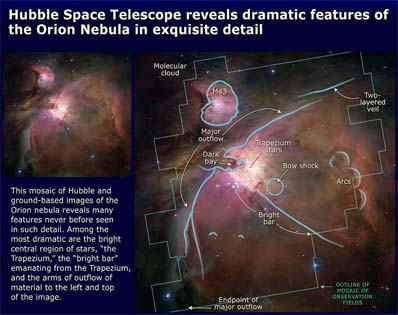
Credit: NASA, ESA and A. Feild (STScI) Download larger image version here
The Orion Nebula is a perfect laboratory to study how stars are born
because it is 1,500 light-years away, a relatively short distance within our
100,000 light-year wide galaxy. Astronomers have a clear view into
this crowded stellar maternity ward because massive stars in the center
of the nebula have blown out most of the dust and gas in which they
formed, carving a cavity in the dark cloud.
"In this bowl of stars we see the entire star formation history of
Orion printed into the features of the nebula: arcs, blobs, pillars,
and rings of dust that resemble cigar smoke," Robberto said. "Each one
tells a story of stellar winds from young stars that impact the
stellar environment and the material ejected from other stars. This
is a typical star-forming environment. Our Sun was probably born 4.5
billion years ago in a cloud like this one."
This extensive study took 105 Hubble orbits to complete. All imaging
instruments aboard the telescope - the ACS, Wide Field and Planetary
Camera 2, and Near Infrared Camera and Multi-Object Spectrometer - were
used simultaneously to study the nebula. The ACS mosaic covers
approximately the apparent angular size of the full moon.
The Hubble Space Telescope is a project of international cooperation
between NASA and the European Space Agency. The Space Telescope
Science Institute conducts Hubble science operations. The Institute
is operated for NASA by the Association of Universities for Research
in Astronomy, Inc., Washington.




 This film looks at the highlights in NASA's history from its creation in the 1950s, through the glory days of the Mercury, Gemini and Apollo programs, birth of the space shuttle and the loss of Challenger, launch of Hubble and much more.
 If at first you don't succeed, keep on trying. That is what the astronauts of space shuttle Endeavour's maiden voyage did in their difficult job of rescuing a wayward communications satellite. Spacewalkers were unable to retrieve the Intelsat 603 spacecraft, which had been stranded in a useless orbit, during multiple attempts using a special capture bar. So the crew changed course and staged the first-ever three-man spacewalk to grab the satellite by hand. The STS-49 astronauts describe the mission and narrate highlights in this post-flight presentation.
 The mission for the crew of space shuttle Challenger's April 1984 flight was two-fold -- deploy the experiment-laden Long Duration Exposure Facility (LDEF) and then track down the crippled Solar Max spacecraft, capture it and perform repairs during spacewalks. Initial attempts by the astronauts to grab the craft while wearing the Manned Maneuvering Unit spacewalk backpacks failed, but the crew ultimately retrieved Solar Max and installed fresh equipment while it was anchored in the payload bay. The crew narrates this post-flight presentation of home movies and highlights from mission STS-41C.
 The space shuttle program was grounded for 32 months in the painful wake of the 1986 Challenger accident. Americans finally returned to space in September 1988 when shuttle Discovery safely launched for its mission to deploy a NASA communications satellite. Enjoy this post-flight presentation narrated by the astronauts as they show movies and tell the story of the STS-26 mission.
 Imagine a space shuttle mission in which the astronaut crew launched two commercial and one military communications spacecraft, then conducted a pair of incredible spacewalks to recover, fix and redeploy a satellite that malfunctioned just four months earlier. The rescue mission was a success, starting with an astronaut making a catch of the spinning satellite with just his gloved-hand. Enjoy this post-flight presentation narrated by the astronauts as they tell the story of shuttle Discovery's August 1985 mission known as STS-51I.
 In our continuing look back at the classic days of the space shuttle program, today we show the STS-41D post-flight presentation by the mission's astronauts. The crew narrates this film of home movies and mission highlights from space shuttle Discovery's maiden voyage in August 1984. STS-41D deployed a remarkable three communications satellites -- a new record high -- from Discovery's payload bay, extended and tested a 100-foot solar array wing and even knocked free an icicle from the shuttle's side using the robot arm.
 As the title aptly describes, this movie straps you aboard the flight deck for the thunderous liftoff, the re-entry and safe landing of a space shuttle mission. The movie features the rarely heard intercom communications between the crewmembers, including pilot Jim Halsell assisting commander Bob Cabana during the landing.
 On Christmas Eve in 1968, a live television broadcast from Apollo 8 offered this message of hope to the people of Earth. The famous transmission occurred as the astronauts orbited the Moon.