Spaceflight Now +
|
|
|
|
|

Premium video content for our Spaceflight Now Plus subscribers.
Final Atlas 3 launched
 The last Lockheed Martin Atlas 3 rocket launches from Complex 36 at Cape Canaveral Air Force Station at 2:41 a.m. EST carrying a classified spy satellite cargo for the U.S. National Reconnaissance Office. This movie follows the mission through ignition of Centaur. (5min 30sec file) The last Lockheed Martin Atlas 3 rocket launches from Complex 36 at Cape Canaveral Air Force Station at 2:41 a.m. EST carrying a classified spy satellite cargo for the U.S. National Reconnaissance Office. This movie follows the mission through ignition of Centaur. (5min 30sec file)
 Play video Play video
Atlas 3 onboard
 A camera mounted on the Centaur upper stage captured this dramatic footage of the spent first stage separation, deployment of the RL10 engine nozzle extension, the powerplant igniting and the rocket's nose cone falling away during launch. A camera mounted on the Centaur upper stage captured this dramatic footage of the spent first stage separation, deployment of the RL10 engine nozzle extension, the powerplant igniting and the rocket's nose cone falling away during launch.
Play video
Farewell to Complex 36
 Following the 145th and final Atlas rocket liftoff from Cape Canaveral's Complex 36, officials "toast" the historic two-pad site and its blockhouse. Then the spotlights illuminating the pads are turned off as the complex "goes dark." (10min 50sec file) Following the 145th and final Atlas rocket liftoff from Cape Canaveral's Complex 36, officials "toast" the historic two-pad site and its blockhouse. Then the spotlights illuminating the pads are turned off as the complex "goes dark." (10min 50sec file)
Play video:
Dial-up | Broadband
Download audio:
For iPod
Shuttle crew in training
 Astronauts Soichi Noguchi and Steve Robinson go under water in the Neutral Bouyancy Lab's gigantic pool to practice spacewalk activities for the upcoming STS-114 return-to-flight space shuttle mission. (3min 45sec file) Astronauts Soichi Noguchi and Steve Robinson go under water in the Neutral Bouyancy Lab's gigantic pool to practice spacewalk activities for the upcoming STS-114 return-to-flight space shuttle mission. (3min 45sec file)
Play video
Visiting the Cape
 The STS-114 return-to-flight space shuttle crew visits Kennedy Space Center to inspect Discovery and the new sensor boom that will look for orbiter launch damage. (2min 22sec file) The STS-114 return-to-flight space shuttle crew visits Kennedy Space Center to inspect Discovery and the new sensor boom that will look for orbiter launch damage. (2min 22sec file)
Play video
Day of Remembrance
 NASA pays tribute to those lost while furthering the cause of exploration, including the Apollo 1, Challenger and Columbia crews, during this Day of Remembrance memorial from agency headquarters on Jan. 27. (38min 58sec file) NASA pays tribute to those lost while furthering the cause of exploration, including the Apollo 1, Challenger and Columbia crews, during this Day of Remembrance memorial from agency headquarters on Jan. 27. (38min 58sec file)
Play video:
Dial-up | Broadband
Download audio:
For iPod
Shuttle's new inspector
 The Orbiter Boom Sensor System is loaded into space shuttle Discovery's payload bay. The arm will be used to inspect the shuttle for damage following the return-to-flight launch. (4min 18sec file) The Orbiter Boom Sensor System is loaded into space shuttle Discovery's payload bay. The arm will be used to inspect the shuttle for damage following the return-to-flight launch. (4min 18sec file)
Play video
Spacewalk highlights
 The Expedition 10 conducts a successful spacewalk outside the International Space Station to mount a German robotic arm and Russian science package to the Zvezda service module's exterior. (5min 07sec file) The Expedition 10 conducts a successful spacewalk outside the International Space Station to mount a German robotic arm and Russian science package to the Zvezda service module's exterior. (5min 07sec file)
Play video
Huygens science update
 One week after the Huygens probe landed on Saturn's moon Titan, scientists hold a news conference to announce additional results and describe more pictures from the mission. (69min 02sec file) One week after the Huygens probe landed on Saturn's moon Titan, scientists hold a news conference to announce additional results and describe more pictures from the mission. (69min 02sec file)
Play video:
Dial-up | Broadband
ISS spacewalk preview
 The upcoming spacewalk by the International Space Station's Expedition 10 crew is previewed by NASA officials at the Johnson Space Center on Jan. 21. (25min 04sec file) The upcoming spacewalk by the International Space Station's Expedition 10 crew is previewed by NASA officials at the Johnson Space Center on Jan. 21. (25min 04sec file)
Play video:
Dial-up | Broadband
Launch of Deep Impact!
 A Boeing Delta 2 rocket blasts off from Cape Canaveral carrying NASA's comet-smashing probe called Deep Impact. This extended clip follows the mission through second stage ignition and jettison of the rocket's nose cone. (5min 37sec file) A Boeing Delta 2 rocket blasts off from Cape Canaveral carrying NASA's comet-smashing probe called Deep Impact. This extended clip follows the mission through second stage ignition and jettison of the rocket's nose cone. (5min 37sec file)
Play video
Press Site view
 A camera located at Cape Canaveral's Press Site 1 location offers this view of the Delta rocket's ascent. (1min 24sec file) A camera located at Cape Canaveral's Press Site 1 location offers this view of the Delta rocket's ascent. (1min 24sec file)
Play video
Become a subscriber
More video
|
|
|
|
|
|
Saturn has strange hot spot
W. M. KECK OBSERVATORY NEWS RELEASE
Posted: February 4, 2005
Astronomers using the Keck I telescope in Hawaii are learning much more about a strange, thermal "hot spot" on Saturn that is located at the tip of the planet's south pole. In what the team is calling the sharpest thermal views of Saturn ever taken from the ground, the new set of infrared images suggest a warm polar vortex at Saturn's south pole -- the first to ever be discovered in the solar system. This warm polar cap is home to a distinct compact hot spot, believed to contain the highest measured temperatures on Saturn. A paper announcing the results appears in the Feb. 4th issue of "Science."

Mosaic false-color image of thermal heat emission from Saturn and its rings taken on February 4, 2004, with the Keck I telescope at 17.65 micron wavelengths. The black square at 4 o'clock represents missing data. Credit: W. M. Keck Observatory/NASA/JPL-G. Orton
Download larger image version here
|
A "polar vortex" is a persistent, large-scale weather pattern, likened to
a jet stream on Earth that occurs in the upper atmosphere. On Earth, the
Arctic Polar Vortex is typically located over eastern North America in
Canada and plunges cold artic air to the Northern Plains in the United
States. Earth's Antarctic Polar Vortex, centered over Antarctica, is
responsible for trapping air and creating unusual chemistry, such as the
effects that create the "ozone hole." Polar vortices are found on Earth,
Jupiter, Mars and Venus, and are colder than their surroundings. But new
images from the W. M. Keck Observatory show the first evidence of a polar
vortex at much warmer temperatures. And the warmer, compact region at the
pole itself is quite unusual.
"There is nothing like this compact warm cap in the Earth's atmosphere,"
said Dr. Glenn S. Orton, of the Jet Propulsion Laboratory in Pasadena and
lead author of the paper describing the results. "Meteorologists have
detected sudden warming of the pole, but on Earth this effect is very
short-term. This phenomenon on Saturn is longer-lived because we've been
seeing hints of it in our data for at least two years."
The puzzle isn't that Saturn's south pole is warm; after all, it has been
exposed to 15 years of continuous sunlight, having just reached its summer
Solstice in late 2002. But both the distinct boundary of a warm polar
vortex some 30 degrees latitude from the southern pole and a very hot
"tip" right at the pole were completely unexpected.
"If the increased southern temperatures are solely the result of
seasonality, then the temperature should increase gradually with
increasing latitude, but it doesn't," added Dr. Orton. "We see that the
temperature increases abruptly by several degrees near 70 degrees south
and again at 87 degrees south."
The abrupt temperature changes may be caused by a concentration of
sunlight-absorbing particulates in the upper atmosphere which trap in heat
at the stratosphere. This theory explains why the hot spot appears dark
in visible light and contains the highest measured temperatures on the
planet. However, this alone does not explain why the particles themselves
are constrained to the general southern part of Saturn and particularly to
a compact area near the tip of Saturn's south pole. Forced downwelling of
relatively dry air would explain this effect, which is consistent with
other observations taken of the tropospheric clouds, but more observations
are needed.
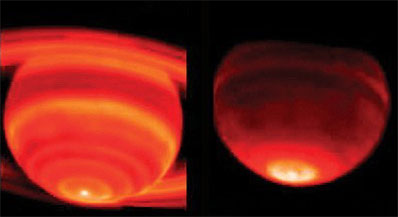
False-color mosaics of Saturn's infrared heat emission taken with the Keck I telescope. Credit: W. M. Keck Observatory/NASA/JPL-G. Orton
Download larger image version here
|
More details may be forthcoming from an infrared spectrometer on the joint
NASA/ESA Cassini mission which is currently orbiting Saturn. The
Composite Infrared Spectrometer (CIRS) measures continuous spectral
information spanning the same wavelengths as the Keck observations, but
the two experiments are expected to complement each other. Between March
and May in 2005, the CIRS instrument on Cassini will be able to look at
the south polar region in detail for the first time. The discovery of the
hot spot at Saturn's south pole has prompted the CIRS science team, one of
whom is Dr. Orton, to spend more time looking at this area.
"One of the obvious questions is whether Saturn's north pole is
anomalously cold and whether a cold polar vortex has been established
there," added Dr. Orton. "This is a question that can only be answered by
the Cassini's CIRS experiment in the near term, as this region can not be
seen from Earth using ground-based instruments."
Observations of Saturn were taken in the imaging mode of the Keck Long
Wavelength Spectrometer (LWS) on February 4, 2004. Images were obtained
at 8.00 microns, which is sensitive to stratospheric methane emission, and
also at 17.65 and 24.5 microns, which is sensitive to temperatures at
various layers in Saturn's upper troposphere. The full image of the
planet was mosaicked from many sets of individual exposures.
Future work observing Saturn will include more high-resolution thermal
imaging of Saturn, particularly due to the fact that the larger polar
vortex region may change in the next few years. The team has also
discovered other phenomena which could be time dependent and are best
characterized by imaging instruments at Keck, such as a series of
east-west temperature oscillations, most prominently near 30 degrees
south. These effects appear to be unrelated to anything in Saturn's
relatively featureless visible cloud system, but the variability is
reminiscent of east-west temperature waves in Jupiter which move very
slowly compared to the rapid jets tracked by cloud motions.
Funding for this research was provided by NASA's Office of Space Sciences
and Applications, Planetary Astronomy Discipline, and the NASA Cassini
project. The Cassini-Huygens mission is a cooperative project of NASA,
the European Space Agency and the Italian Space Agency. The Jet
Propulsion Laboratory, a division of the California Institute of
Technology in Pasadena, manages the Cassini-Huygens mission for NASA's
Science Mission Directorate, Washington, D.C.
The W.M. Keck Observatory is operated by the California Association for
Research in Astronomy, a non-profit scientific partnership of the
California Institute of Technology, the University of California, and
NASA.
|
|
|
|
|