Spaceflight Now +
|
|
|
|
|

Premium video content for our Spaceflight Now Plus subscribers.
External tank arrives
 The external tank for space shuttle Discovery's return-to-flight launch arrives at Kennedy Space Center. The tank is offloaded from the barge and moved into the Vehicle Assembly Building. (3min 15sec file) The external tank for space shuttle Discovery's return-to-flight launch arrives at Kennedy Space Center. The tank is offloaded from the barge and moved into the Vehicle Assembly Building. (3min 15sec file)
 Play video Play video
Shuttle news conference
 Senior space shuttle program officials hold a news conference at Kennedy Space Center on Jan. 6 following delivery of the redesigned external fuel tank to be used on the return-to-flight launch. (51min 47sec file) Senior space shuttle program officials hold a news conference at Kennedy Space Center on Jan. 6 following delivery of the redesigned external fuel tank to be used on the return-to-flight launch. (51min 47sec file)
Play video
Tank leaves New Orleans
 The redesigned external fuel tank to be used on the return-to-flight space shuttle launch is rolled out of the Michoud Assembly Facility and place on a barge for shipment from New Orleans to Kennedy Space Center. (1min 29sec file) The redesigned external fuel tank to be used on the return-to-flight space shuttle launch is rolled out of the Michoud Assembly Facility and place on a barge for shipment from New Orleans to Kennedy Space Center. (1min 29sec file)
Play video
Final touches
 Technicians put the final touches on the Lockheed Martin-built space shuttle external fuel tank in advance of its shipment to the Cape. (1min 44sec file) Technicians put the final touches on the Lockheed Martin-built space shuttle external fuel tank in advance of its shipment to the Cape. (1min 44sec file)
Play video
Mars rover cake
 NASA Administrator Sean O'Keefe is presented with a commemorative birthday cake marking the one-year anniversary of the Mars rover Spirit's landing. (1min 21sec file) NASA Administrator Sean O'Keefe is presented with a commemorative birthday cake marking the one-year anniversary of the Mars rover Spirit's landing. (1min 21sec file)
Play video
Rover news briefing
 On the one-year anniversary of Spirit's landing on Mars, mission officials hold a status news conference on the twin exploration rovers to discuss the latest findings and future plans for the craft. (31min 20sec file) On the one-year anniversary of Spirit's landing on Mars, mission officials hold a status news conference on the twin exploration rovers to discuss the latest findings and future plans for the craft. (31min 20sec file)
Play video
NASA chief speech
 During celebrations marking the Mars rover milestone on Jan. 3, NASA Administrator Sean O'Keefe gave this speech at the Jet Propulsion Laboratory. (10min 20sec file) During celebrations marking the Mars rover milestone on Jan. 3, NASA Administrator Sean O'Keefe gave this speech at the Jet Propulsion Laboratory. (10min 20sec file)
Play video
The Mars rover story
 Storyteller Syd Lieberman presents "Twelve Wheels on Mars" that describes the adventure to build, launch and explore with the Mars rovers Spirit and Opportunity. (54min 57sec file) Storyteller Syd Lieberman presents "Twelve Wheels on Mars" that describes the adventure to build, launch and explore with the Mars rovers Spirit and Opportunity. (54min 57sec file)
Play video
Delta 4-Heavy launch
 The Boeing Delta 4-Heavy rocket is launched from Cape Canaveral on its demonstration flight. (4min 35sec file) The Boeing Delta 4-Heavy rocket is launched from Cape Canaveral on its demonstration flight. (4min 35sec file)
Play video
Onboard the Heavy
 An onboard camera records the launch of Boeing's Delta 4-Heavy rocket from liftoff through separation of the outer boosters. (4min 40sec file) An onboard camera records the launch of Boeing's Delta 4-Heavy rocket from liftoff through separation of the outer boosters. (4min 40sec file)
Play video
Become a subscriber
More video
|
|
|
|
|
|
Site picked in Hawaii for new solar observatory
NATIONAL SOLAR OBSERVATORY NEWS RELEASE
Posted: January 8, 2005
Plans for the world's largest solar optical telescope moved forward Jan. 6 when the board of directors of the Association of Universities for Research in Astronomy (AURA), endorsed recommendations to build the 4-meter (13-ft) Advanced Technology Solar Telescope (ATST) at Haleakala, Maui, Hawaii.
| |
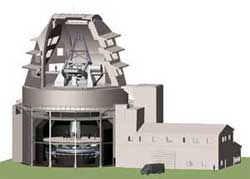
An artist's drawing shows the ATST Observatory Facility. Source: NSO
|
ATST, an international project led by the National Science Foundation's
National Solar Observatory (NSO), will become the world's most powerful
solar optical telescope when it starts operating around 2012. AURA
operates the NSO under a cooperative agreement with the NSF. Principal
partners on ATST are the University of Hawaii, the University of Chicago,
the New Jersey Institute of Technology, and the High Altitude Observatory.
Haleakala is home to the University of Hawaii's Institute for Astronomy
and the Mees Solar Observatory. Other partners include the National
Aeronautics and Space Administration and the U.S. Air Force.
"The Advanced Technology Solar Telescope will be the world's premier
observatory for studying the detailed processes that occur on the Sun,"
said Dr. William Smith, AURA's president. "It is therefore appropriate
that we have chosen a premier site that will host this facility."
Dr. Rolf-Peter Kudritzki, director of the IfA, announced that the ATST
project is moving forward to undertake a joint State/Federal Environmental
Impact Statement at Haleakala, and that the ATST project is identified as
a potential new facility in the University of Hawaii, Institute for
Astronomy's Haleakala Observatory Long Range Development Plan.
Selection of Haleakala follows almost three years of studies that started
with 70 potential sites. The final selection was then based on extensive
surveys at six of the 70 sites and narrowed to three finalist sites:
Haleakala, Big Bear Lake, CA and La Palma in the Canary Islands of Spain.
The ATST Science Working Group recommended Haleakala as the prime
candidate in October 2004. The NSO's Solar Observatory Council endorsed
the recommendation in December and forwarded it to the AURA board.
"A range of seeing conditions, including those needed to study the faint
corona, makes Haleakala an excellent site," said Dr. Stephen Keil, NSO's
director and the ATST principal investigator. "The ATST site selection and
the ATST design represent the work of a large segment of the U.S. and
international solar communities. The major scientific goals of observing
and understanding magnetic fields at their fundamental spatial and
temporal scales at all heights in the solar atmosphere are best fulfilled
on Haleakala."
By combining a large aperture with advances in adaptive optics to correct
for atmospheric blurring, ATST will measure the structure and evolution of
solar magnetic structures at much finer spatial and temporal scales than
is possible with existing telescopes. Most important, ATST will be able to
measure these structures both on the bright disk and in the faint corona,
and from near ultraviolet through out to the relatively unexplored thermal
infrared part of the spectrum.
Few astrophysical research disciplines are as directly relevant to life on
Earth as understanding and perhaps predicting variations in solar
activity. These variations impact humanity with events ranging from
disrupted satellite communications to global changes in Earth's climate.
ATST is the tool to measure the fine-scale magnetism that drives solar
activity.
|
|
|
|
|