Spaceflight Now +
|
|
|
|
|

Premium video content for our Spaceflight Now Plus subscribers.
Soyuz docking
 The Russian Soyuz TMA-5 capsule successfully docks to the International Space Station, delivering the Expedition 10 crew for its half-year mission. (3min 21sec file) The Russian Soyuz TMA-5 capsule successfully docks to the International Space Station, delivering the Expedition 10 crew for its half-year mission. (3min 21sec file)
 Play video Play video
Docking in full
 This longer-length broadband clip follows the Soyuz TMA-5 capsule's approach and docking to the station's Pirs module. (8min 47sec file) This longer-length broadband clip follows the Soyuz TMA-5 capsule's approach and docking to the station's Pirs module. (8min 47sec file)
Play video
Post-docking news conference
 Russian and U.S. space officials hold a post-docking press conference from the mission control center outside Moscow. (23min 04sec file) Russian and U.S. space officials hold a post-docking press conference from the mission control center outside Moscow. (23min 04sec file)
Play video
Launch of Expedition 10
 The Russian Soyuz rocket blasts off from Baikonur Cosmodrome carrying the Expedition 10 crew International Space Station for a six-month mission. (2min 25sec file) The Russian Soyuz rocket blasts off from Baikonur Cosmodrome carrying the Expedition 10 crew International Space Station for a six-month mission. (2min 25sec file)
Play video
Launch in full
 This longer-length broadband clip follows the launch of Expedition 10 from the final minute of the countdown through deployment of the Soyuz capsule from the third stage. (10min 15sec file) This longer-length broadband clip follows the launch of Expedition 10 from the final minute of the countdown through deployment of the Soyuz capsule from the third stage. (10min 15sec file)
Play video
The State Commission
 The State Commission hears from senior Russian and American officials before giving final approval to launch Expedition 10 to the International Space Station. (13min 46sec file) The State Commission hears from senior Russian and American officials before giving final approval to launch Expedition 10 to the International Space Station. (13min 46sec file)
Play video
Become a subscriber
More video
|
|
|
|
|
|
European probe on track for its Moon encounter
EUROPEAN SPACE AGENCY NEWS RELEASE
Posted: October 18, 2004
From October 10 to 14, the ion engine of Euoprean Space Agency's SMART-1 carried out a continuous thrust manoeuvre in a last major push that will get the spacecraft to the Moon capture point on November 13.
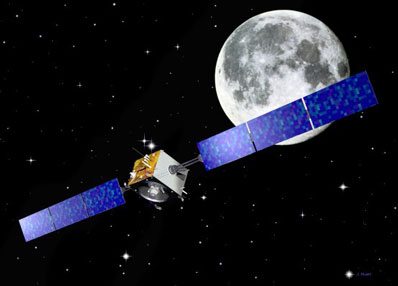
An artist's concept of SMART 1 and its destination -- our moon. Credit: ESA
|
SMART-1, on its way to the Moon, has now covered more than 80 million kilometres. Its journey started on September 27, 2003, when the spacecraft was launched on board an Ariane 5 rocket from Europe's spaceport in Kourou, French Guiana. Since then, it has been spiralling in progressively larger orbits around Earth, to eventually be captured by the lunar gravity and enter into orbit around the Moon in November this year.
The SMART-1 mission was designed to pursue two main objectives. The first is purely technological: to demonstrate and test a number of space techniques to be applied to future interplanetary exploration missions. The second goal is scientific, mainly dedicated to lunar science. It is the technology demonstration goal, in particular the first European flight test of a solar-powered ion engine as a spacecraft's main propulsion system, that gave shape to the peculiar route and duration (13 months) of the SMART-1 journey to the Moon.
The long spiralling orbit around Earth, which is bringing the spacecraft closer and closer to the Moon, is needed for the ion engine to function and be tested over a distance comparable to that a spacecraft would travel during a possible interplanetary trip. The SMART-1 mission is also
testing the response of a spacecraft propelled by such an engine during gravity-assisted manoeuvres. These are techniques currently used on interplanetary journeys, which make use of the gravitational pull of celestial objects (e.g. planets) for the spacecraft to gain acceleration and reach its final target while saving fuel.
In SMART-1's case, the Moon's gravitational pull has been exploited in three "lunar resonance" manoeuvres. The first two successfully took place in August and September 2004. The last resonance manoeuvre was on October 12, during the last major ion engine thrust, which lasted nearly five days, from October 10 to 14. Thanks to this final thrust, SMART-1 will make two more orbits around Earth without any further need to switch on the engine, apart from minor trajectory correction if needed. The same thrust will allow the spacecraft to progressively fall into the natural sphere of attraction of the Moon and start orbiting around it from 13 November, when it is 60 000 kilometres from the lunar surface.
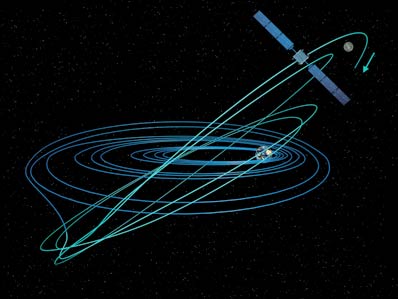
This illustration shows SMART 1 maneuvering from Earth to the Moon. Credit: ESA
|
SMART-1 will reach its first perilune (initial closest distance from the lunar surface) on November 15, while the ion engine is performing its first and major thrust in orbit around the Moon. After that it will continue orbiting around the Moon in smaller loops until it reaches its final operational orbit (spanning between 3000 and 300 kilometres over the Moon's poles) in mid-January 2005. From then, for six months Smart-1 will start the first comprehensive survey of key chemical elements on the lunar surface and will investigate the theory of how the Moon was formed.
|
|
|
|
|