Spaceflight Now +
|
|
|
|
|

Premium video content for our Spaceflight Now Plus subscribers.
Shuttle engine tested
 One of the three liquid-fueled main engines that will power Discovery into orbit during the space shuttle return-to-flight mission is test-fired at Stennis Space Center. (2min 57sec file) One of the three liquid-fueled main engines that will power Discovery into orbit during the space shuttle return-to-flight mission is test-fired at Stennis Space Center. (2min 57sec file)
 Play video Play video
Delta 4-Heavy preview
 Preview what a Boeing Delta 4 rocket launch will be like with this animation package of a "Heavy" configuration vehicle. (1min 41sec file) Preview what a Boeing Delta 4 rocket launch will be like with this animation package of a "Heavy" configuration vehicle. (1min 41sec file)
Play video
Rover's stuck RAT
 A problem with the Opportunity rover's Rock Abrasion Tool is explained in detailed by JPL mission manager Chris Salvo. (4min 14sec file) A problem with the Opportunity rover's Rock Abrasion Tool is explained in detailed by JPL mission manager Chris Salvo. (4min 14sec file)
Play video
New water clues
 Spirit's examination of rock outcropping at Gusev Crater has yielded new clues about the history of water there, as explained by Doug Ming, a rover science team member from Johnson Space Center. (5min 59sec file) Spirit's examination of rock outcropping at Gusev Crater has yielded new clues about the history of water there, as explained by Doug Ming, a rover science team member from Johnson Space Center. (5min 59sec file)
Play video
Spirit on a hill
 A stunning new picture from the Mars rover Spirit taken from the hillside shows the sweeping plains of Gusev and the crater's rim on the distant horizon. Expert narration is provided by Steve Squyres, the rover lead scientist. (1min 22sec file) A stunning new picture from the Mars rover Spirit taken from the hillside shows the sweeping plains of Gusev and the crater's rim on the distant horizon. Expert narration is provided by Steve Squyres, the rover lead scientist. (1min 22sec file)
Play video
Update on Opportunity
 Steve Squyres, the rover lead scientist, descibes Opportunity's ongoing work inside Endurance Crater and narrates new pictures that includes clouds moving across the Martian sky. (5min 50sec file) Steve Squyres, the rover lead scientist, descibes Opportunity's ongoing work inside Endurance Crater and narrates new pictures that includes clouds moving across the Martian sky. (5min 50sec file)
Play video
Latest Mars briefing
 Scientists and mission officials explain the latest findings and exploration by the Spirit and Opportunity rovers during this news conference on August 18. (49min 40sec file) Scientists and mission officials explain the latest findings and exploration by the Spirit and Opportunity rovers during this news conference on August 18. (49min 40sec file)
Play video
Ship docks to station
 The Russian Progress 15P resupply ship makes a fully automated rendezvous and docking with the International Space Station. An external camera on the craft provides this view of the final approach to the aft port of the Zvezda service module. (3min 49sec file) The Russian Progress 15P resupply ship makes a fully automated rendezvous and docking with the International Space Station. An external camera on the craft provides this view of the final approach to the aft port of the Zvezda service module. (3min 49sec file)
Play video
Become a subscriber
More video
|
|
|
|
|
|
Deepest image of exploded star uncovers bipolar jets
NASA NEWS RELEASE
Posted: August 23, 2004
A spectacular new image of Cassiopeia A released today from NASA's Chandra X-ray Observatory has nearly 200 times more data than the "First Light" Chandra image of this object made five years ago. The new image reveals clues that the initial explosion, caused by the collapse of a massive star, was far more complicated than suspected.
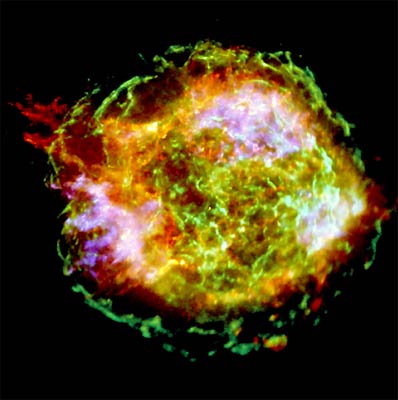
This spectacular image of the supernova remnant Cassiopeia A is the most detailed image ever made of the remains of an exploded star. The one million second image shows a bright outer ring (green) ten light years in diameter that marks the location of a shock wave generated by the supernova explosion. A large jet-like structure that protrudes beyond the shock wave can be seen in the upper left. In this image, the colors represent different ranges of X-rays with red, green, and blue representing, low, medium, and higher X-ray energies. Credit: NASA/CXC/GSFC/U.Hwang et al.
|
"Although this young supernova remnant has been intensely
studied for years, this deep observation is the most detailed
ever made of the remains of an exploded star," said Martin
Laming of the Naval Research Laboratory, Washington. Laming
is part of a team of scientists led by Una Hwang of NASA's
Goddard Space Flight Center, Greenbelt, Md. "It is a gold
mine of data that astronomers will be panning through for
years to come," he added.
The 1 million-second (about 11.5-day) observation of
Cassiopeia A uncovered two large, opposed jet-like structures
that extend to about 10 light-years from the center of the
remnant. Clouds of iron that have remained nearly pure for
the approximately 340 years since the explosion also were
detected.
"The presence of the bipolar jets suggests that jets could be
more common in relatively normal supernova explosions than
supposed by astronomers," said Hwang. A paper by Hwang,
Laming and others on the Cassiopeia A observation will appear
in an upcoming issue of The Astrophysical Journal Letters.
X-ray spectra show that the jets are rich in silicon atoms
and relatively poor in iron atoms. In contrast, fingers of
almost-pure iron gas extend in a direction nearly
perpendicular to the jets. This iron was produced in the
central, hottest regions of the star.
The high silicon and low iron abundances in the jets indicate
that massive, matter-dominated jets were not the immediate
cause of the explosion, as these should have carried out
large quantities of iron from the central regions of the
star.
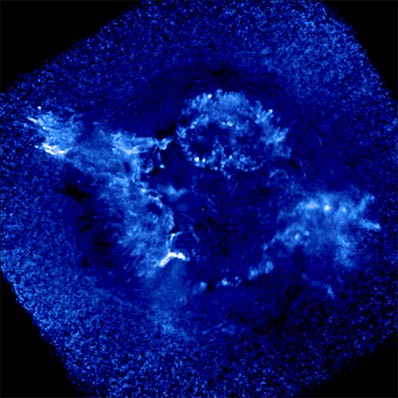
This image shows the ratio of the intensity of the X-radiation from silicon ions with two orbital electrons to the intensity of X-radiation at slightly lower energies, which is due primarily to magnesium and iron ions. The image highlights the jet and counterjet traced by silicon X-ray emission. Credit: NASA/CXC/GSFC/U.Hwang et al.
|
A working hypothesis is that the explosion produced high-
speed jets similar to those in hypernovae that produce gamma-
ray bursts, but in this case, with much lower energies. The
explosion also left a faint neutron star at the center of the
remnant.
Unlike the rapidly rotating neutron stars in the Crab Nebula
and Vela supernova remnants that are surrounded by dynamic
magnetized clouds of electrons, this neutron star is quiet
and faint. Nor has pulsed radiation been detected from it. It
may have a very strong magnetic field generated during the
explosion that helped to accelerate the jets, and today
resembles other strong-field neutron stars (a.k.a.
"magnetars") in lacking a wind nebula.
Chandra was launched July 23, 1999, aboard the Space Shuttle
Columbia. Less than a month later, it was able to start
taking science measurements along with its calibration data.
The original Cassiopeia A observation was taken August 19,
1999, and released to the scientific community and the public
one week later. At launch, Chandra's original mission was
intended to be five years. Last August NASA announced that
the mission, having successfully completed that objective,
would be extended for another five years.
The data for this new Cassiopeia A image were obtained by
Chandra's Advanced Charged Coupled Device Imaging
Spectrometer (ACIS) instrument during the first half of 2004.
Due to its value to the astronomical community, this rich
dataset was made available immediately to the public.
NASA's Marshall Space Flight Center, Huntsville, Ala.,
manages the Chandra program for the NASA Science Mission
Directorate, Washington. Northrop Grumman of Redondo Beach,
Calif., formerly TRW, Inc., was the prime development
contractor for the observatory. The Smithsonian Astrophysical
Observatory controls science and flight operations from the
Chandra X-ray Center in Cambridge, Mass.
|
|
|
|
|