|
|
|

|
|
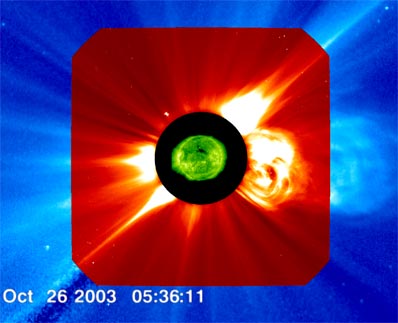
Space probes track blast wave through solar system NASA NEWS RELEASE Posted: July 8, 2004 A fleet of spacecraft dispersed throughout the solar system gave the best picture to date of the effects of blast waves from solar storms as they propagate through the solar system.
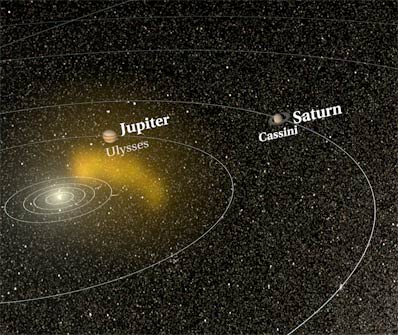
No NASA satellites near Earth were severely damaged by the storms. The International Space Station astronauts curtailed some of their activities and took shelter in the Russian- supplied Service Module several times during the storm. Because this kind of event will have significant implications for radiation protection requirements for explorers who venture outside the Earth's protective magnetosphere (magnetic field), scientists have been working for years to develop the capability to predict when these massive storms will erupt. "Over many decades, improvements in weather forecasting have saved lives and property. Space weather forecasting is still in development, but is needed to better protect our space infrastructure and future human and robotic explorers," said Carl Walz, Astronaut and Program Executive for Advanced Concepts and Project Prometheus at NASA Headquarters, Washington. The storms rocked the inner solar system from Mars to Saturn. The Mars Radiation Environment Experiment (MARIE) instrument on the Mars Odyssey spacecraft orbiting Mars was disabled by radiation. The Ulysses spacecraft near Jupiter and the Cassini spacecraft near Saturn both detected radio waves from magnetic storms generated as the blast wave slammed into the vast magnetic fields around those giant planets.
The most recent reports come from the Voyagers, which are near an unexplored region where the solar wind becomes turbulent as it crashes into the thin gas between stars. Slowing as it plowed into the outer heliosphere (a large bubble of space around the sun which is "blown up" by fast- moving solar wind), the blast wave reached Voyager 2 at seven billion miles (11 billion kilometers) from the sun on April 28 and continued toward Voyager 1 at almost nine billion miles (14.5 billion km) from the sun. There are at least two kinds of solar storm effects: prompt radiation, and shocks that accelerate electrically charged (ionized) atomic particles. The prompt radiation travels at nearly the speed of light, causes the most severe electrical effects on satellites, and has the greatest impact on long- distance radio communications. The prompt radiation was detected in radio waves throughout the solar system after each storm. The shocks that accelerate particles to millions of miles per hour take a little longer to develop, but they pack the biggest wallop to the aurora, power grids and energetic particles that become trapped in Earth's radiation belts. These storms created a new radiation belt near Earth that lasted for several weeks. The shocks created by the storms in the inner solar system not only accelerated electrons and protons to high energy, they also trapped the particles in the inner heliosphere. This resulted in elevated radiation levels everywhere between Venus and Mars that decayed gradually over a period of weeks. The widely dispersed spacecraft are helping scientists piece together a more comprehensive picture of how disturbances propagate through the solar system. What determines the evolving shape and variable speed with which the shocks travel in different directions is not well understood. The differences in the speeds and arrival times at Mars and Earth suggest that the process is not simple. The sun's magnetic field also affects how well connected different places in the solar system are. Understanding how particle-accelerating shocks travel through the solar system will help us understand and predict how radiation levels will change in different locations in space. In the months ahead, the blast wave will crash into the heliopause, the tangible edge of the heliosphere, where the material ejected by the sun piles up against the wind from nearby stars. The collision may generate extremely low- frequency radio signals that will give us a much more accurate understanding of the size of the sun's domain. The energy carried by the material will push the interstellar gas outward by as much as 400 million miles (640 million km), about 4 times the distance from the sun to the Earth. |
|
|
|
 |
||||||||||||||||||||||||||||||||||||||||||
 Scientists reveal stunning pictures of Saturn's moon Titan and other results during this news conference from July 3. (38min 17sec file)
 Cassini's stunning close-up images of the rings around Saturn, taken just after the craft entered orbit Thursday morning, are presented with expert narration by Carolyn Porco, the mission imaging team leader. (8min 39sec file)
 Mission control erupts in applause as communications from Cassini confirm the orbit insertion burn has begun. (60sec file)
 Signals from Cassini announce the conclusion of the Saturn orbit insertion burn, confirming the spacecraft has arrived at the ringed planet. (2min 15sec file)
 Mission officials hold a post-orbit insertion burn news conference at 1 a.m. EDT July 1 to discuss Cassini's successful arrival at Saturn. (25min 27sec file)
 Officials from the U.S., European and Italian space agencies discuss the international cooperation in the Cassini mission and future exploration projects during this news conference from 2 p.m. EDT June 30. (19min 35sec file)
 This informal "ring-side chat" from 5 p.m. EDT June 30 discusses the Cassini mission to Saturn and the future of space exploration. (49min 20sec file)