|
|
|

|
|
Great Observatories uncover black holes & hidden objects NASA NEWS RELEASE Posted: June 1, 2004 Astronomers unveiled the deepest images from NASA's new Spitzer Space Telescope today and announced the detection of distant objects -- including several supermassive black holes -- that are nearly invisible in even the deepest images from telescopes operating at other wavelengths.
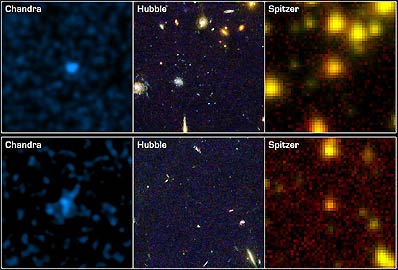
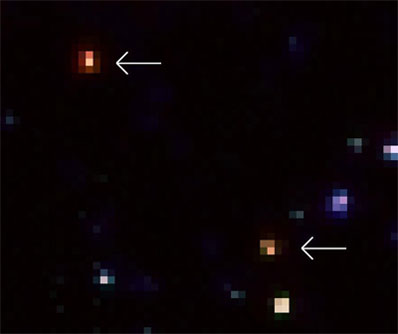
Seven of the objects detected by Spitzer may be part of the long-sought population of "missing" supermassive black holes that powered the bright cores of the earliest active galaxies. The discovery completes a full accounting of all the X-ray sources seen in one of the deepest surveys of the universe ever taken. This detective story required the combined power of NASA's three Great Observatories -- the Hubble Space Telescope, Chandra X-ray Observatory and Spitzer Space Telescope. Each observatory studies different wavelengths, from high-energy X-rays with Chandra, through visible light with Hubble, and into the infrared with Spitzer. Together, these telescopes yield far more information than any single instrument. All three telescopes looked as far as 13 billion light-years away, toward a small patch of the southern sky containing more than 10,000 galaxies, in a coordinated project called the Great Observatories Origins Deep Survey (GOODS). Chandra images detected more than 200 X-ray sources believed to be supermassive black holes in the centers of young galaxies. Extremely hot interstellar gases falling into the black holes produce the X-rays. Hubble's Advanced Camera for Surveys revealed optical galaxies around almost all the X-ray black holes. However, seven mysterious X-ray sources remained for which there was no optical galaxy. Dr. Anton Koekemoer of the Space Telescope Science Institute, Baltimore, Md., discovered these sources and has three intriguing possibilities for their origin: "The galaxies around these black holes may be completely hidden by thick clouds of dust absorbing all their light, or may contain very old, red stars. Or some could be the most distant black holes ever observed -- perhaps as far as 13 billion light-years." If so, all their optical light would be shifted to very long infrared wavelengths by expansion of the universe. Scientists eagerly awaited the Spitzer images to solve this puzzle. Because Spitzer observes at infrared wavelengths up to 100 times longer than those probed by Hubble, Spitzer might be able to see the otherwise invisible objects. Indeed, the very first Spitzer images of these objects, obtained earlier this year, immediately revealed the telltale infrared glow from the host galaxies around all the missing X-ray black holes. Three of Koekemoer's galaxies are extremely "red," or bright, in infrared. The Spitzer data, together with new images at shorter infrared wavelengths from the Very Large Telescope at the European Southern Observatory, indicate that the galaxies around these black holes could be heavily obscured by dust, and perhaps more distant than other known dust-obscured galaxies. Some of the other objects, however, have quite different colors, and are even more intriguing. "Their colors may be consistent with objects more distant than any now known," said Dickinson, who cautioned that additional Spitzer observations later this year will help confirm what kind of objects these might be. Old Galaxies Shine in Infrared: In another study using the same Spitzer data, Dr. Haojing Yan of the California Institute of Technology, Pasadena, Calif., studied 17 unusual galaxies near the Hubble Ultra Deep Field. This small patch of sky within the GOODS area was recently the target for the deepest optical images ever taken with Hubble's Advanced Camera. The Deep Field optical images, released in March 2004, reach more than five times fainter than the GOODS Hubble data. But even with that phenomenal sensitivity, two of the 17 Spitzer-selected objects remain completely invisible in optical light, while the others are only faintly detected. Yan finds that these galaxies get steadily brighter at longer wavelengths, and seem to be more distant cousins of the so-called "Extremely Red Objects," known from previous deep surveys. Most are distant galaxies that are red because they are either old or dusty. These new Spitzer-identified objects, however, appear to lie farther away to a time when the universe was only two billion years old.
Black Holes In Hiding: Using Hubble and Chandra data, Dr. Meg Urry, a GOODS astronomer at Yale University, New Haven, Conn., and her team suggest that most accreting black holes are hidden at visible wavelengths, even in the early universe. Few such hidden black holes had previously been found at such large distances, despite theoretical arguments for their existence. They were missed because their visible radiation is so dim they look like faint, ordinary galaxies. "With the new Spitzer data these very luminous, distant objects are easily visible," said Urry. "The great sensitivity of the new Spitzer infrared cameras, combined with the superb spatial resolution of Chandra, means that finding all of the black holes that are powered by infalling gas is now possible." Urry's team is using data from the three space observatories to take a census of the supermassive black holes that formed two to five billion years after the big bang. Most of these active galactic nuclei are hidden by dust, which absorbs visible and some X-ray light but emits strongly at infrared wavelengths. "The Spitzer GOODS observations verify that large numbers - perhaps three-quarters - of the obscured active galactic nuclei were indeed present in the early universe. The longer-wavelength Spitzer data still to come will reveal even more shrouded active galactic nuclei," said Urry, "including some, missed by X-ray observations, which look like ultraluminous infrared galaxies."
|
|
|
|
 |
|||||||||||||||||||||||||||||||||||||||||||
 Ride along with the Progress 14P resupply ship as it makes the final approach and docking to the International Space Station on May 27 as seen by a camera mounted on the craft's nose. (9min 02sec file)
 Scientists present new discoveries from the Spitzer Space Telescope, including their findings of raw ingredients for life detected around young stars. (53min 03sec file)
 The Expedition 9 crew describes their upcoming spacewalk in Russian spacesuits, life aboard the space station and the view of Earth in this interview with Bill Harwood of CBS News. (20min 19sec file)
 The Progress 13P cargo ship departs the International Space Station on May 24 carrying trash and unneeded items to burn up in the atmosphere. (2min 56sec file)
 The Associated Press interviews the two-man Expedition 9 crew living aboard the International Space Station on May 24. (9min 36sec file)
 The Lockheed Martin Atlas 2AS rocket launches from Cape Canaveral carryin the AMC-11 communications satellite. (4min 30sec file)