Spaceflight Now +
|
|
|
|
|
Premium video content for our Spaceflight Now Plus subscribers.
Changing NASA's culture
 Administrator Sean O'Keefe holds a discussion with agency workers around the country about organizational culture change at NASA. (56min 12sec file) Administrator Sean O'Keefe holds a discussion with agency workers around the country about organizational culture change at NASA. (56min 12sec file)
 Play video Play video
Yuri Gagarin
 Historical footage documents the flight of cosmonaut Yuri Gagarin, the first human in space. (2min 25sec file) Historical footage documents the flight of cosmonaut Yuri Gagarin, the first human in space. (2min 25sec file)
Play video
Cosmonautics Day
 Expedition 8 crewmembers Michael Foale and Alexander Kaleri celebrate Cosmonautics Day aboard the International Space Station. (3min 07sec file) Expedition 8 crewmembers Michael Foale and Alexander Kaleri celebrate Cosmonautics Day aboard the International Space Station. (3min 07sec file)
Play video
Mars rover briefing
 Officials discuss the extended missions for the Mars rovers and present the latest pictures at this briefing from Thursday, April 8. (34min 10sec file) Officials discuss the extended missions for the Mars rovers and present the latest pictures at this briefing from Thursday, April 8. (34min 10sec file)
Play video
Gravity Probe-B preview
 Scientists and mission officials preview the Gravity Probe-B project in this pre-flight news briefing from Friday, April 2. (62min 25sec file) Scientists and mission officials preview the Gravity Probe-B project in this pre-flight news briefing from Friday, April 2. (62min 25sec file)
Play video
NEW! X-43A in infrared
 This newly-released infrared video, captured by a U.S. Army aircraft tracking the launch, shows the X-43A research vehicle flying away from its Pegasus rocket booster. This newly-released infrared video, captured by a U.S. Army aircraft tracking the launch, shows the X-43A research vehicle flying away from its Pegasus rocket booster.
Play video
NEW! Aboard Pegasus
 A camera mounted on the Pegasus rocket booster shows the X-43A research vehicle separating to perform its scramjet experiment over the Pacific Ocean. A camera mounted on the Pegasus rocket booster shows the X-43A research vehicle separating to perform its scramjet experiment over the Pacific Ocean.
Play video
More clips
This date in history
 On April 5, 1991, space shuttle Atlantis lifted off from Kennedy Space Center carrying the Compton Gamma Ray Observatory -- NASA's second Great Observatory. (3min 15sec file) On April 5, 1991, space shuttle Atlantis lifted off from Kennedy Space Center carrying the Compton Gamma Ray Observatory -- NASA's second Great Observatory. (3min 15sec file)
Play video
Become a subscriber
More video
|
|
|
|
|
|
Hubble observes planetoid Sedna as mystery deepens
NASA NEWS RELEASE
Posted: April 14, 2004
Astronomers poring over 35 NASA Hubble Space Telescope images of the solar system's farthest known object, unofficially named Sedna, are surprised that the object does not appear to have a companion moon of any substantial size.
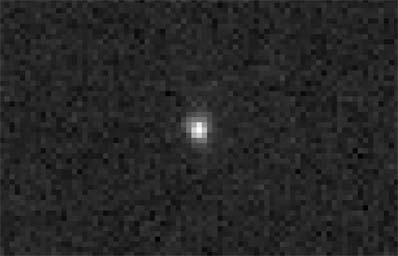
At a distance of over 8 billion miles, Sedna is so far away it is reduced to one picture element (pixel) in this image taken in high-resolution mode with Hubble's Advanced Camera for Surveys. Credit: NASA, ESA and M. Brown (Caltech)
|
This unexpected result might offer new clues to the origin and
evolution of objects on the far edge of the solar system.
When Sedna's existence was announced on March 15, its discoverer,
Mike Brown of Caltech, was so convinced it had a satellite that
an artist's concept of Sedna released to the media included a
hypothetical moon.
Brown's prediction was based on the fact that Sedna appears to
have a very slow rotation that could best be explained by the
gravitational tug of a companion object. Almost all other
solitary bodies in the solar system complete a spin in a matter
of hours.
"I'm completely baffled at the absence of a moon," says Brown.
"This is outside the realm of expectation and makes Sedna even
more interesting. But I simply don't know what it means."
Immediately following the announcement of the discovery of Sedna,
astronomers turned the Hubble Space Telescope toward the new
planetoid to search for the expected companion moon. The
space-based platform provides the resolving power needed to make
such precision measurements in visible light. "Sedna's image isn't
stable enough in ground-based telescopes," says Brown.
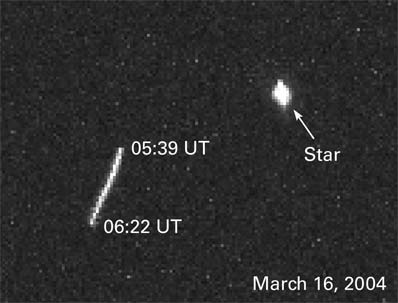
Hubble took a total of 35 images of Sedna on March 16, 2004. The planetoid appeared to move slightly between exposures, due to the motion of Hubble around Earth and the motion of the Earth around the Sun. Sedna, too, is moving through space, but too slowly for that to be seen in these images. The fact that the object shows this parallax shift between exposures demonstrates that Sedna is a member of the solar system, and hence is far closer to the Earth than the background star (at right) in the same field of view. Credit: NASA, ESA and M. Brown (Caltech)
|
Surprisingly, the Hubble images taken March 16 with the new Advanced
Camera for Surveys only show the single object Sedna, along with a
faint, very distant background star in the same field of view.
"Despite HST's crisp view (equivalent to trying to see a soccer ball
900 miles away), it still cannot resolve the disk of mysterious Sedna,"
says Brown. This would place an upper limit in the object's size of
being approximately three-quarters the diameter of Pluto, or about
1,000 miles across.
But Brown predicted that a satellite would pop up as a companion "dot"
in Hubble's precise view. The object is not there, though there is a
very small chance it might have been behind Sedna or transiting in
front of it, so that it could not be seen separately from Sedna itself
in the Hubble images.
Brown based this prediction on his earlier observations of apparent
periodic changes in light reflecting from Sedna's mottled surface. The
resulting light curve gives a long rotation period exceeding 20 days
(but not greater than 50 days). If true, Sedna would be the slowest
rotating object in the solar system after Mercury and Venus, whose slow
rotation rates are due to the tidal influence of the Sun.
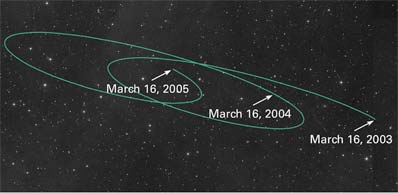
A plot of Sedna's apparent motion through space from 2003 to 2005 easily demonstrates that it is close enough to be part of the solar system. The looping path isn't real, but is caused by the fact that Earth is orbiting the Sun and so "laps" Sedna, like a faster race car, once every year. Credit: NASA, ESA and M. Brown (Caltech)
|
One easy way out of this dilemma is the possibility that the rotation
period is not as slow as the astronomers thought. But even with a
careful reanalysis the team remains convinced that the period is
correct. Brown admits, "I'm completely lost for an explanation as to
why the object rotates so slowly."
Small bodies like asteroids and comets typically complete one rotation
in a matter of hours. Pluto's rotation has been slowed to a relatively
leisurely six-day period because Pluto is tidally locked to the
revolution period of its satellite Charon. Hubble easily resolves Pluto
and Charon as two separate bodies. NASA's forthcoming James Webb Space
Telescope will provide a platform for further high resolution studies
of the infrared light from such distant, cold bodies in our solar system.
The Space Telescope Science Institute (STScI) is operated by the
Association of Universities for Research in Astronomy, Inc. (AURA),
for NASA, under contract with the Goddard Space Flight Center,
Greenbelt, MD. The Hubble Space Telescope is a project of international
cooperation between NASA and the European Space Agency (ESA).
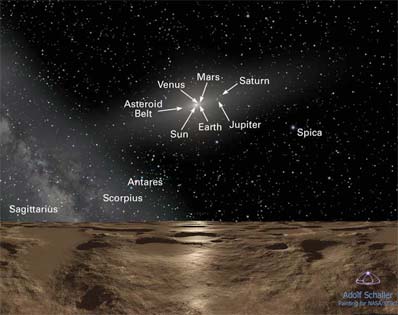
Points of interest in artist's view of Sedna. Credit: Credit: NASA and A. Schaller
|
|
|
|
|

|