New view of Milky Way in gamma rays
EUROPEAN SPACE AGENCY NEWS RELEASE
Posted: November 11, 2003

ESA's gamma-ray observatory Integral is making excellent progress, mapping the Galaxy at key gamma-ray wavelengths. It is now poised to give astronomers their truest picture yet of recent changes in the Milky Way's chemical composition. At the same time, it has confirmed an 'antimatter' mystery at the centre of the galaxy.


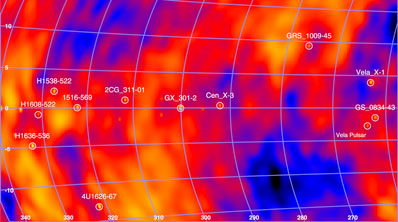
A portion of Integral's gamma-ray map of the galaxy. The yellow dots correspond to bright known gamma-rays sources, whilst blue areas indicate regions of low emission. Credit: ESA/SPI team
 
Since its formation from a cloud of hydrogen and helium gas, around 12,000 million years ago, the Milky Way has gradually been enriched with heavier chemical elements. This has allowed planets and, indeed, life on Earth to form.

Today, one of those heavier elements - radioactive aluminium - is spread throughout the Galaxy and, as it decays into magnesium, gives out gamma rays with a wavelength known as the '1809 keV line.' Integral has been mapping this emission with the aim of understanding exactly what is producing all this aluminium.

In particular, Integral is looking at the aluminium 'hot spots' that dot the Galaxy to determine whether these are caused by individual celestial objects or the chance alignment of many objects.

Astronomers believe that the most likely sources of the aluminium are supernovae (exploding high-mass stars) and, since the decay time of the aluminium is around one million years, Integral's map shows how many stars have died in recent celestial history. Other possible sources of the aluminium include 'red giant' stars or hot blue stars that give out the element naturally.

To decide between these options, Integral is also mapping radioactive iron, which is only produced in supernovae. Theories suggest that, during a supernova blast, aluminium and iron should be produced together in the same region of the exploding star. Thus, if the iron's distribution coincides with that of the aluminium, it will prove that the overwhelming majority of aluminium comes indeed from supernovae.

These measurements are difficult and have not been possible so far, since the gamma-ray signature of radioactive iron is about six times fainter than that of the aluminium. However, as ESA's powerful Integral observatory accumulates more data in the course of the next year, it will finally be possible to reveal the signature of radioactive iron. This test will tell astronomers whether their theories of how elements form are correct.

In addition to these maps, Integral is also looking deeply into the centre of the Galaxy, to make the most detailed map ever of 'antimatter' there.

Antimatter is like a mirror image to normal matter and is produced during extremely energetic atomic processes: for example, the radioactive decay of aluminium. Its signature is known as the '511 keV line.' Even though Integral's observations are not yet complete, they show that there is too much antimatter in the centre of the Galaxy to be coming from aluminium decay alone. They also show clearly that there must be many sources of antimatter because it is not concentrated around a single point.

There are many possible sources for this antimatter. As well as supernovae, old red stars and hot blue stars, there are jets from neutron stars and black holes, stellar flares, gamma-ray bursts and interaction between cosmic rays and the dusty gas clouds of interstellar space.

Chris Winkler, ESA's Integral's Project Scientist, says: "We have collected excellent data in the first few months of activity but we can and will do much more in the next year. Integral's accuracy and sensitivity have already exceeded our expectations and, in the month t come, we could get the answers to some of astronomy's most intriguing questions."

These and other preliminary results, plus a thorough description of the Integral spacecraft and mission are published this month in a dedicated issue of the journal Astronomy and Astrophysics.

At its 105th meeting on October 6, 2003, ESA's Science Programme Committee unanimously decided to extend the Integral mission until December 2008.

The International Gamma Ray Astrophysics Laboratory (Integral) is the first space observatory that can simultaneously observe celestial objects in gamma rays, X-rays and visible light. Integral was launched on a Russian Proton rocket on October 17, 2002 into a highly elliptical orbit around Earth. Its principal targets include regions of the galaxy where chemical elements are being produced and compact objects, such as black holes.

The SPI spectrometer on board Integral measures the energy of incoming gamma rays with extraordinary accuracy. It is more sensitive to faint radiation than any previous gamma ray instrument and allows the precise nature of gamma ray sources to be determined. SPI's Principal Investigators are: J.-P. Roques, (CESR Toulouse, France), V. Schoenfelder (MPE Garching, Germany).

Exploring Mars
Astronomy Now is pleased to announce the publication of Exploring Mars. The very best images of Mars taken by orbiting spacecraft and NASA's Spirit and Opportunity rovers fill up the 98 glossy pages of this special edition!
 Choose your store:
U.S. - U.K. - E.U. - Worldwide

Mars Rover mission patch
A mission patch featuring NASA's Mars Exploration Rover is now available from the Astronomy Now Store.
 Choose your store:
U.S. - U.K. - E.U. - Worldwide

Apollo 11 special patch
Special collectors' patch marking the 35th anniversary of the historic Apollo 11 moon landing is now available.
 Choose your store:
U.S. - U.K. - E.U. - Worldwide

Inside Apollo mission control
An insider's view of how Apollo flight controllers operated and just what they faced when events were crucial.
 Choose your store:
U.S.

The ultimate Apollo 11 DVD
This exceptional chronicle of the historic Apollo 11 lunar landing mission features new digital transfers of film and television coverage unmatched by any other.
 Choose your store:
U.S. - U.K. - E.U. - Worldwide

Next ISS crew
Own a little piece of history with this official patch for the International Space Station's Expedition 11 crew. We'll ship yours today!
 Choose your store:
U.S.

Final Shuttle Mission Patch

Free shipping to U.S. addresses!

The crew emblem for the final space shuttle mission is now available in our store. Get this piece of history!
 U.S. STORE
 WORLDWIDE STORE

STS-134 Patch

Free shipping to U.S. addresses!

The final planned flight of space shuttle Endeavour is symbolized in the official embroidered crew patch for STS-134. Available in our store!
 U.S. STORE
 WORLDWIDE STORE

Ares 1-X Patch
The official embroidered patch for the Ares 1-X rocket test flight, is available for purchase.
 U.S. STORE
 WORLDWIDE STORE

Apollo Collage
This beautiful one piece set features the Apollo program emblem surrounded by the individual mission logos.
 U.S. STORE
 WORLDWIDE STORE

Project Orion
The Orion crew exploration vehicle is NASA's first new human spacecraft developed since the space shuttle a quarter-century earlier. The capsule is one of the key elements of returning astronauts to the Moon.
 U.S. STORE


Fallen Heroes Patch Collection
The official patches from Apollo 1, the shuttle Challenger and Columbia crews are available in the store.
 U.S. STORE
 WORLDWIDE STORE

An insider's view of how Apollo flight controllers operated and just what they faced when events were crucial.
 Choose your store:
U.S.

Columbia Report
A reproduction of the official accident investigation report into the loss of the space shuttle Columbia and its crew of seven.
 Choose your store:
U.S. - U.K. - E.U. - Worldwide

Mars Panorama

DISCOUNTED! This 360 degree image was taken by the Mars Pathfinder, which landed on the Red Planet in July 1997. The Sojourner Rover is visible in the image.
 Choose your store:
U.S.

Apollo 11 Mission Report
Apollo 11 - The NASA Mission Reports Vol. 3 is the first comprehensive study of man's first mission to another world is revealed in all of its startling complexity. Includes DVD!
 Choose your store:
U.S. - U.K. - E.U. - Worldwide

Rocket DVD
If you've ever watched a launch from Kennedy Space Center, Cape Canaveral, Vandenberg Air Force Base or even Kodiak Island Alaska, there's no better way to describe what you witnessed than with this DVD.
 Choose your store:
U.S. - U.K. - E.U. - Worldwide

Gemini 7
Gemini 7: The NASA Mission Reports covers this 14-day mission by Borman and Lovell as they demonstrated some of the more essential facts of space flight. Includes CD-ROM.
 Choose your store:
U.S. - U.K. - E.U. - Worldwide

Apollo patches
The Apollo Patch Collection: Includes all 12 Apollo mission patches plus the Apollo Program Patch. Save over 20% off the Individual price.
 Choose your store:
U.S. - U.K. - E.U. - Worldwide

Mars Rover mission patch
A mission patch featuring NASA's Mars Exploration Rover is available from our online.
 Choose your store:
U.S. - U.K. - E.U. - Worldwide

Apollo 9 DVD
On the road to the moon, the mission of Apollo 9 stands as an important gateway in experience and procedures. This 2-DVD collection presents the crucial mission on the voyage to the moon.
 Choose your store:
U.S. - U.K. - E.U. - Worldwide

Get e-mail updates
Sign up for our NewsAlert service and have the latest news in astronomy and space e-mailed direct to your desktop (privacy note: your e-mail address will not be used for any other purpose).
Enter your e-mail address:

INDEX | PLUS | NEWS ARCHIVE | LAUNCH SCHEDULE
ASTRONOMY NOW | STORE

ADVERTISE

© 2012 Spaceflight Now Inc.