|
 |

|
||||
|
|
||||
|
3D Universe map bolsters case for dark energy, matter SLOAN DIGITAL SKY SURVEY NEWS RELEASE Posted: October 28, 2003
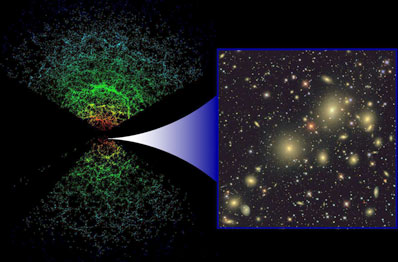
"From the outset of the project in the late 80's, one of our key goals has been a precision measurement of how galaxies cluster under the influence of gravity", explained Richard Kron, SDSS's director and a professor at The University of Chicago. SDSS Project spokesperson Michael Strauss from Princeton University and one of the lead authors on the new study elaborated that: "This clustering pattern encodes information about both invisible matter pulling on the galaxies and about the seed fluctuations that emerged from the Big Bang." The findings are described in two papers submitted to the Astrophysical Journal and to the Physical Review D. The leading cosmological model invokes a rapid expansion of space known as inflation that stretched microscopic quantum fluctuations in the fiery aftermath of the Big Bang to enormous scales. After inflation ended, gravity caused these seed fluctuations to grow into the galaxies and the galaxy clustering patterns observed in the SDSS. Images of these seed fluctuations were released from the Wilkinson Microwave Anisotropy Probe (WMAP) in February, which measured the fluctuations in the relic radiation from the early Universe. "We have made the best three-dimensional map of the Universe to date, mapping over 200,000 galaxies up to two billion light years away over six percent of the sky", said another lead author of the study, Michael Blanton from New York University. The gravitational clustering patterns in this map reveal the makeup of the Universe from its gravitational effects and, by combining their measurements with that from WMAP, the SDSS team measured the cosmic matter to consist of 70 percent dark energy, 25 percent dark matter and five percent ordinary matter. They found that neutrinos couldn't be a major constituent of the dark matter, putting the strongest constraints to date on their mass. Finally, the SDSS research found that the data are consistent with the detailed predictions of the inflation model. These numbers provide a powerful confirmation of those reported by the WMAP team. The inclusion of the new SDSS findings helps to improve measurement accuracy, more than halving the uncertainties from WMAP on the cosmic matter density and on the Hubble parameter (the cosmic expansion rate). Moreover, the new measurements agree well with the previous state-of-the-art results that combined WMAP with the Anglo-Australian 2dF galaxy redshift survey. "Different galaxies, different instruments, different people and different analysis - but the results agree", says Max Tegmark from the University of Pennsylvania, first author on the two papers. "Extraordinary claims require extraordinary evidence", Tegmark says, "but we now have extraordinary evidence for dark matter and dark energy and have to take them seriously no matter how disturbing they seem." "The real challenge is now to figure what these mysterious substances actually are", said another author, David Weinberg from Ohio State University. The SDSS is the most ambitious astronomical survey ever undertaken, with more than 200 astronomers at 13 institutions around the world. "The SDSS is really two surveys in one", explained Project Scientist James Gunn of Princeton University. On the most pristine nights, the SDSS uses a wide-field CCD camera (built by Gunn and his team at Princeton University and Maki Sekiguchi of the Japan Participation Group) to take pictures of the night sky in five broad wavebands with the goal of determining the position and absolute brightness of more than 100 million celestial objects in one-quarter of the entire sky. When completed, the camera was the largest ever built for astronomical purposes, gathering data at the rate of 37 gigabytes per hour. On nights with moonshine or mild cloud cover, the imaging camera is replaced with a pair of spectrographs (built by Alan Uomoto and his team at The Johns Hopkins University). They use optical fibers to obtain spectra (and thus redhsifts) of 608 objects at a time. Unlike traditional telescopes in which nights are parceled out among many astronomers carrying out a range of scientific programs, the special-purpose 2.5m SDSS telescope at Apache Point Observatory in New Mexico is devoted solely to this survey, to operate every clear night for five years. The first public data release from the SDSS, called DR1, contained about 15 million galaxies, with redshift distance measurements for more than 100,000 of them. All measurements used in the findings reported here would be part of the second data release, DR2, which will be made available to the astronomical community in early 2004. Strauss said the SDSS is approaching the halfway point in its goal of measuring one million galaxy and quasar redshifts. "The real excitement here is that disparate lines of evidence from the cosmic microwave background (CMB), large-scale structure and other cosmological observations are all giving us a consistent picture of a Universe dominated by dark energy and dark matter", said Kevork Abazajian of the Fermi National Accelerator Laboratory and the Los Alamos National Laboratory. The Sloan Digital Sky Survey (www.sdss.org) is a joint project of The University of Chicago, Fermilab, the Institute for Advanced Study, the Japan Participation Group, The Johns Hopkins University, the Los Alamos National Laboratory, the Max-Planck-Institute for Astronomy (MPIA), the Max-Planck- Institute for Astrophysics (MPA), New Mexico State University, University of Pittsburgh, Princeton University, the United States Naval Observatory, and the University of Washington. Funding for the project has been provided by the Alfred P. Sloan Foundation,
the Participating Institutions, the National Aeronautics and Space
Administration, the National Science Foundation, the U.S. Department of
Energy, the Japanese Monbukagakusho, and the Max Planck Society.
|
|
|
|
 Stargazing DVD  Bring the beauty and majesty of the universe to your home, direct from the Hubble Space Telescope, with this DVD. Bring the beauty and majesty of the universe to your home, direct from the Hubble Space Telescope, with this DVD. U.S. STOREU.K. & WORLDWIDE STORE U.S. STOREU.K. & WORLDWIDE STORE
|
|