|
 |

|
||||
|
|
||||
|
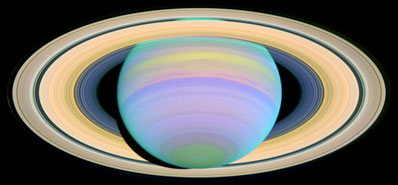
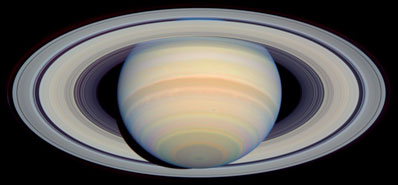
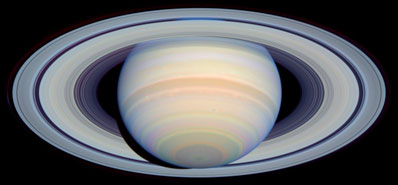
The slant on Saturn's rings SPACE TELESCOPE SCIENCE INSTITUTE NEWS RELEASE Posted: September 9, 2003 This is a series of images of Saturn, as seen at many different wavelengths, when the planet's rings were at a maximum tilt of 26 degrees toward Earth. Saturn experiences seasonal tilts away from and toward the Sun, much the same way Earth does. This happens over the course of its 29.5-year orbit. This means that approximately every 30 years, Earth observers can catch their best glimpse of Saturn's South Pole and the southern side of the planet's rings. Between March and April 2003, researchers took full advantage to study the gas giant at maximum tilt. They used NASA's Hubble Space Telescope to capture detailed images of Saturn's Southern Hemisphere and the southern face of its rings.
By examining the hazes and clouds present in these images, researchers can learn about the dynamics of Saturn's atmosphere. Scientists gain insight into the structure and gaseous composition of Saturn's clouds via inspection of images such as these taken by the Hubble telescope. Over several wavelength bands, from infrared to ultraviolet, these images reveal the properties and sizes of aerosols in Saturn's gaseous makeup. For example, smaller aerosols are visible only in the ultraviolet image, because they do not scatter or absorb visible or infrared light, which have longer wavelengths. By determining the characteristics of the atmosphere's constituents, researchers can describe the dynamics of cloud formation. At certain visible and infrared wavelengths, light absorption by methane gas blocks all but the uppermost layers of Saturn's atmosphere, which helps researchers discern clouds at different altitudes. In addition, when compared with images of Saturn from seasons past (1991 and 1995), this view of the planet also offers scientists a better comprehension of Saturn's seasonal changes. The Space Telescope Science Institute (STScI) is operated by the
Association of Universities for Research in Astronomy, Inc. (AURA),
for NASA, under contract with the Goddard Space Flight Center,
Greenbelt, MD. The Hubble Space Telescope is a project of
international cooperation between NASA and the European Space
Agency (ESA).
|
|
|
|
Apollo 17 DVD now shipping Relive the last manned mission to the moon with this six-disc DVD featuring more than 25 hours of footage. Now shipping from the Astronomy Now Store. Relive the last manned mission to the moon with this six-disc DVD featuring more than 25 hours of footage. Now shipping from the Astronomy Now Store. U.S. STOREU.K. & WORLDWIDE STORE U.S. STOREU.K. & WORLDWIDE STORE Earth from space DVD  80 minutes of spectacular digital video of planet Earth beamed down from the shuttle accompanied by instrumental music, plus a 4-minute shuttle liftoff guaranteed to rock your living room.U.S. STOREU.K. & WORLDWIDE STORE 80 minutes of spectacular digital video of planet Earth beamed down from the shuttle accompanied by instrumental music, plus a 4-minute shuttle liftoff guaranteed to rock your living room.U.S. STOREU.K. & WORLDWIDE STORE
|
|