|
 |

|
||||
|
|
||||
|
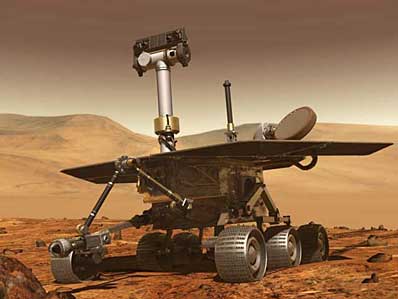
Landing sites selected for Mars Exploration Rovers NASA NEWS RELEASE Posted: April 11, 2003 NASA has chosen two scientifically compelling landing sites for twin robotic rovers to explore on the surface of Mars early next year. The two sites are a giant crater that appears to have once held a lake, and a broad outcropping of a mineral that usually forms in the presence of liquid water.
"Landing on Mars is very difficult, and it's harder on some parts of the planet than others," said Dr. Ed Weiler, NASA associate administrator for space science in Washington. "In choosing where to go, we need to balance science value with engineering safety considerations at the landing sites. The sites we have chosen provide such balance." The first rover, scheduled for launch May 30, will be targeted to land at Gusev Crater, 15 degrees south of Mars' equator. The second, scheduled to launch June 25, will be targeted to land at Meridiani Planum, an area with deposits of an iron oxide mineral (gray hematite) about two degrees south of the equator and halfway around the planet from Gusev. Which rover is targeted to a specific site is still considered tentative, while further analyses and simulations are conducted. NASA can change the order as late as approximately one month after the launch of the first rover. The first mission will parachute to an airbag-cushioned landing on Jan. 4, 2004, and the second on Jan. 25, 2004. "A tremendous amount of effort has gone into evaluating possible landing sites in the past two years, to maximize the probability of mission success" said Peter Theisinger, MER project manager at NASA's Jet Propulsion Laboratory (JPL), Pasadena, Calif. Images and measurements from two NASA spacecraft orbiting Mars provided scientists and engineers, evaluating potential landing sites, with details of candidate site topography, composition, rockiness and geological context. "Meridiani and Gusev both show powerful evidence of past liquid water, but in very different ways," said Dr. Steve Squyres, principal investigator for the rovers' science toolkit and a geologist at Cornell University, Ithaca, N.Y. "Meridiani has a chemical signature of past water. Gray hematite is usually, but not always, produced in an environment where there is liquid water. At Gusev, you've got a big hole in the ground with a dry riverbed going right into it. There had to have been a lake in Gusev Crater at some point. They are fabulous sites, and they complement each other because they're so different," he said. MER site selection began with identifying all areas on Mars that fit a set of engineering-driven requirements, said JPL's Dr. Matt Golombek, co-chair of a landing-site steering committee. To qualify, candidate sites had to be near the equator, low in elevation, not too steep, not too rocky and not too dusty, among other criteria; 155 potential sites were studied. A series of public meetings evaluated the merits of potential landing sites. More than 100 Mars scientists participated in the meetings. "These two landing sites have been studied more than anywhere else on Mars. Both sites have specific scientific hypotheses that can be tested using the instruments on board each rover. It should be a very busy and exciting time after landing for the scientists analyzing the wealth of new data from the ground," said Dr. Cathy Weitz, MER program scientist at NASA Headquarters, Washington. "Clearly there is tremendous interest in the science community in what these missions can accomplish and eagerness to help see that the rovers go to the best possible sites," said National Air and Space Museum's Dr. John Grant, the steering committee's other co-chair. Once they reach their landing sites, each rover's prime mission will last at least 90 Martian days (92 Earth days). The rovers are solar-powered, and in approximately 90 days, dust accumulating on the solar arrays likely will be diminishing the power supply. The twin MER spacecraft are at NASA's Kennedy Space Center,
Fla., in preparation for launch. JPL manages the MER Project
for NASA's Office of Space Science, Washington. JPL is a
division of the California Institute of Technology in
Pasadena.
|
|
|
|
 Hubble Calendar  NEW! This remarkable calendar features stunning images of planets, stars, gaseous nebulae, and galaxies captured by NASA's orbiting Hubble Space Telescope.
 U.S. STOREU.K. & WORLDWIDE STORE U.S. STOREU.K. & WORLDWIDE STOREHubble Posters  Stunning posters featuring images from the Hubble Space Telescope and world-renowned astrophotographer David Malin are now available from the Astronomy Now Store.U.S. STOREU.K. & WORLDWIDE STORE Stunning posters featuring images from the Hubble Space Telescope and world-renowned astrophotographer David Malin are now available from the Astronomy Now Store.U.S. STOREU.K. & WORLDWIDE STORE
|
|