|
 |

|
||||
|
|
||||
|
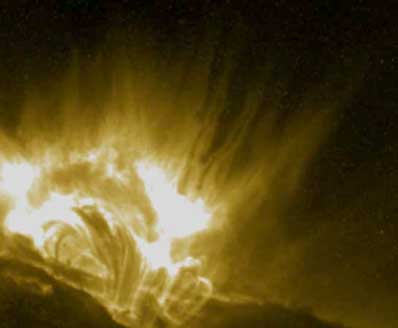
Giant solar tadpoles born in explosion NASA-GSFC NEWS RELEASE Posted: April 10, 2003 Dark features resembling Earth-sized tadpoles were seen swimming in the atmosphere of the Sun after it was heated to millions of degrees following an enormous explosion, according to scientists who made the observation using NASA's Transition Region and Coronal Explorer (TRACE) spacecraft.
The explosion on April 21, 2002, was an "X-class" solar flare, the most powerful kind, releasing about as much energy as a billion one-megaton nuclear bombs. It was also associated with a coronal mass ejection (CME), a multi-billion ton eruption of electrified gas (plasma) into space. The tadpoles are mysterious in part because of their behavior. "In the vicinity of a solar flare associated with a CME, most matter is moving away from the solar surface, but the tadpoles move downward at initial speeds between 30 and 600 kilometers per second (about 19 to 373 miles/sec.), something you don't expect," said Dr. David McKenzie of Montana State University - Bozeman, who has observed these features many times before at lower resolution with the Soft X-ray Telescope on board the Japanese Yohkoh spacecraft. TRACE observes ultraviolet light from iron atoms in solar plasma at two temperatures: 1.5 million degrees Celsius (2.7 million Fahrenheit) and 10 million degrees Celsius (18 million Fahrenheit). Theories explaining the tadpoles included the possibilities that they were dense blobs of plasma, with a different temperature than what TRACE could detect, that absorbed ultraviolet light from plasma behind them or that they were voids with hardly any ultraviolet-emitting plasma in them. While both circumstances would create dark regions in TRACE images, the new data, coordinated with observations from other spacecraft, have now convinced scientists that the tadpoles are superheated magnetic voids in the plasma. The voids are formed when magnetic fields that lace the solar atmosphere reconnect and snap back to the surface following a flare and CME. According to the analysis presented today, the tadpoles appear dark simply because there is very little material in them. "Imagine a hot-air balloon lifting off the ground and stretching elastic tethers placed over its top," said McKenzie. "The tethers are like the solar magnetic field, and the balloon represents the CME. As the balloon rises, the elastic tethers stretch, get pulled together, and start to tangle underneath the balloon. If the tethers were to behave like solar magnetic fields, instead of simply breaking, broken tethers would reconnect to other broken tethers, forming new connections (magnetic reconnection)." "If this tangling and reconnection goes on long enough, pieces of elastic tethers that are connected to the ground (the solar surface) connect to other 'grounded' segments, and subsequently snap back down to the ground. Their snapping downwards gives the tadpoles a downward motion, as the stretched magnetic fields relax to form long rows of arches called arcades. Pieces connected to the balloon get tied to other 'balloon-connected' segments and are carried off as magnetic fields embedded in the CME." Apparently, the tadpoles are reconnected magnetic tubes, seen in cross section. The tube's magnetic pressure temporarily keeps the surrounding hot plasma out, forming a void. With very little or no plasma inside the tubes, there is no ultraviolet emission there, and they appear as dark blobs (tadpoles) when seen in cross section. After the reconnection, the magnetic tubes shrink away from the departing CME. As the tubes move downward, the voids gradually fill with hot plasma from underneath and disappear. TRACE is able to take more detailed pictures faster, allowing scientists to better characterize the behavior of the tadpoles. "No one knows exactly how magnetic reconnection works. The TRACE observations give us constraints, which allow us to select from among many competing theories," said Deluca. "Improved understanding of magnetic reconnection will help us better understand when a highly-magnetized region of the Sun will suddenly erupt as a flare or CME," added Deluca. Other members of the TRACE team include lead author Mr. Fenwick Cooper, a Ph.D. student at the University of Warwick, The United Kingdom, Prof. Valery Nakariakov, also of the University of Warwick, and Dr. Dan Seaton of SAO.
|
|
|
|
 Hubble Calendar  NEW! This remarkable calendar features stunning images of planets, stars, gaseous nebulae, and galaxies captured by NASA's orbiting Hubble Space Telescope.
 U.S. STOREU.K. & WORLDWIDE STORE U.S. STOREU.K. & WORLDWIDE STOREHubble Posters  Stunning posters featuring images from the Hubble Space Telescope and world-renowned astrophotographer David Malin are now available from the Astronomy Now Store.U.S. STOREU.K. & WORLDWIDE STORE Stunning posters featuring images from the Hubble Space Telescope and world-renowned astrophotographer David Malin are now available from the Astronomy Now Store.U.S. STOREU.K. & WORLDWIDE STORE
|
|