|
 |

|
||||
|
|
||||
|
Greenhouse effects also on other planets EUROPEAN SPACE AGENCY NEWS RELEASE Posted: February 17, 2003 Our planet is warming up, and experts warn that the consequences will be serious. To see precisely how the process works, scientists need as much information as possible and from many different sources. There are valuable clues out in space. ESA's missions to Venus, Mars, and Saturn's moon Titan will soon provide useful information to understand how our own planet's climate is regulated.
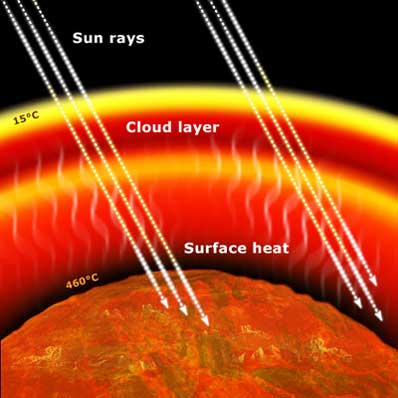
The Sun's energy heats the Earth's surface and the planet radiates energy back into space. However, certain atmospheric gases trap some of the outgoing energy, retaining heat. Without this natural phenomenon, average temperatures on Earth would be 30 degrees lower than the current 15 degrees Celsius. Unfortunately, fossil-fuel combustion and deforestation release large amounts of greenhouse gases to the atmosphere, strengthening the greenhouse effect. Global temperatures have increased more than half a degree in the last century as a result. For a really strong greenhouse effect, we should look at Venus. Venus is similar to Earth in terms of size and mass, but its surface temperature is about 460 degrees Celsius. This is hot enough to melt lead! The Venusian atmosphere is mainly made up of carbon dioxide, a greenhouse gas. On Earth, carbon dioxide makes up only a tiny fraction of the atmosphere. However, man-made emissions have caused carbon dioxide concentrations here to increase by about 30% since pre-industrial times. Why is there so much carbon dioxide in the Venusian atmosphere? What made Venus evolve so differently from Earth? "Good questions. That is precisely one of the things we want to find out" says Hakan Svedhem, Project Scientist for ESA's mission Venus Express, due for launch in 2005. Is Venus a mirror that reflects how the Earth will be if global warming continues at its current speed? "Venus will help us understand what happens when the greenhouse effect is really extreme. However, it's not a good example of what will happen to Earth due to human activities. Life on Earth would disappear due to the extreme temperatures much before reaching even half of the concentrations of carbon dioxide on Venus!" says Svedhem. As a complete contrast to Venus, there is Mars. The Red Planet displays hardly any greenhouse effect. Mars does have some atmospheric carbon dioxide, but almost no atmosphere! The existing atmosphere is so thin that it cannot retain energy from the Sun. There are therefore extreme temperature contrasts between day and night and sun or shade. However, most scientists agree that Mars was much warmer in the past and even had oceans, which means that the atmosphere was also very different. About 3600 million years ago, something happened and the planet evolved towards its current state. What could have triggered such a huge change in climate? "We will answer this question with Mars Express" explains Agustin Chicarro, Project Scientist of ESA's mission to Mars, due for launch in May 2003. Finally, if we look at Titan, Saturn's largest moon, we see a moderate greenhouse effect mostly due to the large concentrations of methane, another greenhouse gas, in its atmosphere. Astronomers have compared Titan with the early Earth. It would be a suitable place for life if it were not so cold: its surface is extremely cold at about -180 degrees Celsius. Understanding which factors influence Titan's climate would be enormously helpful to us, on Earth. "What we learn on Titan will certainly be useful to understand the other planets", confirms Jean-Pierre Lebreton, Project Scientist of Huygens, ESA's probe to Titan.
|
|
|
|
 Hubble Calendar  NEW! This remarkable calendar features stunning images of planets, stars, gaseous nebulae, and galaxies captured by NASA's orbiting Hubble Space Telescope.
 U.S. STOREU.K. & WORLDWIDE STORE U.S. STOREU.K. & WORLDWIDE STOREHubble Posters  Stunning posters featuring images from the Hubble Space Telescope and world-renowned astrophotographer David Malin are now available from the Astronomy Now Store.U.S. STOREU.K. & WORLDWIDE STORE Stunning posters featuring images from the Hubble Space Telescope and world-renowned astrophotographer David Malin are now available from the Astronomy Now Store.U.S. STOREU.K. & WORLDWIDE STORE
|
|