|
 |

|
||||
|
|
||||
|
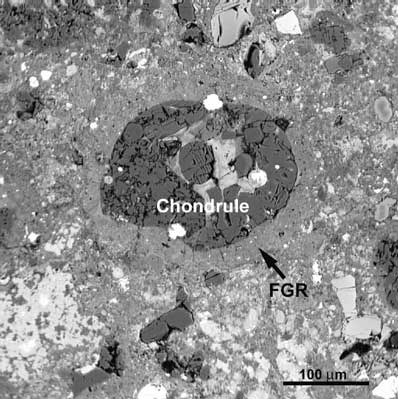
Shock waves may explain water in meteorites UNIVERSITY OF ARIZONA NEWS RELEASE Posted: January 23, 2003 Shock waves through icy parts of the solar nebula could well be the mechanism that enriched meteorites with water -- water that some believe provided an otherwise dry Earth with oceans, according to a new study published in the current issue of Science. Scientists have long debated how "chondrules" might have formed. Chondrules are millimeter-sized blobs of once-melted minerals found within chondritic meteorites, which are thought to be the oldest objects in the solar system. In some of these meteorites, chondrules are rimmed by fine silicate dust particles that have reacted with water.
Planetary scientists at the University of Arizona and University of Hawaii now report that chondrule-forming shock waves in icy regions of the nebula could have produced conditions that allowed rapid mineral hydration. Fred J. Ciesla, Dante S. Lauretta and Lon L. Hood of the UA and Barbara Cohen of the UH collaborated in the study. Lauretta and Cohen speculated years ago that a big energetic event, like a shock wave, might produce enough energy to vaporize ice particles and briefly create conditions that made such quick hydration reactions possible. Ciesla modeled the scenario of what happened to particles of silicate and ice during a shock wave event. "And what happens is, the ice particles vaporize in this very energetic event, producing high water vapor pressure. During this brief period of increased water pressure, the hydration reaction occurs much faster than previously predicted," Ciesla said. "During this brief period, the chondrules melt and the rims form in the same event." Gas slows as it passes through a shock front, increasing in temperature and density. But solid particles entrained in the gas continue through the shock wave at high velocity. "The solid particles heat up because they are speeding through the slower-moving gas. And just as a meteor is heated up and burns when it enters Earth's atmosphere, particles are heated when they collide with the gas molecules. Gas both heats and slows the chondrules, so they melt and begin to cool. The water vapor then reacts with the dust to form these hydrated silicates, and the chondrules accrete these silicates to form their rims." "An interesting characteristic of these particular meteorites is that they contain a lot of water, and the deuterium-to-hydrogen ratios in that water matches the ratios we find in Earth's water," Ciesla noted. Why Earth has water is a mystery, for "especially early on in the solar nebula, the area where the Earth formed was too hot for water to incorporate into a solid body," Ciesla said. Meteorites may have delivered at least part of Earth's water, although that remains open to debate, he added. The scenario also suggests how so much organic material has survived in the carbonaceous chondrite meteorites. If water reacted with the fine dust in the solar nebula as the new research suggests, temperatures in the meteorites would have remained low enough for organic molecules to survive and be delivered, along with water, to Earth. Although the idea that shock waves formed the hydrated rock and chondrules found in the most primitive meteorites stands up to quantitative analysis, scientists are still speculating about where the shock waves come from, and it's a topic Ciesla hopes to address in this doctoral thesis. UA planetary scientist Lon Hood, one of the authors on the Science paper, originally theorized that as Jupiter was forming, it excited the orbits of the many "planetismals," or planet building-blocks, in the region that became the present day asteroid belt so that they were propelled through the gas in the solar nebula at speeds greater than the speed of sound, creating shock waves. Ciesla has begun testing that idea. Other ideas on the origin of shock waves also involve Jupiter is some way,
he said.
|
|
|
|
 Earth Calendar  NEW! This amazing 2003 calendar features stunning images of mountain ranges, volcanoes, rivers, and oceans obtained from previous NASA space shuttle missions.
 U.S. STOREU.K. & WORLDWIDE STORE U.S. STOREU.K. & WORLDWIDE STOREHubble Calendar  NEW! This remarkable calendar features stunning images of planets, stars, gaseous nebulae, and galaxies captured by NASA's orbiting Hubble Space Telescope.U.S. STOREU.K. & WORLDWIDE STORE
Hubble Posters  Stunning posters featuring images from the Hubble Space Telescope and world-renowned astrophotographer David Malin are now available from the Astronomy Now Store.U.S. STOREU.K. & WORLDWIDE STORE Stunning posters featuring images from the Hubble Space Telescope and world-renowned astrophotographer David Malin are now available from the Astronomy Now Store.U.S. STOREU.K. & WORLDWIDE STORE
|
|