Hubble's new camera unveils a panoramic view of universe
NASA NEWS RELEASE
Posted: April 30, 2002
Jubilant astronomers today unveiled humankind's most spectacular views
of the universe as captured by the NASA Hubble Space Telescope's new
Advanced Camera for Surveys (ACS). They also reported that Hubble is
operating superbly since the March servicing mission and are looking
forward to more pictures from the newly revived NICMOS camera.
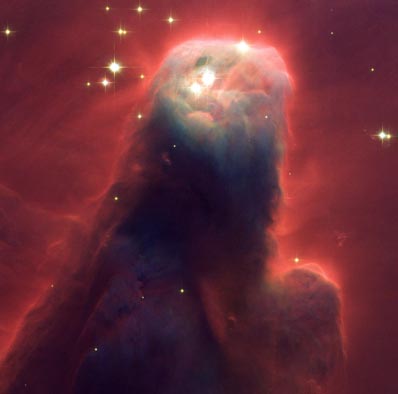
Called
the Cone Nebula (NGC 2264) -- so named because, in ground-based images,
it has a conical shape -- this giant pillar of gas and dust resides in a turbulent star-forming region. This picture shows the upper 2.5 light-years of the nebula, a height that equals 23 million roundtrips to the Moon. The entire nebula is 7 light-years long. The Cone Nebula resides 2,500 light-years away in the constellation Monoceros. Radiation from hot, young stars [located beyond the top of the image]
has slowly eroded the nebula over millions of years. Ultraviolet light
heats the edges of the dark cloud, releasing gas into the relatively
empty region of surrounding space. Credit: NASA and the ACS Science Team (H. Ford, G. Illingworth,
M. Clampin, G. Hartig, T. Allen, K. Anderson, F. Bartko, N. Benitez,
J. Blakeslee, R. Bouwens, T. Broadhurst, R. Brown, C. Burrows,
D. Campbell, E. Cheng, N. Cross, P. Feldman, M. Franx, D. Golimowski,
C. Gronwall, R. Kimble, J. Krist, M. Lesser, D. Magee, A. Martel,
W. J. McCann, G. Meurer, G. Miley, M. Postman, P. Rosati, M. Sirianni,
W. Sparks, P. Sullivan, H. Tran, Z. Tsvetanov, R. White, and R. Woodruff)
|
"The ACS is opening a wide new window onto the universe. These are
among the best images of the distant universe humans have ever seen,"
says Johns Hopkins University astronomer Holland Ford, the lead
scientist in the ACS' seven-year development. "The ACS will let us
obtain the deepest image of the universe for the foreseeable future",
added astronomer Garth Illingworth, the deputy leader for the ACS.
The camera's tenfold increase in efficiency will open up much
anticipated new "discovery space" for Hubble. "ACS will allow us to
push back the frontier of the early universe. We will be able to enter
the 'twilight zone' period when galaxies were just beginning to form
out of the blackness following the cooling of the universe from the
big bang," says Ford.
"The first astronomical images from the new Advanced Camera for Surveys
are remarkable, breathtaking," said Dr. David Leckrone, Hubble Space
Telescope Senior Project Scientist at NASAšs Goddard Space Flight Center
in Greenbelt, MD. "They're everything we expected and more. The only
problem is doing them full justice as we try to show them to the public
on 'old-fashioned' television, or in newspapers or magazines."
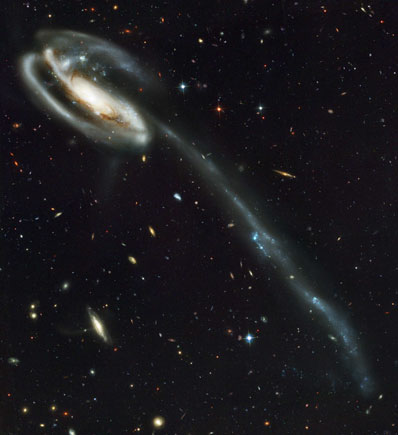
This picture of the galaxy UGC 10214 was taken by the Advanced Camera for Surveys. Dubbed the "Tadpole," this spiral galaxy is unlike the textbook images of stately galaxies. Its distorted shape was caused by a small interloper, a very blue,
compact galaxy visible in the upper left corner of the more massive
Tadpole. The Tadpole resides about 420 million light-years away in the
constellation Draco. Seen shining through the Tadpole's disk, the tiny intruder is likely a hit-and-run galaxy that is now leaving the scene of the accident. Strong
gravitational forces from the interaction created the long tail of
debris, consisting of stars and gas that stretch out more than 280,000
light-years.
Numerous young blue stars and star clusters, spawned by the galaxy
collision, are seen in the spiral arms, as well as in the long "tidal"
tail of stars. Credit: NASA and the ACS Science Team (H. Ford, G. Illingworth,
M. Clampin, G. Hartig, T. Allen, K. Anderson, F. Bartko, N. Benitez,
J. Blakeslee, R. Bouwens, T. Broadhurst, R. Brown, C. Burrows,
D. Campbell, E. Cheng, N. Cross, P. Feldman, M. Franx, D. Golimowski,
C. Gronwall, R. Kimble, J. Krist, M. Lesser, D. Magee, A. Martel,
W. J. McCann, G. Meurer, G. Miley, M. Postman, P. Rosati, M. Sirianni,
W. Sparks, P. Sullivan, H. Tran, Z. Tsvetanov, R. White, and R. Woodruff)
|
Among the suite of four "suitable-for-framing" ACS science
demonstration pictures released today is a stunning view of a
colliding galaxy, dubbed the "Tadpole," located 420 million light-years
away. Unlike textbook images of stately galaxies, the "Tadpole" with a
long tidal tail of stars, looks like a runaway pinwheel firework. It
captures the essence of our dynamic, restless and violent universe.
But what came as an unexpected bonus is the enormous number of galaxies
beyond the Tadpole galaxy -- twice the number in the legendary Hubble
Deep Field (HDF) in 1995 (as many as 6,000 galaxies). Amazingly,
the ACS picture was taken in one-twelfth the time it took for the
original HDF -- and in blue light sees even fainter objects than the
HDF. Like the HDF, the galaxies stretch back to nearly the beginning of
time and contain myriad shapes that are snapshots of galaxies throughout
the universe's 13 billion-year evolution. The ACS images are so sharp
astronomers can identify "building blocks" of galaxies, colliding
galaxies, an exquisite "Whitman's Sampler" of galaxies, and extremely
distant galaxies in the field. The ACS image of the Tadpole illustrates
the dramatic gains over Wide Field Planetary Camera 2 that were expected
from doubling the area and resolution, and five times improvement in
sensitivity.
The other pictures include a stunning collision between two spiral
galaxies -- dubbed "the Mice" -- that presage what may happen to our
own Milky Way several billion years in the future when it collides
with the neighboring galaxy in the constellation Andromeda. Computer
simulations made by J. Barnes and J. Hibbard show that we are seeing
the collision of the Mice approximately 160 million years after their
closest encounter. Running the simulations forward in time shows that
the two galaxies will eventually merge, forming an elliptical-like
galaxy. A similar fate may await the Milky Way and the Andromeda galaxy.
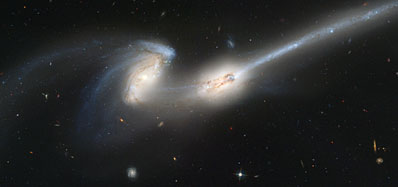
The Advanced Camera for Surveys has captured a spectacular pair of galaxies engaged in a celestial dance of cat and mouse or, in this case, mouse and mouse. Located 300 million light-years away in the constellation Coma
Berenices, the colliding galaxies have been nicknamed "The Mice" because
of the long tails of stars and gas emanating from each galaxy. Otherwise
known as NGC 4676, the pair will eventually merge into a single giant
galaxy. Credit: NASA and the ACS Science Team (H. Ford, G. Illingworth,
M. Clampin, G. Hartig, T. Allen, K. Anderson, F. Bartko, N. Benitez,
J. Blakeslee, R. Bouwens, T. Broadhurst, R. Brown, C. Burrows,
D. Campbell, E. Cheng, N. Cross, P. Feldman, M. Franx, D. Golimowski,
C. Gronwall, R. Kimble, J. Krist, M. Lesser, D. Magee, A. Martel,
W. J. McCann, G. Meurer, G. Miley, M. Postman, P. Rosati, M. Sirianni,
W. Sparks, P. Sullivan, H. Tran, Z. Tsvetanov, R. White, and R. Woodruff)
|
Looking closer to home, ACS imaged the "Cone Nebula," a craggy-looking
mountaintop of cold gas and dust that is a cousin to Hubble's iconic
"pillars of creation" in the Eagle Nebula, photographed in 1995.
Peering into a celestial maternity ward called the M17 Swan Nebula,
the ACS revealed a watercolor fantasy-world tapestry of vivid colors
and glowing ridges of gas. Embedded in this crucible of star creation
are embryonic planetary systems.
Mounted aboard the world's premier optical-ultraviolet telescope, the
ACS is a camera of superlatives. It is expected to go beyond the
sensitvitiy of the largest ground-based telescope to eventually see
the very faintest objects ever. Its camera delivers a panoramic
crispness comparable to that of a wide-screen IMAX movie, a staggering
16 million picture elements (megapixels) per snapshot (typical consumer
cameras are 2 to 4 megapixels).
The new high-tech mechanical "refrigerator" installed on Hubble during
the recent SM3B servicing mission has successfully pumped most of the
heat out of the interior of the Near Infrared Camera and Multi-Object
Spectrometer (NICMOS), achieving the target temperature for neon gas
passing through the instrument of 70 degrees Kelvin (-203 degrees
Centigrade or -333 degrees Fahrenheit). Since entering this new phase
of self-regulated operation, the NICMOS Cooling System has successfully
maintained 70K to within a few hundredths of one degree.
Engineers are now in the process of checking out the operation of the
resuscitated NICMOS instrument. By early June, scientists expect to
release the first astronomical images taken with the NICMOS since 1998,
when it was still being cooled by a rapidly depleting block of solid
nitrogen ice. "One might now say that our new mechanical cooler has
taken infrared astronomy out of the ice age," said Leckrone.
The new rigid solar arrays, working with the new Power Control Unit,
are generating 27 percent more electrical power than the previous
arrays. This doubles the electrical power that we are able to allocate
to the scientific instruments on Hubble. The new reaction wheel is
operating normally.
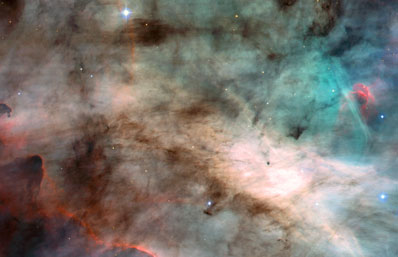
This is an image of the center of the Omega Nebula, a hotbed of newly born stars wrapped in colorful blankets of glowing gas and cradled in an enormous cold, dark hydrogen cloud. The region of the nebula shown in this photograph is about 3,500 times wider than our solar system. The area represents about 60 percent of the
total view captured by ACS. The nebula, also called M17 and the Swan
Nebula, resides 5,500 light-years away in the constellation Sagittarius. Like its famous cousin in Orion, the Swan Nebula is illuminated by
ultraviolet radiation from young, massive stars, located just beyond the
upper right corner of the image. Each star is about six times hotter and
30 times more massive than the Sun. The powerful radiation from these
stars evaporates and erodes the dense cloud of cold gas within which the
stars formed. The blistered walls of the hollow cloud shine primarily in
the blue, green, and red light emitted by excited atoms of hydrogen,
nitrogen, oxygen, and sulfur. Particularly striking is the rose-like
feature, seen to the right of center, which glows in the red light
emitted by hydrogen and sulfur. Credit: NASA and the ACS Science Team
|
After a brief period of normal operation following SM3B, Hubble's Gyro
Number 3 has reverted to the same anomalous operation that it displayed
prior to the mission. Engineers anticipate that its life may be
shortened because of a higher than desired motor current being drawn
through electrical wires (flex leads) that are known to break.
Nevertheless, at this time Gyro 3 is fully operational.
Nearly a month ago, the Space Telescope Imaging Spectrograph and the
Wide Field and Planetary Camera 2 resumed science observations.
"This servicing mission has turned out to be an extraordinary success,"
said Leckrone. "It was the most difficult and complicated Hubble
servicing mission attempted to date and our observatory came through
it with flying colors."
Electronic image files, animation and additional information are
available on the Internet at: http://oposite.stsci.edu/pubinfo/pr/2002/11.
The Space Telescope Science Institute (STScI) is operated by the
Association of Universities for Research in Astronomy, Inc. (AURA),
for NASA, under contract with the Goddard Space Flight Center,
Greenbelt, MD. The Hubble Space Telescope is a project of international
cooperation between NASA and the European Space Agency (ESA).
|
|
|
|

|