Retired quasars generate most energetic cosmic rays
NASA-GODDARD NEWS RELEASE
Posted: April 23, 2002

  Galaxy
Galaxy
Galaxy
Galaxy
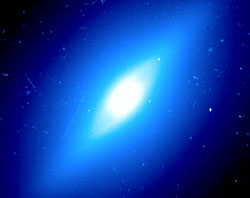
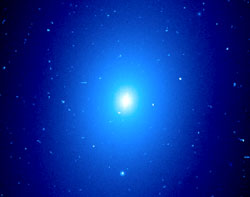
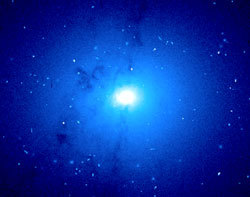
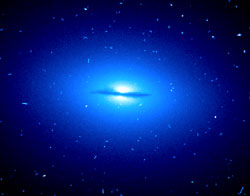
Each galaxy contains a central black hole of at least 100 million solar masses that, if spinning, could form a colossal battery sending atomic particles, like sparks, shooting off towards Earth at near light speed. Credit: NASA/HST/Timothy Hamilton
 
They are old but not forgotten. Nearby "retired" quasar galaxies, billions of years past their glory days as the brightest beacons in the Universe, may be the current source of rare, high-energy cosmic rays, the fastest-moving bits of matter known and whose origin has been a long-standing mystery, according to scientists at NASA and Princeton University.

The scientists have identified four elliptical galaxies that may have started this second career of cosmic-ray production, all located above the handle of the Big Dipper and visible with backyard telescopes. Each contains a central black hole of at least 100 million solar masses that, if spinning, could form a colossal battery sending atomic particles, like sparks, shooting off towards Earth at near light speed.

These findings were discussed in a press conference at the joint meeting of the American Physical Society and the High Energy Astrophysics Division of the American Astronomical Society in Albuquerque, N.M. The team includes Dr. Diego Torres of Princeton University and Drs. Elihu Boldt, Timothy Hamilton and Michael Loewenstein of NASA's Goddard Space Flight Center in Greenbelt, Md.

Quasar galaxies are thousands of times brighter than ordinary galaxies, fueled by a central black hole swallowing copious amounts of interstellar gas. In galaxies with so-called quasar remnants, the black hole nucleus is no longer a strong source of radiation.

"Some quasar remnants might not be so lifeless after all, keeping busy in their later years," said Torres. "For the first time, we see the hint of a possible connection between the arrival directions of ultra-high energy cosmic rays and locations on the sky of nearby dormant galaxies hosting supermassive black holes."

Ultra high-energy cosmic rays represent one of astrophysics' greatest mysteries. Each cosmic ray -- essentially a single sub-atomic particle such as a proton traveling just shy of light speed -- packs as much energy as a major league baseball pitch, over 40 million trillion electron volts. (The rest energy of a proton is about a billion electron volts.) The particles' source must be within 200 million light years of Earth, for cosmic rays from beyond this distance would lose energy as they traveled through the murk of the cosmic microwave radiation pervading the Universe. There is considerable uncertainty, however, over what kinds of objects within 200 million light years could generate such energetic particles.

"The very fact that these four giant elliptical galaxies are apparently inactive makes them viable candidates for generating ultra high-energy cosmic rays," said Boldt. Drenching radiation from an active quasar would dampen cosmic-ray acceleration, sapping most of their energy, Boldt said.

The team concedes it cannot determine if the black holes in these galaxies are spinning, a basic requirement for a compact dynamo to accelerate ultra-high energy cosmic rays. Yet scientists have confirmed the existence of at least one spinning supermassive black hole, announced in October 2001. The prevailing theory is that supermassive black holes spin up as they accrete matter, absorbing orbital energy from the infalling matter.

Ultra-high-energy cosmic rays are detected by ground-based observatories, such as the Akeno Giant Air Shower Array near Yamanashi, Japan. They are extremely rare, striking the Earth's atmosphere at a rate about one per square kilometer per decade. Construction is underway for the Auger Observatory, which will cover 3,000 square kilometers (1,160 square miles) on an elevated plain in western Argentina. A proposed NASA mission called OWL (Orbiting Wide-angle Light-collectors) would detect the highest-energy cosmic rays by looking down on the atmosphere from space.

Loewenstein joins NASA Goddard's Laboratory for High Energy Astrophysics as a research associate with the University of Maryland, College Park. Hamilton, also a member of the Lab, is a National Research Council fellow.

Apollo 11 special patch
Special collectors' patch marking the 35th anniversary of the historic Apollo 11 moon landing is now available.
 Choose your store:
U.S. - U.K. - E.U. - Worldwide

Inside Apollo mission control
An insider's view of how Apollo flight controllers operated and just what they faced when events were crucial.
 Choose your store:
U.S.

The ultimate Apollo 11 DVD
This exceptional chronicle of the historic Apollo 11 lunar landing mission features new digital transfers of film and television coverage unmatched by any other.
 Choose your store:
U.S. - U.K. - E.U. - Worldwide

Next ISS crew
Own a little piece of history with this official patch for the International Space Station's Expedition 11 crew. We'll ship yours today!
 Choose your store:
U.S.

Apollo 12 tribute DVD set

New! Featuring the jovial crew of Pete Conrad, Dick Gordon and Alan Bean, the Apollo 12 mission was struck by lightning shortly after liftoff but proceeded on the second successful exploration voyage to the lunar surface. This three-disc DVD brings the mission to life with extraordinary detail.
 Choose your store:
U.S. - U.K. - E.U. - Worldwide

Fallen Heroes special patch
This special 12-inch embroidered patch commemorates the U.S. astronauts who made the ultimate sacrifice, honoring the crews of Apollo 1, Challenger and Columbia.
 Choose your store:
U.S. - U.K. - E.U. - Worldwide

Women in Space
Women of Space: Cool Careers on the Final Frontier is for girls, young women, and anyone else interested in learning about exciting careers in space exploration. Includes CD-ROM.
 Choose your store:
U.S. - U.K. - E.U. - Worldwide

Mars rover poster
This new poster features some of the best pictures from NASA's amazing Mars Exploration Rovers Spirit and Opportunity.
 Choose your store:
U.S.

The Unbroken Chain
Guenter Wendt's autobiography, The Unbroken Chain, is a ground-shaking, fumes in your nostrils account of the glory days of manned spaceflight.
 U.S. STORE
 WORLDWIDE STORE

Expedition 20
The official embroidered patch for the International Space Station Expedition 20 crew is now available from our stores.
 U.S. STORE
 WORLDWIDE STORE

Current Shuttle Mission Patch
The official embroidered patch for shuttle Atlantis' flight to deliver critical spare equipment to the space station.
 U.S. STORE
 WORLDWIDE STORE


Ares Patch
The Ares Project will develop two new rockets to launch astronauts back to the Moon under NASA's Vision for Exploration. The Ares 1 will employ a single space shuttle solid rocket booster to loft the Orion crew capsule. The gigantic Ares 5 will haul the equipment and cargo needed for such lunar voyages. This is the Ares emblem.
 U.S. STORE


One Giant Leap
Hosted by Corbin Bernsen, this award winning documentary marks the 50th anniversary of the U.S. space agency and features exclusive interviews with veteran astronauts.
 U.S. STORE
 WORLDWIDE STORE

Expedition 21
The official embroidered patch for the International Space Station Expedition 21 crew is now available from our stores.
 U.S. STORE
 WORLDWIDE STORE

Hubble Posters
Stunning posters featuring images from the Hubble Space Telescope and world-renowned astrophotographer David Malin are now available from the Astronomy Now Store.
 U.S. STORE
 U.K. & WORLDWIDE STORE

Get e-mail updates
Sign up for our NewsAlert service and have the latest news in astronomy and space e-mailed direct to your desktop (privacy note: your e-mail address will not be used for any other purpose).
Enter your e-mail address:

INDEX | PLUS | NEWS ARCHIVE | LAUNCH SCHEDULE
ASTRONOMY NOW | STORE

ADVERTISE

© 2009 Spaceflight Now Inc.