|
 |

|
||||
|
|
||||
|
Astronomers detect stellar ashes at the dawn of time JOINT ASTRONOMY CENTRE NEWS RELEASE Posted: April 10, 2002
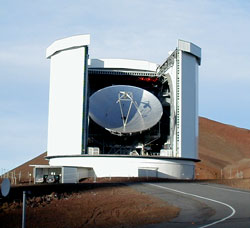
Dr. Kate Isaak of Cambridge University will be announcing these exciting new results at the National Astronomy Meeting in Bristol on 11th April 2002. Using the SCUBA (Submillimetre Common-User Bolometer Array) camera on the James Clerk Maxwell Telescope in Hawaii, the team of British astronomers observed a sample of the most distant quasars known, to detect their primeval 'host' galaxies. The submillimetre wavelength radiation detected by SCUBA comes from large amounts of cool dust, a substance formed in supernovae and/or the atmospheres of old stars. Team leader Dr. Robert Priddey (Imperial College) said "These quasars are the most distant submillimetre sources known. We're looking more than nine-tenths of the way back to the birth of the universe in the Big Bang." The quasars are extremely far from us, as measured by their very high redshifts of 5-6. These huge distances mean that their light was emitted when the universe was less than a tenth of its current age -- a mere billion years after the Big Bang. Consequently, the host galaxies are caught when they are extremely young, and when astronomers might expect to see a burst of star formation. Dr. Priddey explained, "It's amazing enough that these quasars, powered by billion solar mass black holes, should already exist only a billion years after the Big Bang. That these quasars also appear to contain so much dust yields important clues to the formation of massive galaxies in the youthful cosmos." Although it is not yet known whether the dust in these quasars is heated by hot, young stars within the galaxy, or directly by the quasar itself, the very existence of the dust and its constituent elements such as silicon and carbon implies that a large mass of stars have already been born, grown old and expired, within only a billion years of the Big Bang. Dr. Isaak said, "These observations of very distant quasars are part of a programme looking at the submillimetre emission of quasars from low to high redshift. If we hunt for ever higher redshift quasars, we might catch the epoch at which the first dust forms." Team member Dr. Richard McMahon (University of Cambridge) added "The stars that made the carbon and silicon in these quasars are probably like the stars that made the carbon in our own bodies. It is very exciting to be able to learn when the chemical elements in our bodies were made. These quasars seem to be forming stars at a rate of around 1000 stars like the Sun per year." Quasars are incredibly bright and distant objects, thought to be examples of Active Galaxies, which shine hundreds of times brighter than normal galaxies like our own. They are powered by gas in the galactic core falling into a 'supermassive' black hole which can be as much as one billion times as massive as our own Sun. For a brief period, the compact nucleus shine brighter than all the stars in the galaxy. SCUBA (the Submillimetre Common-User Bolometer Array) is currently the world's most powerful "submillimetre-wave" camera. It has revolutionised our knowledge of many areas of astronomy. The instrument contains highly sensitive detectors called bolometers, which are cooled to 0.06 degrees above absolute zero (-273 degrees Centigrade) to make them super-sensitive to the incoming submillimetre waves. It has been in operation on the James Clerk Maxwell Telescope (JCMT) in Hawaii for about five years. The host galaxies detected by SCUBA contain dust with a mass about 100 million times that of our Sun. The black holes in their cores are at least one billion times as massive as our Sun, and are swallowing about 10-100 solar masses of material per year. 'Redshift' measures the factor by which the light we observe from distant
sources has been stretched, as the Universe expands during the course of its
journey. The higher the redshift, the further away the source. The most
distant of the quasars has a redshift of six, meaning that it emitted the
light we detect when the radius of the Universe was one seventh of its
current value. At this time, the universe was about a billion years old,
compared to its current age of over 10 billion years.
|
|
|
|

|
||