|
 |

|
||||
|
|
||||
|
Scientists predict calmer space weather ahead HARVARD-SMITHSONIAN CENTER FOR ASTROPHYSICS NEWS RELEASE Posted: March 20, 2002
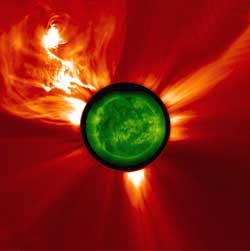
The predictions of calmer weather are the result of analyzing observations from a CfA instrument called the Ultraviolet Coronagraph Spectrometer, or UVCS. These first-of-a-kind observations by UVCS and other instruments aboard the international Solar and Heliospheric Observatory (SOHO) are providing the best descriptions yet of the workings of the Sun from its core to its surface. The observations also are leading the way to better long-term predictions of how and when the Sun's gusty particle emissions are released to affect spacecraft and life on Earth. Improved predictions are expected after next-generation instruments come on line later in the decade. "We need these better predictions as we become more dependent upon satellites and reliable long-distance communications," says CfA's Dr. Mari Paz Miralles. Solar activity varies over an 11-year cycle. Every eleven years the Sun undergoes a period of low activity called solar minimum that ascends to a period of high activity called solar maximum and then back to solar minimum. One way of tracking the solar activity is by observing sunspots. Sunspots are regions of intense magnetic field that are cooler and darker than the surrounding areas of the Sun's surface. These active regions can erupt and cause solar flares and coronal mass ejections, which hurl energetic, electrically charged particles toward the Earth. During solar minimum there are only a few sunspots on the Sun's surface, while during solar maximum there are about 20 times more spots. Space weather is influenced not only by the presence of active regions, but also by coronal holes - open magnetic field regions of the corona that have low density and brightness. At solar minimum, the Sun generally has a coronal hole at each of its poles and none near its equator. As solar activity increases, the coronal hole at the Sun's north pole shrinks, other smaller coronal holes emerge near it, and they appear to migrate toward the solar equator and eventually to the south pole. The same happens in reverse at the Sun's south pole. At solar maximum, the coronal holes are found near the equator along with active regions. As the Sun spins, coronal mass ejections and high-energy atomic particles from solar flares are sprayed at the Earth like water from a twirling garden sprinkler. As the solar cycle continues, the coronal holes complete their migration to the opposite pole, causing the Sun's magnetic poles to reverse. The changes in the magnetic field that lead to the flipping of the Sun's magnetic poles is the major reason for long-term variations in space weather. These observations above the solar surface reveal the workings of the solar "dynamo" that operates in the Sun's interior and generates the solar magnetic field. Unlike the Earth, which has a molten iron core, the Sun is gaseous throughout its interior. The Sun's magnetic field is created solely by electrical currents similar to the way an electromagnet operates. In the Sun, these currents are produced by the circulation of extremely hot, electrically charged gas or plasma. A combination of the interior circulation of the plasma and the Sun's rotation creates the magnetic field. The dynamo action takes this initially weak field and builds it up to a much stronger magnetic field. The main driver of this dynamo is the solar differential rotation: the Sun is not a rigid body, but rotates faster at the equator than at the poles. This differential rotation causes any north-south magnetic field inside the Sun to be stretched out in the east-west direction. This stretching contributes to the birth of new active regions, which then drive the movement of magnetic flux to the poles, eventually leading to a reversal of the Sun's entire magnetic field. The UVCS is valuable for studying the Sun because it is the only instrument able to measure atomic particle speeds and temperatures in the region of the solar corona where the primary accelerations of the solar wind and coronal mass ejections occur. The UVCS has observed the solar corona - the faint outer atmosphere of the Sun visible from the Earth during a total solar eclipse - for six years and has recorded drastic changes in this hot, tenuous layer. During this period, the Sun's activity increased from its lowest level in 1996 to its maximum in 2000, then decreased again only to rebound in 2001. This second increase in the Sun's activity level created a double-peaked activity maximum. Another instrument called LASCO from the Navel Research Laboratory makes images of the solar corona and determines particle densities. Together, these two instruments have seen, for the first time, how the densities, temperatures, and speeds of charged particles in the expanding solar wind vary as solar activity changes. In 1996-1997 at solar minimum, UVCS observed a simpler solar wind structure, with fast, hot flows from polar coronal holes that remained open over long periods of time. Around solar maximum, UVCS also observed coronal holes at other places as well, like at the Sun's equator and middle latitudes. When comparing UVCS measurements of coronal holes at solar minimum and maximum, scientists discovered intriguing differences. The wind at solar minimum accelerates faster from coronal holes that are both hotter and less dense than those at solar maximum. These results were reported by Mari Paz Miralles and Steven Cranmer at an international meeting on "SOHO Observations Over Half a Solar Cycle" held in Davos, Switzerland earlier this month. The results are also reported in two articles published in the March 10 and October 20, 2001 issues of Astrophysical Journal Letters. Understanding the variation of the solar corona and its wind over the solar cycle is vital for our comprehension of the Sun's role in our daily lives. As we approach solar minimum, only five years away, the Sun will produce fewer solar flares and fewer coronal mass ejections. But the coronal holes at the solar poles will fan out and their magnetic fields will reach downward toward the solar equator, allowing high-speed wind from the solar poles to reach the Earth. During this relatively peaceful time ahead, we will still need to be mindful of the approach of these high-speed wind streams and their associated high-energy electrons and magnetic disturbances that will still pose a threat to all of our satellite based essentials and conveniences. Headquartered in Cambridge, Massachusetts, the Harvard-Smithsonian Center for Astrophysics (CfA) is a joint collaboration between the Smithsonian Astrophysical Observatory and the Harvard College Observatory. CfA scientists organized into seven research divisions study the origin, evolution, and ultimate fate of the universe. The Solar and Heliospheric Observatory (SOHO) is a mission of international cooperation between the European Space Agency and NASA.
|
|
|
|

|
||