|
||||
|
|
||||
|
|
||||
|
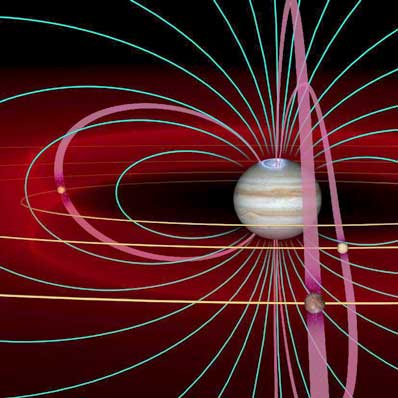
Solar wind buffets vast Jupiter region NASA/JPL NEWS RELEASE Posted: February 28, 2002 Scientists simultaneously using a combination of NASA spacecraft have seen into the workings of an invisible whirling bubble of charged particles surrounding Jupiter. That bubble, Jupiter's magnetosphere, is the biggest object with distinct boundaries within our solar system, more than 100 times wider than Jupiter itself. It contracts in response to shock waves from the Sun, according to one report appearing in the journal Nature tomorrow. In all, seven reports appearing together will detail various results from a concerted research campaign that took advantage of the Saturn- bound Cassini spacecraft's flyby of Jupiter 14 months ago.
"We're seeing results from a remarkable opportunity," said Dr. Scott Bolton, a physicist at NASA's Jet Propulsion Laboratory, Pasadena, Calif., and a co-author of three of the reports. "We had one spacecraft, Galileo, inside the magnetosphere monitoring what was happening there at the same time another spacecraft, Cassini, was outside the magnetosphere monitoring the solar wind just upstream," Bolton said. The solar wind is particles from the Sun flowing outward through the solar system. Jupiter's magnetosphere, like Earth's, deflects the solar wind but gets pushed around by its gusts. On Jan. 10, 2001, when Cassini and Galileo were more than 20 times farther from each other than Earth is from the Moon, each spacecraft encountered the boundary of Jupiter's magnetosphere while the bubble was contracting in response to an increase in solar-wind pressure. "This is the first two-point measurement of the Jovian system actually responding to the solar wind," said Dr. William Kurth, physicist at the University of Iowa, Iowa City, and lead author of the Nature report on these results. "The combined observations of Galileo and Cassini help show us the relative importance of the influence of the solar wind and the factors affecting the magnetosphere from within -- primarily the energy from Jupiter's rotation and the supply of material from volcanoes on the moon Io." The Jupiter observations strengthen confidence in our understanding about Earth's protective magnetosphere.
Besides Galileo, which has been orbiting Jupiter since 1995, and Cassini, scientists used two Earth orbiters -- the Hubble Space Telescope and Chandra X-ray Observatory ñ plus radio telescopes in New Mexico and Arizona to examine Jupiter's surroundings while Cassini was there. Hubble images show patches of Jupiter's aurora stimulated by an event Galileo detected within the magnetosphere, reports Dr. Barry Mauk of Johns Hopkins University's Applied Physics Laboratory, Laurel, Md. The event is a surge of charged particles toward the planet, apparently analogous to similar aurora-triggering surges that release pent-up energy in Earth's magnetosphere. Some other features in Jupiter's aurora are "footprints" of currents flowing through the magnetosphere from three of the planet's large moons, reports Dr. John Clarke of Boston University. Dr. Randall Gladstone of the Southwest Research Institute, San Antonio, Texas, describes a 45-minute rhythm in auroras at X-ray wavelengths, likely linked to a still-unidentified stimulus in the outer portion of the magnetosphere.
High-energy electrons in radiation belts close to Jupiter emit radio waves that have been monitored from Earth for years. JPL's Bolton and other scientists used Cassini while it was near Jupiter to map details never seen before in those belts. About 2,300 students at high schools and middle schools across the country participated in a program of radio- telescope observations that aided interpretation of those Cassini observations. Cassini is a cooperative project of NASA, the European
Space Agency and the Italian Space Agency. JPL manages Cassini
and Galileo for NASA's Office of Space Science, Washington,
D.C. JPL is a division of the California Institute of
Technology in Pasadena.
|
Creating Space Creating Space groups together the history, the vehicles and the models into logical and meaningful categories. This book is equally valuable to space enthusiasts, modellers, and space historians.Columbia Report A reproduction of the official accident investigation report into the loss of the space shuttle Columbia and its crew of seven. U.S. - U.K. - E.U. - Worldwide Mars Panorama DISCOUNTED! This 360 degree image was taken by the Mars Pathfinder, which landed on the Red Planet in July 1997. The Sojourner Rover is visible in the image. U.S. Apollo 11 Mission Report Apollo 11 - The NASA Mission Reports Vol. 3 is the first comprehensive study of man's first mission to another world is revealed in all of its startling complexity. Includes DVD!U.S. - U.K. - E.U. - Worldwide Rocket DVD If you've ever watched a launch from Kennedy Space Center, Cape Canaveral, Vandenberg Air Force Base or even Kodiak Island Alaska, there's no better way to describe what you witnessed than with this DVD.U.S. - U.K. - E.U. - Worldwide Soviet Space For the first time ever available in the West. Rocket & Space Corporation Energia: a complete pictorial history of the Soviet/Russian Space Program from 1946 to the present day all in full color. Available from our store.U.S. - U.K. - E.U. - Worldwide Viking patch This embroidered mission patch celebrates NASA's Viking Project which reached the Red Planet in 1976.U.S. - U.K. - E.U. - Worldwide Apollo 7 DVD For 11 days the crew of Apollo 7 fought colds while they put the Apollo spacecraft through a workout, establishing confidence in the machine what would lead directly to the bold decision to send Apollo 8 to the moon just 2 months later.U.S. - U.K. - E.U. - Worldwide Gemini 12 Gemini 12: The NASA Mission Reports covers the voyage of James Lovell and Buzz Aldrin that capped the Gemini program's efforts to prove the technologies and techniques that would be needed for the Apollo Moon landings. Includes CD-ROM.U.S. - U.K. - E.U. - Worldwide Gemini 12 Gemini 12: The NASA Mission Reports covers the voyage of James Lovell and Buzz Aldrin that capped the Gemini program's efforts to prove the technologies and techniques that would be needed for the Apollo Moon landings. Includes CD-ROM.U.S. - U.K. - E.U. - Worldwide Expedition 20 The official embroidered patch for the International Space Station Expedition 20 crew is now available from our stores.Current Shuttle Mission Patch The official embroidered patch for shuttle Atlantis' flight to deliver critical spare equipment to the space station.![]() Ares Patch The Ares Project will develop two new rockets to launch astronauts back to the Moon under NASA's Vision for Exploration. The Ares 1 will employ a single space shuttle solid rocket booster to loft the Orion crew capsule. The gigantic Ares 5 will haul the equipment and cargo needed for such lunar voyages. This is the Ares emblem.One Giant Leap
Hosted by Corbin Bernsen, this award winning documentary marks the 50th anniversary of the U.S. space agency and features exclusive interviews with veteran astronauts.Expedition 21 The official embroidered patch for the International Space Station Expedition 21 crew is now available from our stores.The web's best space video service! Get additional video, audio, image and virtual reality content for a low-cost monthly or annual subscription fee. Subscriptions start at $5.95/£3.50. Click here to see what's currently available. Hubble Posters Stunning posters featuring images from the Hubble Space Telescope and world-renowned astrophotographer David Malin are now available from the Astronomy Now Store.Get e-mail updates Sign up for our NewsAlert service and have the latest news in astronomy and space e-mailed direct to your desktop (privacy note: your e-mail address will not be used for any other purpose). Station Calendar
NEW! This beautiful 12" by 12" wall calendar features stunning images of the International Space Station and of the people, equipment, and space craft associated with it, as it takes shape day by day in orbit high above the Earth. |
||||||
|
INDEX | PLUS | NEWS ARCHIVE | LAUNCH SCHEDULE ASTRONOMY NOW | STORE ADVERTISE © 2009 Spaceflight Now Inc. |
|||||||