|
 |

|
||||
|
|
||||
|
Cluster quartet probes the secrets of the black aurora ESA SCIENCE RELEASE Posted: December 12, 2001 Anyone living near the Arctic Circle will be familiar with aurorae, the legendary red and green curtains that illuminate the long winter nights. Much less familiar is the mysterious 'black aurora', a strange electrical phenomenon that produces dark, empty regions within the visible Northern and Southern Lights.
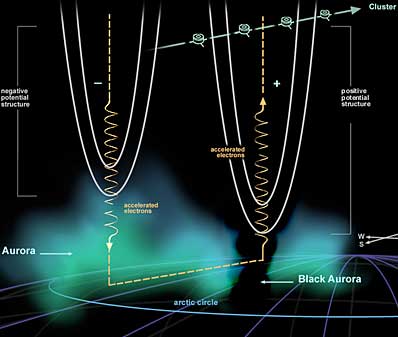
The black aurora takes on various guises - dark rings, curls or black blobs in a sea of faint, glowing aurora. According to the new results, to be announced today at a meeting of the American Geophysical Union in San Francisco, these peculiar patches are caused by a kind of 'anti-aurora', where conditions are the exact opposite of those in the normal aurora. The Cluster data show that the black aurora occurs where there are 'holes' in the ionosphere(*), the part of the upper atmosphere where aurorae are created. Here, the particles that make up the ionosphere are shooting upwards into space inside regions known as 'positively charged electric potential structures'. This is the opposite process to that which creates visible aurorae, where electrons spiral down from space into the atmosphere within similar, but negatively charged, structures. "The black aurora isn't actually an aurora at all; it's a lack of auroral activity in a region where electrons are 'sucked' from the ionosphere," explained Professor Goran Marklund of the Alfven Laboratory in Sweden. "Now, with the aid of the four Cluster spacecraft, we have been able to study for the first time the complex physical processes that create these auroral holes," he said. "Cluster has allowed us to discover how the huge vertical structures associated with the black aurora form, how long they last and how they vary with altitude." The first Cluster observations of the black aurora took place on the morning of January 14, 2001 as the four spacecraft swept from south to north across the northern aurora at an altitude of more than 21,600 km. Aligned like a string of pearls flying 100-seconds apart, the first three spacecraft (Rumba, Salsa and Samba) detected an increase in the energy of the upward-moving electrons, coinciding with an increase in the electric field that was accelerating the electrons, and a stable electric current. However, the electric field had vanished and no evidence of a structure could be seen by the time the fourth spacecraft (Tango) flew over the aurora. Similar results were obtained from a crossing of the southern hemisphere auroral zone on February 14. Once again, the electric field increased steadily in strength, but the electric current stayed constant as the quartet sped overhead.
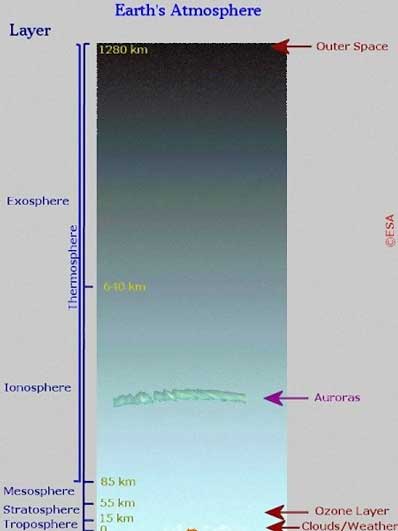
"This period of growth is comparable to the time it takes to 'suck' the electrons from parts of the ionosphere," said Marklund. "This is the first time that we have been able to follow the evolution of these structures as they accelerate the electrons away from the auroral ionosphere," he added. "Understanding the development and growth of these dynamic structures associated with the aurora is a major goal of the Cluster mission, and something which cannot be solved by single satellite measurements," he concluded. The results will be published in the journal Nature on December 13, 2001. (*) The ionosphere is a sparse layer of atmosphere, between 60 km and 600 km above the Earth, that reflects radio waves. It is filled with billions of particles - negatively charged electrons and positively charged ions.
|
|
|
|

|
||