|
 |

|
||||
|
|
||||
|
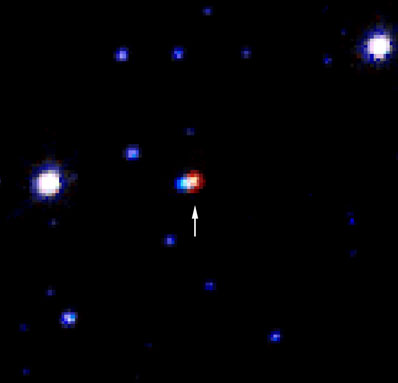
First image taken of a dark matter object released HUBBLE EUROPEAN SPACE AGENCY INFORMATION CENTRE Posted: December 6, 2001 Astronomers have observed a Dark Matter object directly for the first time. Images and spectra of a MACHO microlens - a nearby dwarf star that gravitationally focuses light from a star in another galaxy - were taken by the NASA/ESA Hubble Space Telescope and the European Southern Observatory's Very Large Telescope. The result is a strong confirmation of the theory that a large fraction of Dark Matter exists as small, faint stars in galaxies such as our Milky Way.
For the past ten years, active search projects have been underway for possible candidate objects for Dark Matter. One of many possibilities is that the Dark Matter consists of weakly interacting, massive sub- atomic sized particles known as WIMPs. Alternatively Dark Matter may consist of massive compact objects (MACHOs), such as dead or dying stars (neutron stars and cool dwarf stars), black holes of various sizes or planet-sized collections of rocks and ice. In 1986, Bohdan Paczynski from Princeton University realised that if some of the Dark Matter were in the form of MACHOs, its presence could be detected by the gravitational influence MACHOs have on light from distant stars. If a MACHO object in the Milky Way passes in front of a background star in a nearby galaxy, such as the Large Magellanic Cloud, then the gravitational field of the MACHO will bend the light from the distant star and focus it into our telescopes. The MACHO is acting as a gravitational lens, increasing the brightness of the background star for the short time it takes for the MACHO to pass by. Depending on the mass of the MACHO and its distance from Earth, this period of brightening can last days, weeks or months. The form and duration of the brightening caused by the MACHO - the microlensing light curve - can be predicted by theory and searched for as a clear signal of the presence of MACHO Dark Matter. MACHOs are described as `microlenses' since they are much smaller than other known cases of gravitational lensing, such as those observed around clusters of galaxies. Astronomers from the Lawrence Livermore National Laboratory, the Center for Particle Astrophysics in the United States and the Australian National University joined forces to form the MACHO Project in 1991. This team used a dedicated telescope at the Mount Stromlo Observatory in Australia to monitor the brightness of more than 10 million stars in the Large Magellanic Cloud over a period of eight years. The team discovered their first gravitational lensing event in 1993 and have now published approximately twenty instances of microlenses in the direction of the Magellanic Clouds. These results demonstrate that there is a population of MACHO objects in and around the Milky Way galaxy that could comprise as much as one half of the Milky Way total (baryonic/normal-matter) Dark Matter content. In order to learn more about each microlensing event, the MACHO team has used Hubble to take high-resolution images of the lensed stars. One of these images showed a faint red object within a small fraction of an arc-second from a blue, main sequence background star in the Large Magellanic Cloud. The image was taken by Hubble 6 years after the original microlensing event, which had lasted approximately 100 days. The brightness of the faint red star and its direction and separation from the star in the Large Magellanic Cloud are completely consistent with the values indicated 6 years earlier from the MACHO light curve data alone. This Hubble observation further reveals that the MACHO is a small faint, dwarf star at a distance of 600 light-years with a mass between 5% and 10% of the mass of the Sun. To further confirm its findings, members of the MACHO team sent in a special application for observing time on the FORS instrument on the European Southern Observatory's (ESO) Very Large Telescope (VLT)) to make spectra of the object. ESO responded swiftly and positively to the request. Although it was not possible to separate the spectra of the MACHO and background star, the combined spectrum showed the unmistakable signs of the deep absorption lines of a dwarf M star superimposed on the spectrum of the blue main sequence star in the Large Magellanic Cloud. The combination of the microlensing light curve from the MACHO project, the high-resolution images from Hubble and the spectroscopy from the VLT has established the first direct detection of a MACHO object, to be published in the international science journal Nature on 6 December. The astronomers now have a complete picture of the MACHO: its mass, distance and velocity. The result greatly strengthens the argument that a large fraction of the `normal' Dark Matter in and around our Galaxy exists in the form of MACHOs and that this Dark Matter is not as dark as previously believed! Future searches for MACHO-like objects will have the potential to map
out this form of Dark Matter and reach a greater understanding of the
role that Dark Matter plays in the formation of galaxies. These efforts
will further strengthen the drive to reveal the secrets of Dark Matter
and take a large step towards closing the books on the mass budget of
the Universe.
|
|
|
|

|
|