|
|
Curiosity finds clear evidence of ancient water flow on Mars
BY WILLIAM HARWOOD
STORY WRITTEN FOR CBS NEWS "SPACE PLACE" & USED WITH PERMISSION
Posted: September 27, 2012

NASA's Curiosity Mars rover, slowly nearing its initial science destination where multiple types of terrain come together, has found outcrops of conglomerate rocks made up of eroded gravels that scientists believe were transported across the floor of Gale Crater by a "vigorous" flow of ankle-to-hip-deep water in the distant past.
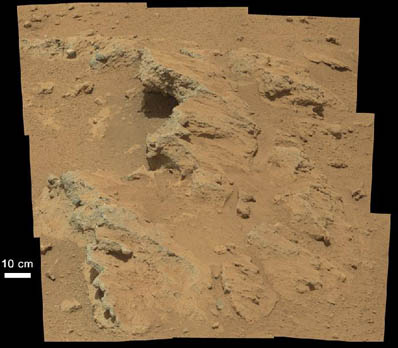
An outcrop of conglomerate rock on the floor of Gale Crater made up of cemented gravels that indicate an ancient flow of water downstream of a channel in the crater wall that spreads out into an alluvial fan up slope from the Curiosity rover. Credit: NASA/JPL-Caltech/MSSS
See larger image
|
It's the first observation of its kind on Mars, showing that an alluvial fan photographed from orbit was, as suspected, formed due to the action of flowing water that entered the crater through a 100-foot-deep, 2,000-foot-wide channel dubbed Peace Vallis that cuts through the crater rim and then fans out across a gentle 1-degree slope toward Curiosity's landing site.
"This rock is made up of rounded gravels in a matrix that's very sand rich," Rebecca Williams of the Planetary Science Institute in Tucson, AZ, told reporters. "And these attributes are consistent with a common sedimentary rock type called a conglomerate. ... Over time, erosion is working on that rock face and liberating some of the gravels and they're falling down and accumulating in a pile at the base of that outcrop."
Geologists are interested in such gravels, she said, because "they tell you that those particles had been subjected to a sediment transport process, either by water or wind."
"And so typically, you start off with a very angular rock fragment and as it's transported, it's bouncing along, interacting with other grains and the surface, and that wears away the edges until you have a very smooth surface. The key components of these gravels are the rounded shape and also the size. These are too large to be transported by wind. The consensus of the science team is these are water transported gravels in a vigorous stream."
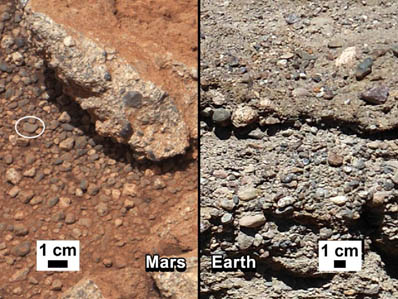
This set of images compares the Link outcrop of rocks on Mars (left) with similar rocks seen on Earth (right). Credit: NASA/JPL-Caltech/MSSS and PSI
See larger image
|
Bill Dietrich, a co-investigator at the University of California at Berkeley, said the gravel size and the distance the rocks were were transported indicates the flow "might have been from ankle-to-hip deep and maybe moving a few feet a second."
In a news release summarizing the findings, Dietrich said "plenty of papers have been written about channels on Mars with many different hypotheses about the flows in them. This is the first time we're actually seeing water-transported gravel on Mars. This is a transition from speculation about the size of streambed material to direct observation of it."
Project scientist John Grotzinger told reporters scientists already were virtually certain that water flowed into Gale Crater in the distant past based on orbital photographs showing what appeared to be an alluvial fan spreading out from the crater rim. Curiosity landed on the floor of the broad crater Aug. 6
But seeing such a structure from orbit is one thing. Seeing the actual rocks made up of debris that was once swept along shallow channels making up the fan is gratifying to the science team because it provides "ground truth" for the observations made from orbit and shows Curiosity landed in a scientifically rich site.
The Curiosity rover was built look for signs of past or present habitability, at least as it is known on Earth, which requires water, a source of energy and organic compounds. The rover is equipped with sophisticated instruments to look for carbon compounds, but no such observations have yet been attempted.
But the discovery of conglomerate rocks in the outflow of the ancient channel that fed the alluvial fan indicates the science team is on the right track and that water played a significant role in the crater's history.
Curiosity currently is on the way to an area known as Glenelg, where three different types of terrain come together.
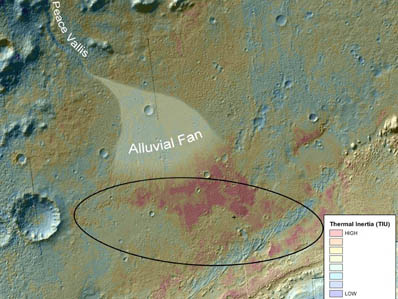
This false-color map shows the area within Gale Crater merges topographic data with thermal inertia data that record the ability of the surface to hold onto heat. The rover is heading toward Glenelg, just to the lower right of Bradbury, where three different types of material connect up in a "triple junction." Credit: NASA/JPL-Caltech/ASU
See larger image
|
"We've driven quite a long way," Grotzinger said. "Yesterday, we had our longest drive of quite a bit over 50 meters and we are most of the way now to Glenelg. The science team is busy trying to choose a target to collect material, probably wind-blown sand, that we will put into (the rover's) chemical laboratories for the first time on this mission."
That work will take two to three weeks, he said, and scientists are taking their time picking out an appropriate sample acquisition site.
In the meantime, "as we were driving along on the way to Glenelg, we encountered some really interesting outcrops that were surprising to the team," Grotzinger said of the conglomerate outcrop. "To us, it just looked like somebody came along the surface of Mars with a jackhammer and lifted up a sidewalk that you might see in downtown LA, sort of like in a construction site.
"What represents the consensus opinion of the science team is that this is a rock that was formed in the presence of water. And we can characterize that water as being a vigorous flow, on the surface of Mars. We're really excited about this because this is one of the reasons that we were interested in coming to this landing site, because it presented from orbit quite a strong case that we would find evidence of water on the ground."
As it turned out, he said, "we landed on this (alluvial fan) and it makes a great starting point for us to do more sophisticated studies using the rover payload."

Additional coverage for subscribers:
 VIDEO:
THE MARS SCIENCE LAB FULL LAUNCH EXPERIENCE PLAY | HI-DEF VIDEO:
THE MARS SCIENCE LAB FULL LAUNCH EXPERIENCE PLAY | HI-DEF
VIDEO:
ATLAS 5 ROCKET LAUNCHES MARS SCIENCE LAB PLAY | HI-DEF
VIDEO:
ONBOARD CAMERA VIEW OF NOSE CONE JETTISON PLAY | HI-DEF
VIDEO:
ONBOARD CAMERA VIEW OF THE STAGING EVENT PLAY | HI-DEF
VIDEO:
ONBOARD VIEW OF ROCKET RELEASING MSL PLAY
VIDEO:
LAUNCH DECLARED A SUCCESS PLAY

VIDEO:
LAUNCH REPLAYS: OUR VIEW OF LIFTOFF PLAY | HI-DEF
VIDEO:
LAUNCH REPLAYS: VAB ROOF PLAY | HI-DEF
VIDEO:
LAUNCH REPLAYS: PATRICK AFB PLAY | HI-DEF
VIDEO:
LAUNCH REPLAYS: SOUTH OF THE PAD PLAY | HI-DEF
VIDEO:
LAUNCH REPLAYS: THE BEACH TRACKER PLAY | HI-DEF
VIDEO:
LAUNCH REPLAYS: SHUTTLE PAD CAMERA PLAY | HI-DEF
VIDEO:
LAUNCH REPLAYS: SHUTTLE WATER TOWER PLAY | HI-DEF
VIDEO:
LAUNCH REPLAYS: TRACKER WEST OF THE PAD PLAY | HI-DEF
VIDEO:
LAUNCH REPLAYS: CLOSE-UP ON UMBILICALS PLAY | HI-DEF
VIDEO:
LAUNCH REPLAYS: COMPLEX 41 VIF PLAY | HI-DEF
VIDEO:
LAUNCH REPLAYS: THE PRESS SITE PLAY | HI-DEF
VIDEO:
PRE-LAUNCH INTERVIEW WITH PROJECT MANAGER PLAY | HI-DEF
VIDEO:
NARRATED PREVIEW OF ATLAS 5 ASCENT PROFILE PLAY | HI-DEF
VIDEO:
ROCKET'S LAUNCH CAMPAIGN HIGHLIGHTS PLAY | HI-DEF
VIDEO:
MSL'S LAUNCH CAMPAIGN HIGHLIGHTS PLAY | HI-DEF
VIDEO:
SPACECRAFT CLEANROOM TOUR PLAY | HI-DEF
VIDEO:
ATLAS ROCKET ROLLS OUT TO LAUNCH PAD PLAY | HI-DEF
VIDEO:
TIME-LAPSE VIEWS OF ROCKET ROLLOUT PLAY | HI-DEF
VIDEO:
THE PRE-LAUNCH NEWS CONFERENCE PLAY
VIDEO:
CURIOSITY ROVER SCIENCE BRIEFING PLAY
VIDEO:
LOOKING FOR LIFE IN THE UNIVERSE PLAY
VIDEO:
WHAT WE KNOW ABOUT THE RED PLANET PLAY
VIDEO:
ROBOTICS AND HUMANS TO MARS TOGETHER PLAY
VIDEO:
PREVIEW OF ENTRY, DESCENT AND LANDING PLAY | HI-DEF
VIDEO:
PREVIEW OF CURIOSITY ROVER EXPLORING MARS PLAY | HI-DEF
VIDEO:
A FLYOVER OF THE GALE CRATER LANDING SITE PLAY | HI-DEF
VIDEO:
NUCLEAR GENERATOR HOISTED TO ROVER PLAY | HI-DEF
VIDEO:
MARS SCIENCE LAB MOUNTED ATOP ATLAS 5 PLAY | HI-DEF
VIDEO:
MOVING MSL TO ATLAS ROCKET HANGAR PLAY | HI-DEF
VIDEO:
SPACECRAFT PLACED ABOARD TRANSPORTER PLAY | HI-DEF
VIDEO:
APPLYING MISSION LOGOS ON THE FAIRING PLAY | HI-DEF
VIDEO:
MSL ENCAPSULATED IN ROCKET'S NOSE CONE PLAY | HI-DEF
VIDEO:
FINAL LOOK AT SPACECRAFT BEFORE SHROUDING PLAY | HI-DEF
VIDEO:
HEAT SHIELD INSTALLED ONTO SPACECRAFT PLAY | HI-DEF
VIDEO:
BEAUTY SHOTS OF SPACECRAFT PACKED UP PLAY | HI-DEF
VIDEO:
ATTACHING THE RING-LIKE CRUISE STAGE PLAY | HI-DEF
VIDEO:
PARACHUTE-EQUIPPED BACKSHELL INSTALLED PLAY | HI-DEF
VIDEO:
SKYCRANE AND CURIOSITY MATED TOGETHER PLAY | HI-DEF
VIDEO:
TWO-HALVES OF ROCKET NOSE CONE ARRIVES PLAY | HI-DEF
VIDEO:
CENTAUR UPPER STAGE HOISTED ATOP ATLAS PLAY | HI-DEF
VIDEO:
FINAL SOLID ROCKET BOOSTER ATTACHED PLAY | HI-DEF
VIDEO:
FIRST OF FOUR SOLID BOOSTERS MOUNTED PLAY | HI-DEF
VIDEO:
FIRST STAGE ERECTED ON MOBILE LAUNCHER PLAY | HI-DEF
VIDEO:
STAGES DRIVEN FROM HARBOR TO THE ASOC PLAY | HI-DEF
VIDEO:
ROCKET ARRIVES ABOARD SEA-GOING VESSEL PLAY | HI-DEF
VIDEO:
STOWING ROVER'S INSTRUMENTED ROBOT ARM PLAY | HI-DEF
VIDEO:
DEPLOYING CURIOSITY'S SIX WHEELS ON EARTH PLAY | HI-DEF
VIDEO:
MMRTG PUT BACK INTO STORAGE AT SPACEPORT PLAY | HI-DEF
VIDEO:
NUCLEAR GENERATOR FIT-CHECK ON THE ROVER PLAY | HI-DEF
VIDEO:
ROVER'S NUCLEAR POWER SOURCE ARRIVES PLAY | HI-DEF
VIDEO:
SPIN-TESTING THE RING-LIKE CRUISE STAGE PLAY | HI-DEF
VIDEO:
UNCOVERING CURIOSITY ROVER IN CLEANROOM PLAY | HI-DEF
VIDEO:
UNVEILING THE ROCKET-POWERED SKYCRANE PLAY | HI-DEF
VIDEO:
UNBOXING THE ROVER FROM SHIPPING CRATE PLAY | HI-DEF
VIDEO:
ROVER HAULED FROM RUNWAY TO PHSF FACILITY PLAY | HI-DEF
VIDEO:
MARS ROVER ARRIVES AT KENNEDY SPACE CENTER PLAY | HI-DEF
VIDEO:
DESCENT WEIGHTS INSTALLED ON BACKSHELL PLAY | HI-DEF
VIDEO:
SOLAR ARRAY PANELS ATTACHED TO CRUISE RING PLAY | HI-DEF
SUBSCRIBE NOW
|
|
|
|
John Glenn Mission Patch
Free shipping to U.S. addresses!
 The historic first orbital flight by an American is marked by this commemorative patch for John Glenn and Friendship 7. The historic first orbital flight by an American is marked by this commemorative patch for John Glenn and Friendship 7.
 U.S. STORE U.S. STORE
WORLDWIDE STORE

|