|
 |

|
||||
|
|
||||
|
Spirit looks down into crater after reaching rim MISSION CONTROL REPORT Posted: March 11, 2004
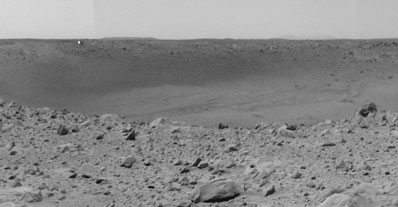
NASA's Spirit has begun looking down into a crater it has been approaching for several weeks, providing a view of what's below the surrounding surface.
"It's been an extremely exciting and productive week for both of the rovers," said Spirit Mission Manager Jennifer Trosper at NASA's Jet Propulsion Laboratory, Pasadena, Calif. Dr. Chris Leger, a rover driver at JPL, said, "The terrain has been getting trickier and trickier as we've gotten close to the crater. The slopes have been getting steeper and we have more rocks." Spirit has now traveled a total of 335 meters (1,099 feet). Spirit's new position on the rim of the crater nicknamed "Bonneville" offers a vista in all directions, including the crater interior. The distance to the opposite rim is about the length of two football fields, nearly 10 times the diameter of Opportunity's landing-site crater halfway around the planet from Spirit. Initial images from Spirit's navigation camera do not reveal any obvious layers in "Bonneville's" inner wall, but they do show tantalizing clues of rock features high on the far side, science-team member Dr. Matt Golombek of JPL said at a news briefing today. "This place where we've just arrived has opened up, and it's going to take us a few days to get our arms around it." Scientists anticipate soon learning more about the crater from Spirit's higher-resolution panoramic camera and the miniature thermal emission spectrometer, both of which can identify minerals from a distance. They will use that information for deciding whether to send Spirit down into the crater. From the crater rim and during martian nighttime earlier today, Spirit took pictures of stars, including a portion of the constellation Orion. Shortly before dawn four martian days earlier, it photographed Earth as a speck of light in the morning twilight. The tests of rover capabilities for astronomical observations will be used in planning possible studies of Mars' atmospheric characteristics at night. Those studies might include estimating the amounts of dust and ice particles in the atmosphere from their effects on starlight, said Dr. Mark Lemmon, a science team member from Texas A&M University, College Station.
Opportunity has been looking up, too. It has photographed Mars' larger moon, Phobos, passing in front of the Sun twice in the past week, and Mars' smaller moon, Deimos, doing so once. Opportunity's miniature thermal emission spectrometer has taken upward-looking readings of the atmospheric temperature at the same time as a similar instrument, the thermal emission spectrometer on NASA's Mars Global Surveyor orbiter, took downward-pointed readings while passing overhead. "They were actually looking directly along the same path," said science team member Dr. Michael Wolff of the Martinez, Ga., branch of the Space Science Institute, Boulder, Colo. The combined readings give the first full temperature profile from the top of Mars' atmosphere to the surface." When pointed at the ground, Opportunity's miniature thermal emission spectrometer has checked the abundance of hematite in all directions from the rover's location inside its landing-site crater. This mineral, in its coarse-grained form, usually forms in a wet environment. Detection of hematite from orbit was the prime factor in selection of the Meridiani Planum region for Opportunity's landing site. "The plains outside our crater are covered with hematite," said Dr. Phil Christensen of Arizona State University, Tempe, lead scientist for the instrument. "The rock outcrop we've been studying has some hematite. Parts of the floor of the crater, interestingly enough, have virtually none." The pattern fits a theory that the crater was dug by an impact that punched through a hematite-rich surface layer, he said. One goal for Opportunity's future work is to learn more about that surface layer to get more clues about the wet past environment indicated by sulfate minerals identified last week in the crater's outcrop. Christensen said that before Opportunity drives out of the crater in about 10 days, scientists plan to investigate one area on the inner slope of the crater that he called "the mother lode of hematite." JPL, a division of the California Institute of Technology in Pasadena, manages the Mars Exploration Rover project for NASA's Office of Space Science, Washington, D.C.
|
|
|
|
Status quicklook Check the status center for complete coverage. 
|
||
|
MISSION STATUS CENTER |
||||||

 VIDEO: TODAY'S SCIENCE AND ROVER STATUS BRIEFING