Twin roving geologists bound for surface of Mars
BY WILLIAM HARWOOD
SPACEFLIGHT NOW

Posted: May 29, 2003


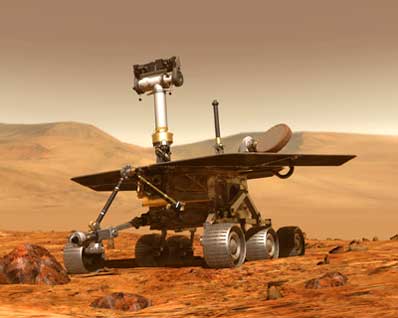
The Mars Exploration Rovers are NASA's next step in studying the mysteries of the Red Planet. Credit: NASA/JPL
 
Building on past successes -- and learning from embarrassing failures -- NASA is poised to jump start its Mars exploration program by sending a pair of "monster truck" rovers to the Red Planet in an $800 million mission to search for clues about what happened to the water than once carved the martian surface.

Launched in June and arriving at their destinations in January, the Mars Exploration Rovers will crawl up to 100 meters (330 feet) per day across two carefully selected landing sites, poring over rocks and soil like robot field geologists and, like any tourist, snapping panoramic pictures as they creep along.

Both solar-powered rovers are equipped with an articulated robot arm carrying the equivalent of a rock hammer and a geologist's lens in the form of high-resolution cameras and instruments to measure the chemical composition of selected samples.

Using powerful computer software, stereoscopic vision and six independently driven and independently steerable wheels, the rovers will autonomously navigate around obstacles while out of contact with ground controllers at the Jet Propulsion Laboratory in Pasadena, Calif.

Commands and engineering data will be beamed directly to and from the rovers during relatively short communications sessions during the start of each martian day, or "sol." Scientific data will be relayed back to Earth twice each afternoon via UHF radio links with the Mars Global Surveyor and Mars Odyssey spacecraft currently in orbit around Mars.

Compared to the small Sojourner rover that caught the world's fancy during the 1997 Mars Pathfinder mission, the Mars Exploration Rovers are full-fledged sport utility vehicles, weighing in at nearly 180 kilograms (400 pounds) each.

"This is the monster truck of Mars rovers," joked MER project scientist Steve Squyres, a geologist at Cornell University.


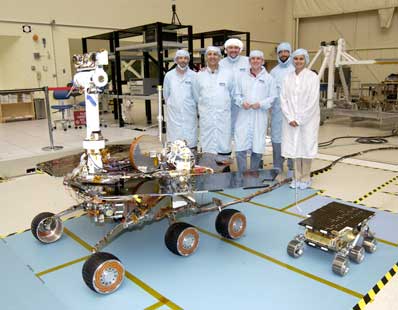
A Mars Exploration Rover stands beside a model of the Pathfinder mission's rover. Credit: NASA/JPL
 
But the objectives of the MER program are no joke. Coming on the heels of two devastating Mars failures in 1999 -- and the Columbia shuttle disaster earlier this year -- NASA is under pressure to prove it still has the right stuff when it comes to space exploration.

More important, the rovers are a critical link in a chain of increasingly ambitious Mars missions designed to prove once and for all whether life ever evolved on the fourth planet.

"You can think of the science objectives of MER as being fundamentally to send two robot geologists to the two most interesting places that we can find on the planet that's safe to land," Squyres said. "And to try to assess whether or not they're the kinds of places where life could have once taken hold and thrived. It's about habitability, it's about whether or not Mars was a habitable place.

"Today, Mars is cold, it's dry, it's barren, it's a very, very inhospitable place for life. But when we look at it from orbit, we see dried up river beds, we see dried up lakebeds, we see minerals that say water maybe was here.

"So what we want to do is go to those places where we think water may have been present, read the record and find out was it warm, was it wet, how warm, how wet, how habitable?"

Getting back on track
The Mars Pathfinder and the Mars Global Surveyor were the first two missions in a long-range scientific assault on Mars and the mystery of its missing water. The original program called for launching two missions every two years, when Mars is favorably positioned, culminating in a robotic sample return mission at the end of this decade.

  Mars '98 missions
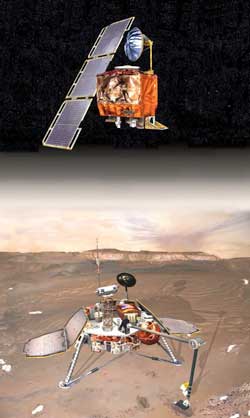
Artist's concept of the failed Mars Climate Orbiter and Polar Lander missions. Photo: NASA/JPL
 
But the second pair of spacecraft -- the Mars Climate Orbiter and the Mars Polar Lander -- were lost in 1999. The Climate Orbiter crashed into the planet due to an embarrassing English-to-metric conversion oversight while the Polar Lander simply disappeared during powered descent to the surface. Engineers believe a sensor problem led to the premature shutdown of its engines.

Wide-ranging NASA and independent investigations identified major management and technical shortcomings in the implementation of former NASA Administrator Daniel Goldin's "faster, better, cheaper" approach to planetary exploration.

The space agency decided to press ahead with the 2001 launch of the Mars Odyssey, currently mapping the Red Planet in concert with the Mars Global Surveyer, but a lander virtually identical to the lost Polar Lander was grounded.

After pondering what sort of mission to mount in 2003, NASA managers ultimately settled on a pair of landers equipped with proven, state-of-the-art instruments and a Pathfinder-style parachute and air bag descent system to improve the odds of a safe touchdown.

"We were faced with a very tough time constraint when I took over as Mars program director in March 2000," said Scott Hubbard, currently director of NASA's Ames Research Center and a member of the board investigating the Columbia disaster.

"We had to make a decision on something that we thought had a high probability of success. And there was at that time no technology available for final landing, terminal descent, for a legged lander that had obstacle avoidance."

Without a reliable, autonomous way for a powered lander to steer around large boulders or steeply sloped terrain during final approach, the success or failure of a costly mission came down to pure chance. Assuming the spacecraft got that far in the first place.

"So given the demonstration of Pathfinder for the air bag technology ... it seemed like the hazard avoidance technology would probably be for a future mission and this looked like a good marriage between existing instruments and a delivery technology that had been proven by Pathfinder."

Even so, he said in an interview, "I will be holding my breath with everybody else, first with the launches and particularly when we get to the landing. ... I feel a little bit like an expectant father."

Landing sites with a watery past
The MER-A lander was scheduled for launch from the Cape Canaveral Air Force Station June 8 atop a Boeing Delta 2 rocket. The second lander was to follow suit June 25.

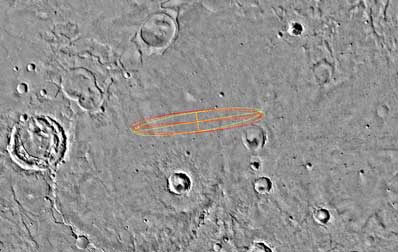
MER-A's target is Gusev Crater, 15 degrees south of the martian equator. MER-B is heading for Meridiani Planum, two degrees below the equator on the other side of Mars. The landing sites were culled from a list of 155 potential targets.


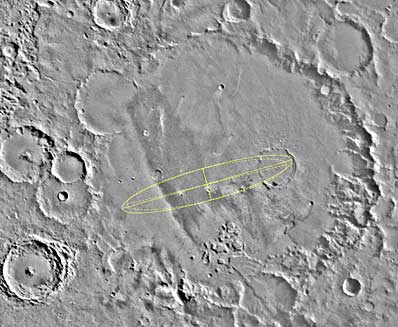
Gusev Crater is seen here in its geological context from NASA Viking images. Credit: NASA/JPL
 
"Gusev is a big hole in the ground, a crater, and it's got this huge dried up river bed flowing into it," Squyres said. "Now if you can come up with an explanation that says there wasn't a lake there, I'd like to hear it. I mean it was water and it flowed into a hole in the ground.

"This is a big crater, it may have been there for a considerable period of time and you're going to have liquid water standing there for long periods of time, potentially, and then you've got sediments, stuff got eroded out of that valley, it had to go someplace. Sedimentary rocks can do a wonderful job of preserving a record of environmental conditions to a geologist who's properly equipped to read that record."

The second rover is bound for a different sort of target, one known to have a high concentration of iron oxide, or gray hematite.


This Viking image of Meridiani Planum shows were the second Mars Exploration Rover is headed. Credit: NASA/JPL
 
"Hematite formes in a number of different ways on Earth but most of them involve the action of liquid water," Squyres said. "So you can think of the hematite mineral signatures being kind of a beacon that's saying to us, 'hey, water may have been here.' Now we don't know how it formed, it could have been a hydrothermal system, could have been a lake, we're not sure. But it says, mineralogically, water."

Still, there is an element of doubt.

"We could be wrong. We could be dead wrong about either one of these sites," Squyres said. "The beauty of going to two different sites is you basically double your science because Mars is such a diverse place. We can go after two really different sets of scientific questions."

Flight Data File
Vehicle: Delta 2 (7925)
Payload: NASA's Mars Exploration Rover-A
Launch date: June 10, 2003
Launch time: 1:58:47 p.m. EDT (1758:47 GMT)
Launch site: SLC-17A, Cape Canaveral, Florida
Satellite broadcast: AMC 2, Transponder 9, C-band

Pre-launch briefing

Mission preview - Our story examining the Mars Exploration Rover project.

Launch windows - A chart listing the daily launch times for MER-A.

Launch timeline No. 1 - Chart with times and descriptions of events to occur during the launch if the first daily opportunity is used.

Launch timeline No. 2 - Chart with times and descriptions of events to occur during the launch if the second daily opportunity is used.

Launch hazard area - A map of the restricted area during liftoff.

Ground track - See the trajectory the rocket will follow during its flight.

Getting to Mars - Our story previewing the rovers' descent and landing to the Martian surface.

MER spacecraft - A technical look at the parts and pieces of the Mars Exploration Rover spacecraft.

Mission science - A look at the science instruments and objectives for the Mars rovers.

Future exploration - Our story looking at NASA's plans for Mars missions through the decade.

Delta 2 rocket - Overview of the Delta 2 Heavy-model rocket used in this launch.

SLC-17 - The launch complex where Delta rockets fly from Cape Canaveral.

Delta directory - See our coverage of previous Delta rocket flights.

Apollo 11 special patch
Special collectors' patch marking the 35th anniversary of the historic Apollo 11 moon landing is now available.
 Choose your store:
U.S. - U.K. - E.U. - Worldwide

Inside Apollo mission control
An insider's view of how Apollo flight controllers operated and just what they faced when events were crucial.
 Choose your store:
U.S.

The ultimate Apollo 11 DVD
This exceptional chronicle of the historic Apollo 11 lunar landing mission features new digital transfers of film and television coverage unmatched by any other.
 Choose your store:
U.S. - U.K. - E.U. - Worldwide

Next ISS crew
Own a little piece of history with this official patch for the International Space Station's Expedition 11 crew. We'll ship yours today!
 Choose your store:
U.S.

Mission Report
Gemini 7: The NASA Mission Reports covers this 14-day mission by Borman and Lovell as they demonstrated some of the more essential facts of space flight. Includes CD-ROM.
 U.S. STORE
 WORLDWIDE STORE

Get e-mail updates
Sign up for our NewsAlert service and have the latest news in astronomy and space e-mailed direct to your desktop (privacy note: your e-mail address will not be used for any other purpose).
Enter your e-mail address:

Hubble Posters
Stunning posters featuring images from the Hubble Space Telescope and world-renowned astrophotographer David Malin are now available from the Astronomy Now Store.
 U.S. STORE
 U.K. & WORLDWIDE STORE

Clearance sale


Price cuts on spectacular calendars featuring the Hubble Space Telescope, Space Station and Earth from space.
 U.S. STORE
 U.K. & WORLDWIDE STORE

Soviet Space
For the first time ever available in the West. Rocket & Space Corporation Energia: a complete pictorial history of the Soviet/Russian Space Program from 1946 to the present day all in full color. Available from our store.
 Choose your store:
U.S. - U.K. - E.U. - Worldwide

Viking patch
This embroidered mission patch celebrates NASA's Viking Project which reached the Red Planet in 1976.
 Choose your store:
U.S. - U.K. - E.U. - Worldwide

Apollo 7 DVD
For 11 days the crew of Apollo 7 fought colds while they put the Apollo spacecraft through a workout, establishing confidence in the machine what would lead directly to the bold decision to send Apollo 8 to the moon just 2 months later.
 Choose your store:
U.S. - U.K. - E.U. - Worldwide

Gemini 12
Gemini 12: The NASA Mission Reports covers the voyage of James Lovell and Buzz Aldrin that capped the Gemini program's efforts to prove the technologies and techniques that would be needed for the Apollo Moon landings. Includes CD-ROM.
 Choose your store:
U.S. - U.K. - E.U. - Worldwide

Apollo 11 special patch
Special collectors' patch marking the 35th anniversary of the historic Apollo 11 moon landing is now available.
 Choose your store:
U.S. - U.K.
MISSION STATUS CENTER

INDEX | PLUS | NEWS ARCHIVE | LAUNCH SCHEDULE
ASTRONOMY NOW | STORE

ADVERTISE

© 2009 Spaceflight Now Inc.