|
|
|

|
|
Scientists confirm abundant water in lunar crater BY STEPHEN CLARK SPACEFLIGHT NOW Posted: November 13, 2009 
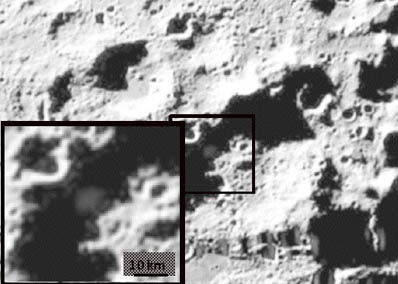
The Centaur rocket stage NASA dispatched on a suicidal plunge into the moon last month uncovered buckets of water inside a frigidly-cold, permanently-dark crater at the lunar south pole, scientists announced Friday. "Yes, we found water," said Tony Colaprete, the LCROSS mission's principal investigator at Ames Research Center. "We didn't find just a little bit. We found a significant amount."
"In our field of view, which is some fraction of the 20-meter crater we made...we had about 25 gallons or so of water," Colaprete said. That number is just a lower limit on the total quantity of water from the crater, and there could be more ice revealed upon further analysis, scientists said. Cabeus holds more water than soil in the Atacama Desert, a barren stretch of land in South America known as the driest place on Earth, according to Colaprete. "Many have said we've all of what we needed to learn about the moon from the Apollo missions. LCROSS is demonstrating that there's much more to learn, and there always is," said Doug Cooke, associate administrator for NASA's exploration systems mission directorate. "This is not your father's moon," said Mike Wargo, chief lunar scientist for the exploration prorgam. "This is not a dead body but one with an awful lot of dynamism in it." Near-infrared, visible and ultraviolet spectrometers mounted on a shepherding spacecraft observed the Centaur's impact and detected a cloud of material, including water vapor, rise above the lunar surface. NASA chartered the $79 million LCROSS mission to determine if water ice exists inside craters at the moon's poles. The craters have been robbed of sunlight for eons and temperatures dip to almost -400 degrees Fahrenheit, according to scientists. The Lunar Prospector satellite detected evidence of polar hydrogen concentrations during its mission a decade ago. A neutron sensor on the Lunar Reconnaissance Orbiter also found strong indications of hydrogen earlier this year. "A decade ago, we knew from Lunar Prospector measurements that there was a large amount of hydrogen in the polar regions of the moon," said Gregory Delory, senior fellow at the Space Sciences Laboratory at the University of California at Berkeley. "Because of the ambiguity of the measurements, there was no consensus," Delory said. "LCROSS has now made that definitive discovery." The findings are a boon to researchers and engineers alike. "It's so valuable to us for so many different reasons, for the scientific reasons for the exploration reasons. That water coule be the key for exploration," Wargo said. Future astronauts living on the moon could harvest ice for drinking water, breathing air and rocket fuel.
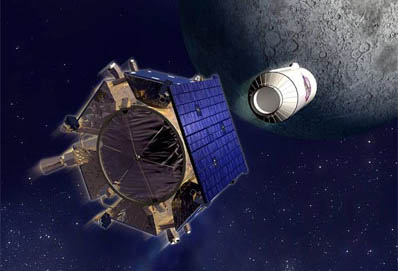
"The team has been working, I think, about 28 hours a day," Worden said. "I'm amazed that they look as bright-eyed and bushy-tailed as they are." LCROSS released the Centaur less than 10 hours before striking the moon, fired its thrusters to back away, and turned on its instruments to watch the impact. The rocket smacked into the moon less than 700 feet from its aimpoint. "The precision of the impact was incredible," Cooke said. "The instruments performed exceptionally well, and now we're seeing remarkable results that are beyond our expectations." Last month's smash produced no apparent fireball or obvious cloud of debris, as some scientists and a flock of Earth observers hoped. Instead, scientists had to carefully analyzed processed data before spotting visual evidence of the ejecta cloud rising between 6 and 8 miles above the surface and spreading hundreds of yards around the crater. But spectral instruments on the LCROSS shepherding satellite collected a heap of data on the chemical make-up of the material excavated by the Centaur. Scientists spent the last month analyzing "squiggly lines" that tell a much deeper story than images about the composition of the crater. Researchers knew the signature of water and hydroxyl, another hydrogen-bearing compound, and tried to fit the expected fingerprint of those molecules to what the LCROSS sensors observed. "That was the eureka moment," Colaprete said. "I was convinced there was water. I've got two independent people working independent problems, and they both came to the same conclusion." I'm pretty impressed by the amount of water in our little 20-meter crater," Colaprete said. Scientists are still in the early stages of analyzing data from LCROSS, and officials could not quantify the exact concentration of water in lunar soil at Cabeus. Future research will also determine the source of the water and how it is distributed across the lunar surface. Other missions have measured trace amounts of water spread far from the moon's poles in areas that receive much sunlight. Colaprete believes LCROSS detected enough water to indicate it is not all absorbed into the surface, but actually contained in ice itself. "What we need to do next is actually take all the information, the amount of ejecta, the size of the crater, how this all changed over time, and actually reconstruct the entire event, understand how it all fits back into the ground, along with all the other things that we've seen in the ejecta plume, to really understand this whole thing in its entirety," Colaprete said. |
|
|
|
|||||||||||||||||||||||
|
MISSION STATUS CENTER |
||||||||||||||||||||||||||||