| T-0:00:05.5 |
Engine start |
 |
The RS-68 main engine begins to ignite as the liquid hydrogen fuel valve is opened, creating a large fireball at the base of the rocket. The engine powers up to full throttle for a computer-controlled checkout before liftoff. |
|
| T-0:00:00.0 |
Liftoff |
 |
The rocket's two strap-on solid rocket motors are lit, the four hold-down bolts are released and the Delta 4 lifts off from Cape Canaveral's pad 37B. The pad's three swing arms retract at T-0 seconds. |
|
| T+0:01:00.7 |
Max-Q |
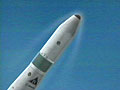 |
The vehicle experiences the region of maximum dynamic pressure. Both solid motors and the RS-68 liquid hydrogen/liquid oxygen engine continue to fire as the vehicle heads downrange, arcing over the Atlantic along a 95-degree flight azimuth. |
|
| T+0:01:40.0 |
Jettison solid motors |
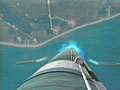 |
Having used up all their solid-propellant and experienced burnout six seconds ago, the two strap-on boosters are jettisoned from the Delta's first stage. The spent casings fall into the ocean. |
|
| T+0:03:30.0 |
Begin engine throttling |
 |
With the maximum axial acceleration reached, the RS-68 powerplant starts throttling down from 102 percent. It will achieve a 57 percent throttle in five seconds. |
|
| T+0:04:26.7 |
Main engine cutoff |
 |
The hydrogen-fueled RS-68 rocket engine completes its firing and shuts down to complete the first stage burn. |
|
| T+0:04:32.7 |
Stage separation |
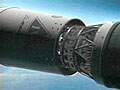 |
The Common Booster Core first stage and the attached interstage are separated in one piece from the Delta 4's upper stage. The upper stage engine's extendible nozzle drops into position as the first stage separates. |
|
| T+0:04:47.2 |
Second stage ignition |
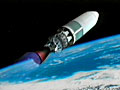 |
The upper stage begins its job to place the GOES-O satellite into space with the first of three firingsby the RL10B-2 liquid hydrogen/liquid oxygen engine. |
|
| T+0:04:57.5 |
Jettison payload fairing |
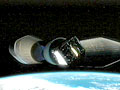 |
The four-meter diameter composite payload fairing that protected the GOES-O cargo atop the Delta 4 during the atmospheric ascent is no longer needed, allowing it to be jettisoned in two halves. |
|
| T+0:12:37.4 |
Upper stage shutdown |
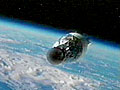 |
The RL10 upper stage engine shuts down to complete its first firing of the launch. The rocket and attached satellite reach a parking orbit of 100.6 by 298.6 nautical miles with an inclination of 28.4 degrees. |
| T+0:23:05.1 |
Restart upper stage |
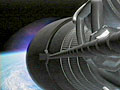 |
After a 10-minute coast period, the upper stage is reignited to raise the orbit's apogee to geosynchronous altitude. The stage's pitch program begins six seconds after restart and lasts until moments before engine cutoff. |
|
| T+0:27:07.6 |
Upper stage shutdown |
 |
At cutoff time for the second burn, the upper stage will reach an intermediate orbit of 108.6 by 18,459 nautical miles with an inclination of 26.6 degrees. |
|
| T+4:10:01.0 |
Restart upper stage |
|
The upper stage will spend a couple of hours coasting to the orbit's high point where the RL10 engine reignites to raise perigee and reduce inclination. |
|
| T+4:10:56.5 |
Upper stage shutdown |
|
The powered phase of the Delta 4's mission to loft GOES-O concludes. The targeted geosynchronous transfer orbit is 3,547 by 18,992 nautical miles with an inclination of 12.1 degrees. |
|
| T+4:17:16.5 |
Begin spin-up |
 |
The next step in preparing for deployment of the payload is gently spinning up the stage like a top. |
|
| T+4:21:26.5 |
Separate spacecraft |
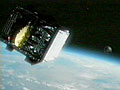 |
The GOES-O weather observatory is released into space from the Delta 4 rocket. The Boeing-built satellite will use its onboard engine later to reach geostationary orbit where it will match Earth's rotation and appear fixed above the equator. |