Spaceflight Now +
|
|
|
|
|
Premium video content for our Spaceflight Now Plus subscribers.
An American in orbit
 Mercury astronaut John Glenn becomes the first American to orbit the Earth on February 20, 1962, when he is launched aboard Friendship 7. Mercury astronaut John Glenn becomes the first American to orbit the Earth on February 20, 1962, when he is launched aboard Friendship 7.
 Play video Play video
Space Thanksgiving
 International Space Station commander Bill McArthur and flight engineer Valery Tokarev mark the Thanksgiving holiday in orbit during this downlinked message. International Space Station commander Bill McArthur and flight engineer Valery Tokarev mark the Thanksgiving holiday in orbit during this downlinked message.
Play video
Soyuz on the move
 Expedition 12 Soyuz commander Valery Tokarev and station commander Bill McArthur temporarily leave the International Space Station. They undocked their Soyuz capsule from the Pirs module and then redocked the craft to the nearby Zarya module. The move clears Pirs for use as the airlock for an upcoming Russian-based spacewalk. Expedition 12 Soyuz commander Valery Tokarev and station commander Bill McArthur temporarily leave the International Space Station. They undocked their Soyuz capsule from the Pirs module and then redocked the craft to the nearby Zarya module. The move clears Pirs for use as the airlock for an upcoming Russian-based spacewalk.
Play video
Pluto New Horizons
 Check out NASA's Pluto-bound New Horizons spacecraft undergoing thermal blanket installation inside the cleanroom at Kennedy Space Center's Payload Hazardous Servicing Facility in preparation for launch in January from the Cape. Check out NASA's Pluto-bound New Horizons spacecraft undergoing thermal blanket installation inside the cleanroom at Kennedy Space Center's Payload Hazardous Servicing Facility in preparation for launch in January from the Cape.
Play video
Mountains of creation
 A new image from NASA's Spitzer Space Telescope reveals billowing mountains of dust ablaze with the fires of stellar youth. The majestic infrared view from Spitzer resembles the iconic "Pillars of Creation" picture taken of the Eagle Nebula in visible light by NASA's Hubble Space Telescope. A new image from NASA's Spitzer Space Telescope reveals billowing mountains of dust ablaze with the fires of stellar youth. The majestic infrared view from Spitzer resembles the iconic "Pillars of Creation" picture taken of the Eagle Nebula in visible light by NASA's Hubble Space Telescope.
Play video
Space history: STS-51A
 This week marks the anniversary of arguably the most daring and complex space shuttle mission. The astronauts successfully launched two satellites and then recovered two others during extraordinary spacewalks by astronauts using jet-propelled backpacks and pure muscle power. This week marks the anniversary of arguably the most daring and complex space shuttle mission. The astronauts successfully launched two satellites and then recovered two others during extraordinary spacewalks by astronauts using jet-propelled backpacks and pure muscle power.
Play video
Space station EVA
 Commander Bill McArthur and flight engineer Valery Tokarev conduct a 5 1/2-hour spacewalk outside the International Space Station, installing a TV camera, doing repair chores and jettisoning a failed science probe. Commander Bill McArthur and flight engineer Valery Tokarev conduct a 5 1/2-hour spacewalk outside the International Space Station, installing a TV camera, doing repair chores and jettisoning a failed science probe.
Play video
Become a subscriber
More video
|
|
|
|
|
|
Cassini spacecraft discovers 'fountains' on Saturn moon
CASSINI PHOTO RELEASE
Posted: November 28, 2005
Credit: NASA/JPL/Space Science Institute
Download larger image version here
|
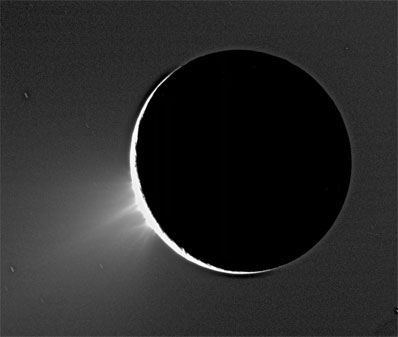
Recent Cassini images of Saturn's moon Enceladus backlit by the sun show the fountain-like sources of the fine spray of material that towers over the south polar region. This image was taken looking more or less broadside at the "tiger stripe" fractures observed in earlier Enceladus images. It shows discrete plumes of a variety of apparent sizes above the limb of the moon.
Credit: NASA/JPL/Space Science Institute
Download larger image version here
|
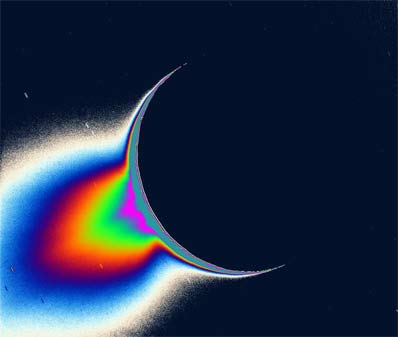
This color-coded image was processed to enhance faint signals, making contours in the plume of material even more apparent. The greatly enhanced and colorized image shows the enormous extent of the fainter, larger-scale component of the plume.
Credit: NASA/JPL/Space Science Institute
Download larger image version here
|
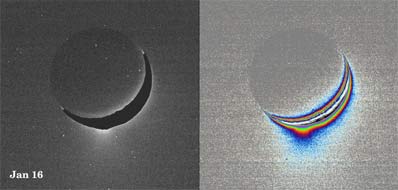
A fine spray of small, icy particles emanating from the warm, geologically unique province surrounding the south pole of Saturn's moon Enceladus was observed in a Cassini narrow-angle camera image of the crescent moon.
Taken from a high phase angle of 148 degrees - a viewing geometry in which small particles become much easier to see - the plume of material becomes more apparent in images processed to enhance faint signals.
Imaging scientists have measured the light scattered by the plume's particles to determine their abundance and fall-off with height. Though the measurements of particle abundance are more certain within 100 kilometers (60 miles) of the surface, the values measured there are roughly consistent with the abundance of water ice particles made by other Cassini instruments (reported in September 2005) at altitudes as high as 400 kilometers (250 miles) above the surface.
At present, it is not clear if the plume particles emanating from the south pole arises because of water vapor escaping from warm ice that is exposed to the surface. Another possibility is that at some depth beneath the surface, the temperatures are hot enough for water to become liquid, which then, under pressure, escapes to the surface like a cold Yellowstone geyser.
The image at the left was taken in visible green light. A dark mask was applied to the moon's bright limb to make the plume feature easier to see.
The image at the right has been color-coded to make faint signals in the plume more apparent. Images of other moons, such as Tethys and Mimas, taken in the last 10 months from similar lighting and viewing geometries, and with identical camera parameters, were closely examined to demonstrate that the plume towering above Enceladus' south pole is real and not a camera artifact.
The images were acquired at a distance of about 209,400 kilometers (130,100 miles) from Enceladus. Image scale is about 1 kilometer (0.6 mile) per pixel.
The Cassini-Huygens mission is a cooperative project of NASA, the European Space Agency and the Italian Space Agency. The Jet Propulsion Laboratory, a division of the California Institute of Technology in Pasadena, manages the mission for NASA's Science Mission Directorate, Washington, D.C. The Cassini orbiter and its two onboard cameras were designed, developed and assembled at JPL. The imaging operations center is based at the Space Science Institute in Boulder, Colo.
|
|
|
|

|