|
|
|

|
|
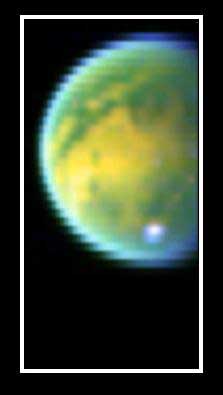
Cassini photos thrill, mystify scientists BY WILLIAM HARWOOD STORY WRITTEN FOR CBS NEWS "SPACE PLACE" & USED WITH PERMISSION Posted: July 3, 2004 New pictures of Saturn's enigmatic moon Titan, taken by cameras aboard the Cassini probe that are capable of penetrating the thick smog-like haze that blankets the frigid world, show strange looking surface features and a deck of methane clouds the size of Arizona. But so far, the instruments have not detected reflections from the surfaces of lakes or small seas of liquid hydrocarbons many scientists believe must form in the ultra-cold environment.
"If we go by 30 times and we haven't seen it, we're going to start getting worried," said Kevin Baines, a member of Cassini's Visual Infrared Mapping Spectrometer team. "But I'd say so far, just going by once, it may have been that the specular reflection point was a continent, a dry area. "So the planet could have plenty of liquids and we just got faked out. We don't know," he said in a telephone interview. "It's just 1 percent of the planet, we shouldn't reach any conclusions from that." Cassini's first flyby of Titan, the day after the craft braked into orbit around the ringed planet, was at a distance of more than 200,000 miles. In October, the nuclear-powered probe will pass within just 745 miles of Titan and "we really expect to get a great view then," said Elizabeth Turtle, a member of the Cassini imaging team.
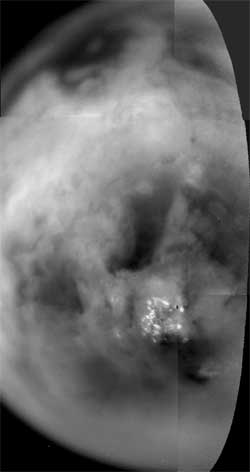
Using filters to look through specific spectral "windows" in the hazy atmosphere, "we're seeing surface features as small as 10 to 20 kilometers (six to 12 miles) across," Turtle said. "This is 10 times better than what we saw during approach. It's a huge improvement." A mosaic made up of the best pictures from Cassini's long-distance flyby show a broad region of Titan's surface stretching from just above its equator to the moon's south pole. A large dark feature vaguely resembling the letter H on its side was visible at the top of the mosaic. The equatorial zones below were dominated by brighter areas while a large deck of clouds was prominent near the south pole. Drifting some nine miles up in Titan's thick nitrogen atmosphere, the clouds clearly moved and changed shape in pictures shot over a five-hour period. "These are dynamical clouds and a meteorologically interesting part of the planet where storms might be happening," said Baines. "There's speculation that it may even be associated with a feature on the ground, so we may have some wind motion lifting up air, methane moisture-laden air, to the point where it can condense out and form clouds." Titan's atmosphere is made up primarily of nitrogen with small levels of methane and molecular hydrogen. Nitrogen and methane combine in the atmosphere but the action of sunlight, even at Saturn's distance, causes the compounds to disassociate and hydrocarbons fall to the surface. Based on a variety of lines of evidence, including a surface temperatures as low as -292 degrees Fahrenheit, scientists believe those hydrocarbons must exist in liquid form, as lakes or large pools. It's also possible Titan is more like a giant sponge, with liquids filling cavities in the materials making up its surface.
Based on Cassini's initial, long-distance flyby, the questions remain open. But scientists were nonetheless disappointed not to catch that tell-tale glint on the mission's first try. "The simulations I've done indicate that if the surface liquid is calm and not roughed up a lot by waves, it would be enormously bright, it would be the brightest thing we would see on Titan," said Bob West, a scientist at the Jet Propulsion Laboratory in Pasadena, Calif. "The calculations also show you can have quite a bit of overlying haze and even with a rough surface, I would have expected to see it by now. And we haven't." Even so, Turtle was elated at what the pictures did show. "It's dangerous to start interpreting a brand new surface that we've never seen before, especially on so little sleep," she said. "But we can't really resist. We're seeing surface brightness variations, we're not seeing topographic shading, the same way you would on a cloudy day on Earth, you don't see shadows or anything like that. "What we're seeing is just variations in the brightness of the surface. We see some surface features that are circular, others are linear. There are some features that look like they're rather concentric to near the south pole. ... And the sense that we're not just seeing circular blobs all over the place suggests it's not just a heavily cratered body, that there has been geologic activity on Titan. "Now, it's anyone's guess as to what that has been, there are quite a lot of candidates, But from these images, we can't say what the geologic activity has been." She said the apparent fuzziness of the surface could be the result of overlying haze, but "we are seeing some fairly fine detail as well." Perhaps not surprisingly, the Cassini data already has forced scientists to change their thinking about the processes going on at the surface. "It had been hypothesized that the dark materials on Titan are hydrocarbons that have fallen out of the atmosphere," Turtle said. "There's a lot of methane in the atmosphere and that gets processed and it falls out onto the surface in simple and complex hydrocarbons. It's been hypothesized that the dark areas were regions where that material had accumulated and that the bright areas might actually be cleaner water-ice regions that were perhaps even swept clean by methane rain coming out of the atmosphere." That was the theory until Friday night. Data from the infrared mapping spectrometer, Baines said, indicates "the brighter areas are mixtures of water ice but there's a mixture of other things in it which contributes to the brightness. So we think there are organics that contribute to that brightness. The brighter areas have been contaminated in a sense with organics, the dark areas are more pure water ice." Stay tuned. In other news, Don Gurnett, principal investigator with Cassini's Radio and Plasma Wave Science experiment, played a recording of particles slamming into the spacecraft as it passed through the plane of Saturn's rings. Moving at some 53,000 mph, Cassini crossed the plane between the F and G rings, a region thought to be devoid of large particles that could cause any serious damage. Playing it safe, the spacecraft was oriented with its big dish antenna facing forward to act as a shield. As it turned out, that was probably a good idea. Gurnett said his instrument recorded 680 impacts per second, some 100,000 in all, during the ascending ring plane crossing and a similar number on the other side of Saturn as Cassini flew back down through the plane. The average size of the particles was on the order of a thousandth of a millimeter, about the size of smoke particles. But some were possibly as large as a tenth of a millimeter. "When one of these particles comes in and hits the spacecraft, it essentially makes a little explosion," Gurnett said. "Hopefully the particle's not too big so it would go through the spacecraft. ... When that explosion occurs, there's a little puff of gas that's produced, part of it is spacecraft material and part of it the particle. And it's heated to like a hundred thousand degrees. And this puff of gas, which is ionized, when it expands over our (instrument) antenna, some of the charge is collected on the antenna and it makes a voltage pulse." He then played a recording of the impact data, converted into an audio file, which sounded like heavy rain hitting Cassini as it plowed through the ring plane. "I would say it was a good thing to have (Cassini's dish) antenna pointed into the direction the particles were arriving," he said. "That was a good move."
|
|
|
|
 |
||||||||||||||||||||||||||||||||||||||||||||
 Mission control erupts in applause as communications from Cassini confirm the orbit insertion burn has begun. (60sec file)
 Signals from Cassini announce the conclusion of the Saturn orbit insertion burn, confirming the spacecraft has arrived at the ringed planet. (2min 15sec file)
 Mission officials hold a post-orbit insertion burn news conference at 1 a.m. EDT July 1 to discuss Cassini's successful arrival at Saturn. (25min 27sec file)
 Cassini's health in the final hours before arrival at Saturn is presented in this status briefing from 12 p.m. EDT on June 30. (33min 09sec file)
 Officials from the U.S., European and Italian space agencies discuss the international cooperation in the Cassini mission and future exploration projects during this news conference from 2 p.m. EDT June 30. (19min 35sec file)
 This informal "ring-side chat" from 5 p.m. EDT June 30 discusses the Cassini mission to Saturn and the future of space exploration. (49min 20sec file)
 Mission managers and scientists provide an update on the Cassini mission and preview the spacecraft's arrival at Saturn during this news conference from June 29. (51min 58sec file)
 Scientists report scientific results from the Cassini spacecraft's close-up examination of Saturn's moon Phoebe. (31min 53sec file)
 This animation shows Cassini during its encounter with the tiny moon Phoebe on the route to Saturn. (42sec file)
 The Cassini spacecraft's arrival at Saturn is previewed in this detailed news conference from NASA Headquarters on June 3. (50min 01sec file)
 Cassini's make-or-break engine firing to enter orbit around Saturn is explained with graphics and animation. Expert narration is provided by Cassini program manager Robert Mitchell. (3min 33sec file)
 The scientific objectives of the Cassini mission to study the planet Saturn, its rings and moons are explained by Charles Elachi, director of the Jet Propulsion Laboratory. (4min 54sec file)
 After entering orbit around Saturn, the Cassini spacecraft will launch the European Huygens probe to make a parachute landing on the surface of the moon Titan. The scientific objectives of Huygens are explained by probe project manager Jean-Pierre Lebreton. (3min 14sec file)