|
||||
|
|
||||
|
|
||||
|
BY JUSTIN RAY Follow the preparations to the maiden launch of Lockheed Martin's Atlas 5 rocket carrying the Eutelsat Hot Bird 6 TV broadcasting satellite. Reload this page for the very latest on the mission. Use our text only page for faster downloads.
THURSDAY, AUGUST 22, 2002
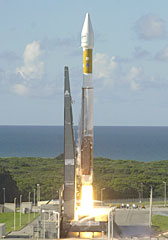
WEDNESDAY, AUGUST 21, 2002 After a remarkably smooth countdown, the inaugural flight began exactly on time at 6:05 p.m. EDT (2205 GMT) from Complex 41 at Cape Canaveral Air Force Station, Florida. Streaking across the Atlantic and into darkness, the two-stage rocket hurled the French-built Hot Bird 6 television broadcasting satellite into a supersynchronous transfer orbit for Paris-based operator Eutelsat. The craft was released over western Africa, just south of the equator, some 31-1/2 minutes after liftoff to complete the 61st consecutive successful Atlas launch. "It was absolutely gorgeous!" Air Force Col. Susan Mashiko, director of the Evolved Expendable Launch Vehicle program office, said after the flight. "Everybody was holding their breath. It was phenomenal." The idea for Atlas 5 goes back almost 10 years when the U.S. military began studies to modernize the capabilities of space launch by enhancing reliability and reducing costs. Atlas 5 and Boeing's Delta 4, scheduled to debut in October, were selected by the Air Force as America's next-generation launchers under the EELV banner. "We had a vision back in 1993 of where we wanted to take the Atlas. With today's successful launch, we celebrate the achievement of that vision and the continuing success story of Atlas," said G. Thomas Marsh, president and general manager of Lockheed Martin Space Systems - Astronautics Operations. A post-launch news conference is scheduled for 10 a.m. EDT Thursday morning. We'll have a complete wrap-up story after that event. We have assembled a photo gallery of 22 launch images, including several taken from video cameras mounted to the rocket. For our Spaceflight Now Plus subscribers, here is a collection of video clips from the maiden voyage of Atlas 5:
2315 GMT (7:15 p.m. EDT)
2257 GMT (6:57 p.m. EDT)
2251 GMT (6:51 p.m. EDT)
2245 GMT (6:45 p.m. EDT)
2238 GMT (6:38 p.m. EDT) We'll take a quick pause. Check back for the orbit numbers and plenty of video and images tonight!
2236 GMT (6:36 p.m. EDT)
2235 GMT (6:35 p.m. EDT)
2234 GMT (6:34 p.m. EDT)
2233 GMT (6:33 p.m. EDT)
2232 GMT (6:32 p.m. EDT)
2231 GMT (6:31 p.m. EDT)
2230 GMT (6:30 p.m. EDT)
2229 GMT (6:29 p.m. EDT)
2228 GMT (6:28 p.m. EDT)
2227 GMT (6:27 p.m. EDT)
2225 GMT (6:25 p.m. EDT)
2223 GMT (6:23 p.m. EDT)
2222 GMT (6:22 p.m. EDT)
2221 GMT (6:21 p.m. EDT)
2220 GMT (6:20 p.m. EDT)
2219 GMT (6:19 p.m. EDT)
2217 GMT (6:17 p.m. EDT)
2216 GMT (6:16 p.m. EDT)
2214 GMT (6:14 p.m. EDT)
2212 GMT (6:12 p.m. EDT)
2211 GMT (6:11 p.m. EDT)
2210 GMT (6:10 p.m. EDT)
2209 GMT (6:09 p.m. EDT)
2208 GMT (6:08 p.m. EDT)
2207 GMT (6:07 p.m. EDT)
2206 GMT (6:06 p.m. EDT)
2205 GMT (6:05 p.m. EDT)
2204 GMT (6:04 p.m. EDT)
2203 GMT (6:03 p.m. EDT)
2202 GMT (6:02 p.m. EDT)
2201 GMT (6:01 p.m. EDT)
2200 GMT (6:00 p.m. EDT)
2159 GMT (5:59 p.m. EDT)
2158 GMT (5:58 p.m. EDT)
2156 GMT (5:56 p.m. EDT)
2153 GMT (5:53 p.m. EDT)
2151 GMT (5:51 p.m. EDT)
2150 GMT (5:50 p.m. EDT)
2139 GMT (5:39 p.m. EDT) The fuel-fill sequence begins at this time in the count for the Russian-made RD-180 main engine, which powers the Atlas rocket during its first four minutes of flight.
2135 GMT (5:35 p.m. EDT) Launch Weather Officer Jim Sardonia just provided another update to officials. The weather reconnaissance aircraft continues to closely monitor clouds around the area. It is believed the cumulus cloud rule could be violated around 6:30 p.m. and last for 30 to 45 minutes. So the first part of the launch window still offers the best chance. The window extends from 6:05 to 7:34 p.m.
2129 GMT (5:29 p.m. EDT)
2118 GMT (5:18 p.m. EDT)
2116 GMT (5:16 p.m. EDT)
2111 GMT (5:11 p.m. EDT)
2105 GMT (5:05 p.m. EDT) There is some weather in the area that meteorologists are watching. It is possible the cells could move within 10 miles of the pad by around 6:30 p.m., which likely would violate the cumulus cloud rule. So the earlier part of the launch window is expected to be best. Meanwhile, loading of the rocket with super-cold rocket fuel has been completed as the Centaur hydrogen tank has reached flight level. The Centaur and Atlas liquid oxygen tanks were filled earlier in the countdown.
2057 GMT (4:57 p.m. EDT)
2054 GMT (4:54 p.m. EDT)
2049 GMT (4:49 p.m. EDT)
2047 GMT (4:47 p.m. EDT)
2041 GMT (4:41 p.m. EDT)
2036 GMT (4:36 p.m. EDT)
2035 GMT (4:35 p.m. EDT)
2016 GMT (4:16 p.m. EDT) Sardonia is keeping with his forecast of a 70 percent chance of meeting the launch weather rules. He says conditions are expected to be better at the beginning of the window than later. Meanwhile, the fast-fill loading of the first stage liquid oxygen tank has been completed to 96 percent. Topping off of the tank is now starting.
2009 GMT (4:09 p.m. EDT)
2005 GMT (4:05 p.m. EDT)
2001 GMT (4:01 p.m. EDT)
1954 GMT (3:54 p.m. EDT)
1949 GMT (3:49 p.m. EDT) Chilled to Minus-298 degrees F, the cryogenic oxidizer will be used with RP-1 kerosene by the RD-180 main engine on the first stage and with liquid hydrogen for the Centaur's single RL-10 engine.
1945 GMT (3:45 p.m. EDT)
1942 GMT (3:42 p.m. EDT)
1940 GMT (3:40 p.m. EDT)
1935 GMT (3:35 p.m. EDT)
1932 GMT (3:32 p.m. EDT) Meanwhile, Centaur liquid oxygen tanking operations are also starting after those chilldown procedures were finished.
1925 GMT (3:25 p.m. EDT) So the available times to launch today have been set as 6:05 to 6:32 p.m. and 6:38 to 7:34 p.m. EDT.
1917 GMT (3:17 p.m. EDT)
1905 GMT (3:05 p.m. EDT) As the count picks up, the launch team will begin pressurizing the RP-1 first stage fuel tank, starting the hazardous gas monitoring system and beginning the first stage and mobile launch platform liquid oxygen chilldown. Read our earlier status center coverage. |
Computer Sciences Corporation With more than 40 years of experience, CSC is the leader in delivering end-to-end technology and business solutions to the Aerospace and Defense industry. ![]() The Atlas 5 blasts off on its maiden voyage. Photo: ILS Pre-launch briefing Atlas 5 overview - Our story looking at a new era in American space rocketry. Launch timeline - A preview of the events to occur during the first Atlas 5 launch. The rocket - Technical story of the new Atlas 5 rocket family. Complex 41 - A tour of the Atlas 5 launch site and description of the "clean pad" concept. Dual ops - Current Atlas rocket models not going away for awhile. Hot Bird 6 - Learn more about the satellite cargo for the first Atlas 5 launch. The weather - A look at the challenges of forecasting the weather for Atlas 5. Atlas index - A directory of our previous Atlas launch coverage. Flight data file Vehicle: Atlas 5 (AV-001) Payload: Hot Bird 6 Launch date: August 21, 2002 Launch window: 6:05-7:34 p.m. EDT (2205-2334 GMT) Launch site: Complex 41, Cape Canaveral AFS, Florida Satellite broadcast: Galaxy 3, Transponder 1, C-band Hubble Astronomy Now presents Hubble: the space telescope's view of the cosmos. A collection of the best images from the world’s premier space observatory. Bring a unique piece of space history to your living room. Two- and six-disc Apollo 15 DVDs will be shipping soon.Now showing For Spaceflight Now+Plus service (subscribers only): QuickTime or RealVideo ![]() As the Atlas 5 rocket was preparing to roll off its launch pad for return to the Vertical Integration Facility to conclude the first countdown dress rehearsal, Spaceflight Now was there to capture this 360-degree panorama. VIEW (QuickTime file) ![]() With the Atlas 5 rocket back inside the Vertical Integration Facility about 1,800 feet away, Spaceflight Now captured this 360-degree panorama from the base of the launch pad at Cape Canaveral's Complex 41. VIEW (QuickTime file) See full listing of video clips. For the first time ever available in the West. Rocket & Space Corporation Energia: a complete pictorial history of the Soviet/Russian Space Program from 1946 to the present day all in full color. Available from our store.U.S. - U.K. - E.U. - Worldwide Viking patch This embroidered mission patch celebrates NASA's Viking Project which reached the Red Planet in 1976.U.S. - U.K. - E.U. - Worldwide Apollo 7 DVD For 11 days the crew of Apollo 7 fought colds while they put the Apollo spacecraft through a workout, establishing confidence in the machine what would lead directly to the bold decision to send Apollo 8 to the moon just 2 months later.U.S. - U.K. - E.U. - Worldwide Gemini 12 Gemini 12: The NASA Mission Reports covers the voyage of James Lovell and Buzz Aldrin that capped the Gemini program's efforts to prove the technologies and techniques that would be needed for the Apollo Moon landings. Includes CD-ROM.U.S. - U.K. - E.U. - Worldwide Apollo 11 Apollo 11 - The NASA Mission Reports Vol. 3 is the first comprehensive study of man's first mission to another world is revealed in all of its startling complexity. Includes DVD!Gemini 7 Gemini 7: The NASA Mission Reports covers this 14-day mission by Borman and Lovell as they demonstrated some of the more essential facts of space flight. Includes CD-ROM.U.S. - U.K. - E.U. - Worldwide Apollo patches The Apollo Patch Collection: Includes all 12 Apollo mission patches plus the Apollo Program Patch. Save over 20% off the Individual price. U.S. - U.K. - E.U. - Worldwide Mars Rover mission patch A mission patch featuring NASA's Mars Exploration Rover is available from our online.U.S. - U.K. - E.U. - Worldwide Apollo 9 DVD On the road to the moon, the mission of Apollo 9 stands as an important gateway in experience and procedures. This 2-DVD collection presents the crucial mission on the voyage to the moon.U.S. - U.K. - E.U. - Worldwide Columbia Report The official accident investigation report into the loss of the space shuttle Columbia and its crew of seven. Includes CD-ROM.U.S. Expedition 18 patch & pin The official embroidered patch and lapel pin for the International Space Station Expedition 18 crew is now available to from our stores.
![]() Columbus mission patch The official astronaut embroidered patch of Atlantis' STS-122 mission that launched the Columbus science lab in February is available to U.S. customers from our store.Project Orion The Orion crew exploration vehicle is NASA's first new human spacecraft developed since the space shuttle a quarter-century earlier. The capsule is one of the key elements of returning astronauts to the Moon.Apollo patches The Apollo Patch Collection: Includes all 12 Apollo mission patches plus the Apollo Program Patch. Save over 20% off the Individual price. U.S. STORE Get e-mail updates Sign up for our NewsAlert service and have the latest news in astronomy and space e-mailed direct to your desktop (privacy note: your e-mail address will not be used for any other purpose). |
|||
|
INDEX | PLUS | NEWS ARCHIVE | LAUNCH SCHEDULE ASTRONOMY NOW | STORE ADVERTISE © 2009 Spaceflight Now Inc. |
||||